




01. Edit your form online
Type text, add images, blackout confidential details, add comments, highlights and more.

Type text, add images, blackout confidential details, add comments, highlights and more.

Draw your signature, type it, upload its image, or use your mobile device as a signature pad.

Send it via email, link, or fax. You can also download it, export it or print it out.
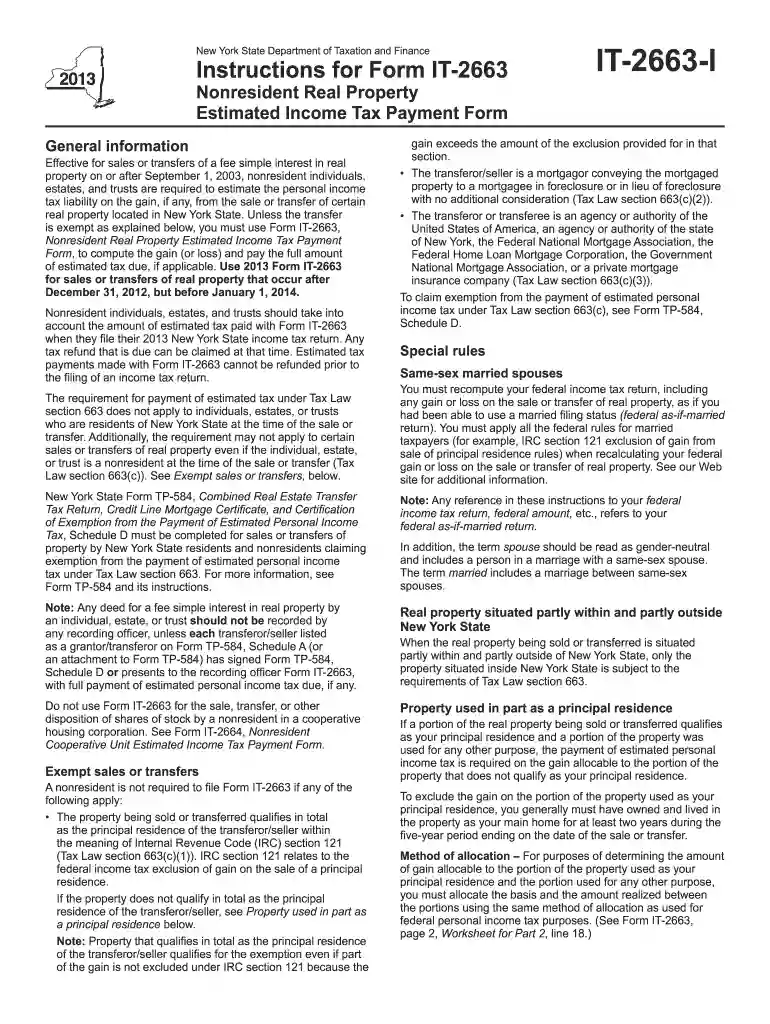
Form IT-2663 is a tax document required for nonresident individuals, estates, and trusts involved in the sale or transfer of real estate in New York State. Its primary purpose is to estimate and report the taxpayer's personal income tax liability on gains from these transactions. This form is crucial for ensuring that nonresident taxpayers comply with New York State tax laws regarding real property transactions.
Ensuring compliance with Form IT-2663 requirements is essential for avoiding penalties and legal issues. Nonresidents must file this form when engaging in real property transfers within New York, providing a declaration of the transaction and tax due. Proper compliance helps in averting additional interest and penalties that result from late or incorrect filing.
Completing Form IT-2663 requires precise information and adherence to provided instructions.
Personal Information:
Property Details:
Calculation of Gain:
Tax Liability Estimation:
Sign and Submit:
The form includes critical sections that must be completed accurately to avoid complications.
Part 1: Seller's Information
Part 2: Property Information
Part 3: Gain Calculation
Part 4: Certification
To submit Form IT-2663, taxpayers must meet certain eligibility conditions.
Nonresidency Status:
Property Type:
Transaction Value:


Certain situations may exempt taxpayers from using this form, such as transfers involving gifts, wills, or certain family transactions. Each case must be evaluated based on the specific instructions provided by the New York State Department of Taxation and Finance.
Adherence to filing deadlines is crucial to maintaining compliance and avoiding penalties.
Deadline:
Extensions:
Failing to file Form IT-2663 or submitting incorrect information may result in significant financial repercussions.
Late Fees:
Penalties:
The New York State Department of Taxation and Finance provides multiple submission options for Form IT-2663.
Online Submission:
Mail:
In-Person:
The form is primarily utilized by nonresident taxpayers involved in real estate transactions within New York State.

Individuals: Engaged in selling property while not residing in New York.
Trusts and Estates: That hold or dispose of property assets in New York.
Each user category must ensure accurate completion to reflect their specific circumstances and tax obligations.
We've got more versions of the Form IT-2663-I:2013:Instructions for Form IT-2663 Nonresident Real - tax ny form. Select the right Form IT-2663-I:2013:Instructions for Form IT-2663 Nonresident Real - tax ny version from the list and start editing it straight away!
| Versions | Form popularity | Fillable & printable |
|---|---|---|
| 2025 | 4.3 Satisfied (21 Votes) | |
| 2024 | 4.6 Satisfied (48 Votes) | |
| 2023 | 4.7 Satisfied (30 Votes) | |
| 2021 | 4.2 Satisfied (24 Votes) | |
| 2020 | 4.3 Satisfied (64 Votes) | |
| 2019 | 4.3 Satisfied (163 Votes) | |
| 2018 | 4.4 Satisfied (176 Votes) | |
| 2016 | 4.3 Satisfied (175 Votes) | |
| 2015 | 4.1 Satisfied (55 Votes) | |
| 2014 | 4.3 Satisfied (65 Votes) | |
| 2013 | 4 Satisfied (39 Votes) |
At DocHub, your data security is our priority. We follow HIPAA, SOC2, GDPR, and other standards, so you can work on your documents with confidence.
Mar 14, 2019 Indicate by check mark whether the registrant is a large accelerated filer, an accelerated filer, a non-accelerated filer, or an emerging growth
What can TAS do for you? We can offer you free help with IRS problems that you cant resolve on your own. We know the tax process can be confusing,.
This form is valid for sales or transfers (date of conveyance) after December 31, 2018, but before January 1, 2020. A The transferor/seller is:.


