




01. Edit your aoc g 106 online
Type text, add images, blackout confidential details, add comments, highlights and more.

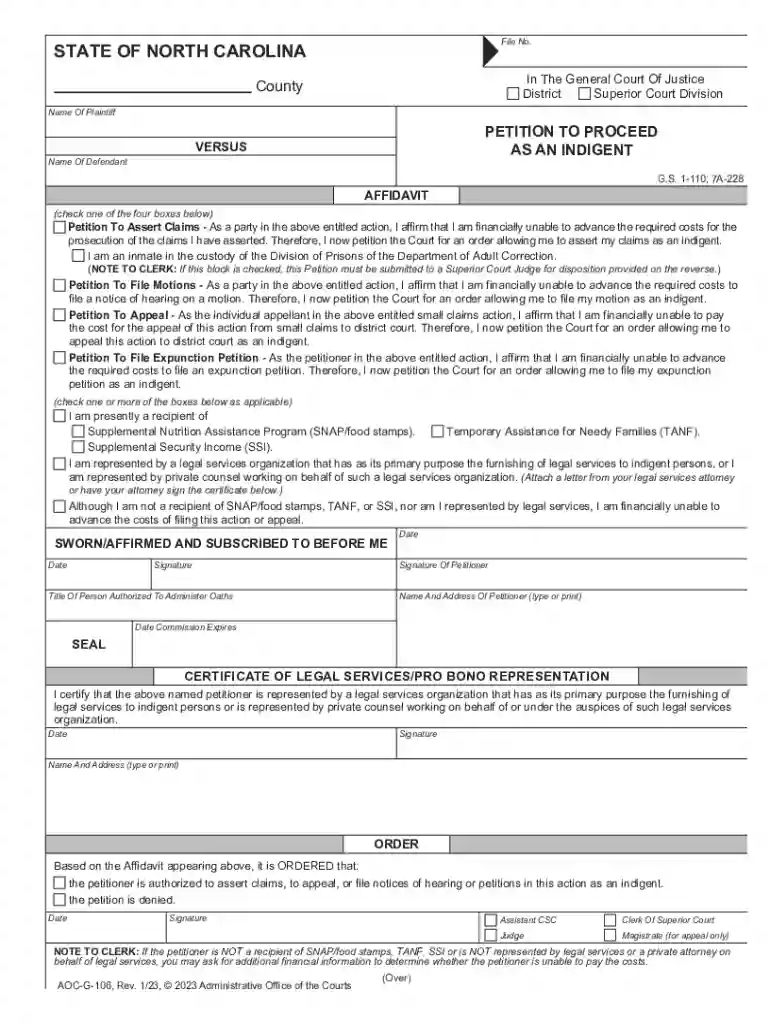
Type text, add images, blackout confidential details, add comments, highlights and more.

Draw your signature, type it, upload its image, or use your mobile device as a signature pad.

Send it via email, link, or fax. You can also download it, export it or print it out.
The "7A-305 Costs in civil actions" form is integral to the legal process in North Carolina, designed to address the allocation and management of costs associated with civil legal actions. It is primarily used to outline the distribution of expenses incurred during court proceedings, including filing fees, attorney costs, and other related charges. This form is essential for maintaining transparency and accountability in financial matters of civil litigation. Understanding its purpose is crucial for litigants wishing to manage or mitigate costs effectively within the judicial framework.
Using the 7A-305 form requires a methodical approach to ensure all relevant costs are accurately documented and allocated. Initially, litigants must gather comprehensive financial information related to their case. This involves a detailed breakdown of all anticipated and incurred expenses. The form facilitates clear communication between involved parties, ensuring each cost is appropriately assigned within the context of the legal action. After completing the form, it should be reviewed by legal counsel to ensure compliance with statutory requirements before submission to the court.
Completing the 7A-305 form involves several precise steps:
The 7A-305 form is primarily used by litigants involved in civil cases, including individuals, legal representatives, and organizations. It is typically relevant for those who wish to manage court-related expenses efficiently, such as plaintiffs, defendants, and their respective legal teams. Additionally, it is a valuable tool for court clerks and administrators who need to maintain accurate financial records regarding case-related expenses.


Key terminology on the 7A-305 form includes:
The legal application of the 7A-305 form is pivotal in the North Carolina civil court system. It ensures equitable and transparent distribution of the financial burden in civil cases. Legally, the form acts as a documented agreement on the allocation of costs, potentially influencing the outcome of cost-related disputes. Courts rely on it to enforce financial responsibilities and resolve disagreements over expense distribution efficiently.
Essential components of the form include:
North Carolina has specific statutes guiding the use of the 7A-305 form. These include eligibility criteria for cost recovery and limitations on the types of expenses that can be included. Understanding these rules is crucial for anyone involved in civil litigation, as they directly influence the financial aspects of managing a case. Legal advisors can provide guidance on these aspects to ensure full compliance and optimal handling of court-related costs.
Illustrative scenarios include:
Ensuring the appropriate use of the 7A-305 form can significantly impact financial management within civil actions in North Carolina, providing clarity and assistance to all involved parties.
We've got more versions of the aoc g 106 form. Select the right aoc g 106 version from the list and start editing it straight away!
At DocHub, your data security is our priority. We follow HIPAA, SOC2, GDPR, and other standards, so you can work on your documents with confidence.
Subsection (d) of 7A-305 lists the expenses of a party that may be recovered as costs. Prior to 2007, there was confusion about whether the list of expenses in
In every action for absolute divorce filed in the district court, a cost of seventy-five dollars ($75.00) shall be assessed against the person filing the


