




01. Edit your form online
Type text, add images, blackout confidential details, add comments, highlights and more.

Type text, add images, blackout confidential details, add comments, highlights and more.

Draw your signature, type it, upload its image, or use your mobile device as a signature pad.

Send it via email, link, or fax. You can also download it, export it or print it out.
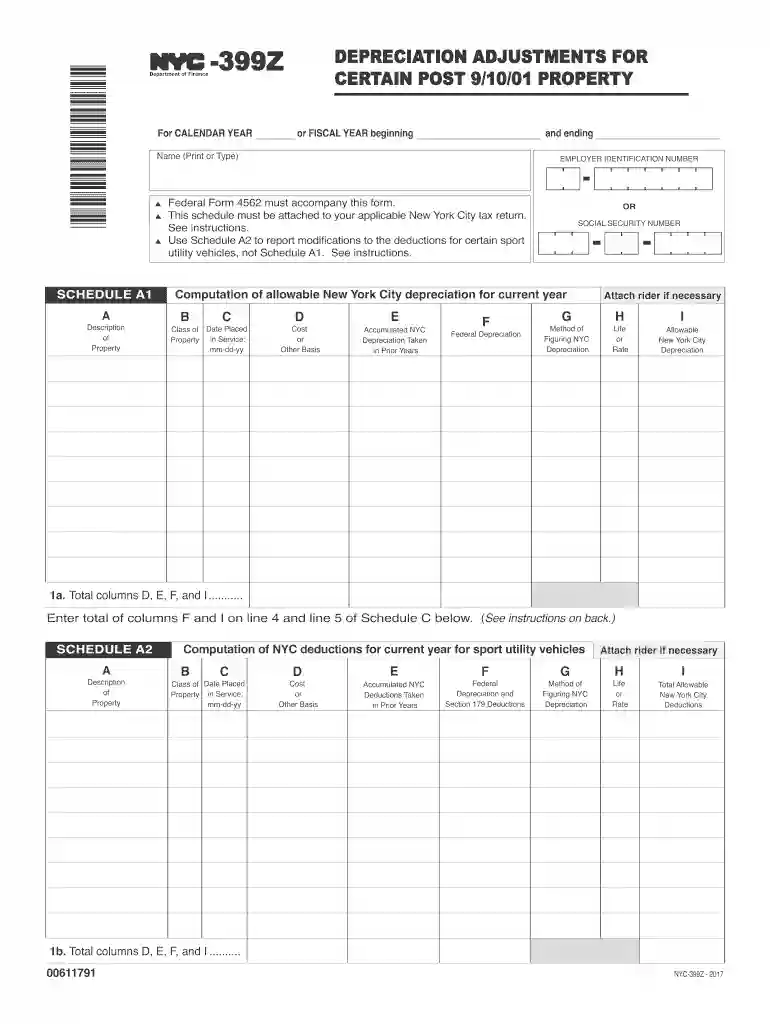
The 399Z 2017 form is a specialized tax document used primarily for reporting depreciation deductions related to certain properties within New York City. This form is crucial for taxpayers who wish to accurately calculate and claim allowable deductions on properties, ensuring compliance with specific local and federal regulations. Its main focus is on properties acquired post-September 10, 2001, a detail that responds to federal legislation impacting NYC tax deductions.
To effectively use the 399Z 2017 form, taxpayers must first identify eligible properties for depreciation deductions. The form contains a series of schedules (A1, A2, B, and C) that guide users through the process of documenting depreciation on items like sport utility vehicles and other qualified properties. Following each schedule carefully ensures that taxpayers report accurate information to reduce potential issues with tax filings.
The form can be acquired from several sources. Typically, it is available through:
The legal standing of the 399Z 2017 form is grounded in its alignment with the ESIGN Act for electronic submissions. Using this form correctly ensures compliance with NYC and federal tax laws, protecting taxpayers from potential audits or legal consequences due to misreported depreciation. Properties must be classified as qualified under the post-2001 purchase guidelines to use this form.
The form is divided into several critical components:
New York City's regulations surrounding the 399Z form are designed to interact with federal deduction allowances, focusing on ensuring businesses and individuals optimize tax advantages. There can be variations based on property type and acquisition date, requiring keen attention to detail from taxpayers to ensure compliance and maximization of depreciation allowances.
IRS regulations need to be kept in mind when dealing with depreciation claims:
The 399Z form is an official document issued by the New York City Department of Finance, integrating both city and federal guidelines for reporting. Taxpayers should ensure they use the most recent version provided by the department, which reflects any updates from legislative changes affecting depreciation claim protocols.
Failing to submit the 399Z 2017 form, or executing its completion incorrectly, can lead to significant penalties, including:
Compliance with the outlined guidelines is essential for maintaining good standing with both New York City and federal tax regulations.
We've got more versions of the 399z 2017 form form. Select the right 399z 2017 form version from the list and start editing it straight away!
| Versions | Form popularity | Fillable & printable |
|---|---|---|
| 2025 | 4.7 Satisfied (44 Votes) | |
| 2024 | 4.8 Satisfied (33 Votes) | |
| 2023 | 4.5 Satisfied (35 Votes) | |
| 2022 | 4.5 Satisfied (39 Votes) | |
| 2021 | 4.8 Satisfied (125 Votes) | |
| 2020 | 4.2 Satisfied (97 Votes) | |
| 2019 | 3.9 Satisfied (44 Votes) | |
| 2018 | 4.3 Satisfied (105 Votes) | |
| 2017 | 4.3 Satisfied (23 Votes) | |
| 2016 | 4.4 Satisfied (399 Votes) | |
| 2015 | 3.8 Satisfied (28 Votes) | |
| 2014 | 4 Satisfied (37 Votes) | |
| 2012 | 4 Satisfied (55 Votes) |
At DocHub, your data security is our priority. We follow HIPAA, SOC2, GDPR, and other standards, so you can work on your documents with confidence.
Sep 10, 2001 NYC-399Z - 2017. EMPLOYER IDENTIFICATION NUMBER. OR. SOCIAL SECURITY A copy of the federal form must ac- company this Form NYC-399Z.
Important Dates. August 2021 to December 2021. Date. Activity. April, 2021. 4/12 Monday. Graduate Registration Begins for Fall 2021. 4/19 Monday.


