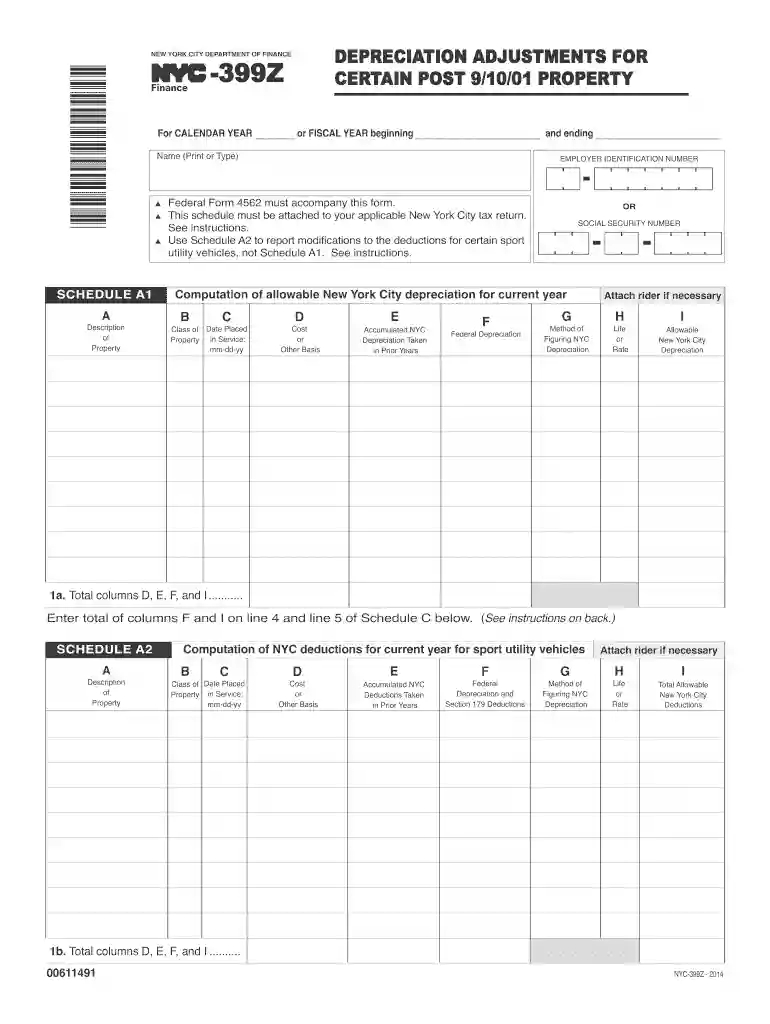
Nyc 399z 2014 form-2026

Get Form
nyc 399z 2014 form Preview on Page 1

Here's how it works

01. Edit your form online
Type text, add images, blackout confidential details, add comments, highlights and more.

02. Sign it in a few clicks
Draw your signature, type it, upload its image, or use your mobile device as a signature pad.

03. Share your form with others
Send it via email, link, or fax. You can also download it, export it or print it out.

Definition & Meaning

The NYC-399Z 2014 form is a specialized tax document used by businesses in New York City to report depreciation adjustments. It is predominantly used by corporations and unincorporated businesses to reconcile differences between federal and city tax codes. This form is essential for entities that have acquired property after September 10, 2001, as it contains provisions tailored to these acquisitions as per local and federal regulations.

Key Elements of NYC-399Z

  • Schedules A1, A2, B, and C: These schedules account for allowable NYC depreciation deductions and align them with the city’s tax requirements.
  • Depreciation Adjustments: It corrects discrepancies between federal and NYC tax depreciation amounts.
  • SUV Modifications: Addresses depreciation related to sport utility vehicles, which may differ from standard rules.

How to Use the NYC-399Z 2014 Form

To effectively utilize the NYC-399Z 2014 form, businesses need to follow a step-by-step process:

  1. Gather Financial Information: Collect all relevant financial records and details about property acquisitions post-2001.
  2. Complete Applicable Schedules: Fill out each relevant schedule with precise numbers and calculations.
  3. Review Depreciation Calculations: Ensure that depreciation amounts align with both federal and NYC standards.
  4. Consult Federal Acts: Reference federal statutes impacting depreciation to ensure compliance with both jurisdictions.

Example Scenarios

  • A business acquiring new machinery would adjust its federal depreciation figures to match those required by New York City.
  • Corporations must also ensure SUV depreciations used differently from standard vehicles are correctly adjusted.

Steps to Complete the NYC-399Z 2014 Form

Completing the NYC-399Z 2014 form involves several detailed steps:

  1. Download the Form: Obtain the form from the official NYC tax department or through authorized software.
  2. Fill out Personal Information: Enter all required informational fields like entity name, address, and tax identification number.
  3. Input Data into Schedules: Enter specific depreciation figures in schedules like A1 and A2 based on business acquisitions.
  4. Calculate Adjustments: Review both allowable and necessary adjustments for depreciation and align them as per NYC rules.
  5. Sign and Review: Ensure all information is correct, then sign and date the form appropriately.

Important Terms Related to NYC-399Z 2014 Form

Understanding specific terminologies is crucial for accurate form completion:

  • Depreciation: The reduction in value of business assets over time, necessitating various tax adjustments.
  • Allowable Deductions: These are deductions permissible under both federal and NYC tax codes.
  • Asset Acquisition: The purchase of physical or tangible assets impacting tax calculations.

Eligibility Criteria

To determine whether your business needs to file the NYC-399Z 2014 form, consider the following criteria:


  • Business Type: Corporations and unincorporated entities active in NYC are primary filers.
  • Assets: Ownership or acquisition of property post-September 2001 necessitates use of this form.
  • Income Source: Businesses reporting income or assets within NYC must reconcile any federal vs. city discrepancies.
decoration image ratings of Dochub

Legal Use of the NYC-399Z 2014 Form

Compliance is key when dealing with the NYC-399Z 2014 form to avoid legal repercussions:

  • Accurate Reporting: All data must reflect true and correct financial conditions.
  • Align with Federal Acts: Ensure adherence to federal acts guidelines to avoid discrepancies and potential audits.
  • Recordkeeping: Retain copies of all submitted forms and supporting documentation for a minimum of seven years.

Examples of Using the NYC-399Z 2014 Form

Real-world examples help clarify form usage:

  • Example 1: A technology company acquires computers and servers in 2013. Adjustments are needed to align federal depreciation claims with NYC regulations.
  • Example 2: A transportation firm can adjust its SUV fleet depreciation to comply with the NYC-specific rules, which might differ from national standards.

Taxpayer Scenarios

Different taxpayers may encounter various scenarios requiring the NYC-399Z 2014 form:

  • Self-employed Individuals: Those owning property or businesses in NYC appear frequently on this form.
  • Larger Corporations: With diverse asset portfolios, may require extensive use of schedules and depreciation adjustments.
  • LLCs and Partnerships: Any business ownership statutes necessitate reconciliation of federal and NYC depreciation, thus using this form.

By understanding and properly utilizing the NYC-399Z 2014 form, businesses can ensure compliance and optimize their tax obligations within the New York City jurisdiction.

decoration image

See more nyc 399z 2014 form versions

We've got more versions of the nyc 399z 2014 form form. Select the right nyc 399z 2014 form version from the list and start editing it straight away!
Versions Form popularity Fillable & printable
2022 4.5 Satisfied (39 Votes)
2021 4.8 Satisfied (125 Votes)
2020 4.2 Satisfied (97 Votes)
2019 3.9 Satisfied (44 Votes)
2018 4.3 Satisfied (105 Votes)
2017 4.3 Satisfied (23 Votes)
2016 4.4 Satisfied (399 Votes)
2015 3.8 Satisfied (28 Votes)
2014 4 Satisfied (37 Votes)
2012 4 Satisfied (55 Votes)
be ready to get more

Complete this form in 5 minutes or less

Get form

Got questions?

We have answers to the most popular questions from our customers. If you can't find an answer to your question, please contact us.
Contact us
FILE FORM NYC-4S Corporations (as defined in Section 11- 602.1 of the New York City Administra- tive Code) doing business, employing capital, or owning or leasing property in a corporate or organized capacity, or main- taining an office in New York City must file a General Corporation Tax return.
All domestic and foreign S corporations and qualified S subsidiaries in New York City that are: Doing business; Employing capital; Owning or leasing property, in a corporate or organized capacity; or.
Corporations (as defined in Section 11-602.1 of the New York City Administrative Code) doing business, employing capital, owning or leasing property in a corporate or organized capacity, or maintaining an office in New York City must file a General Corporation Tax return.
Complete Form NYC-208, Claim for New York City Enhanced Real Property Tax Credit for Homeowners and Renters, and submit it with your New York State personal income tax return, Form IT-201.
FORM NYC-3L, SCHEDULE M - Merger, Acquisition and Consolidation Report must be filed by any corporation subject to the General Corporation Tax that is involved in a merger, acquisition or con- solidation during any tax period ending on or after July 1, 1989.

Security and compliance

At DocHub, your data security is our priority. We follow HIPAA, SOC2, GDPR, and other standards, so you can work on your documents with confidence.

Learn more
ccpa2
pci-dss
gdpr-compliance
hipaa
soc-compliance
be ready to get more

Complete this form in 5 minutes or less

Get form

People also ask

New York has a graduated corporate income tax, with rates ranging from 6.5 percent to 7.25 percent. New York also has a 4.00 percent state sales tax rate and an average combined state and local sales tax rate of 8.53 percent. New York has a 1.54 percent effective property tax rate on owner-occupied housing value.
Non-Resident Employees of the City of New York - Form 1127 Most New York City employees living outside of the five boroughs (hired on or after January 4, 1973) must file form NYC-1127. This form calculates the City waiver liability, which is the amount due as if the filer were a resident of NYC.

Related links