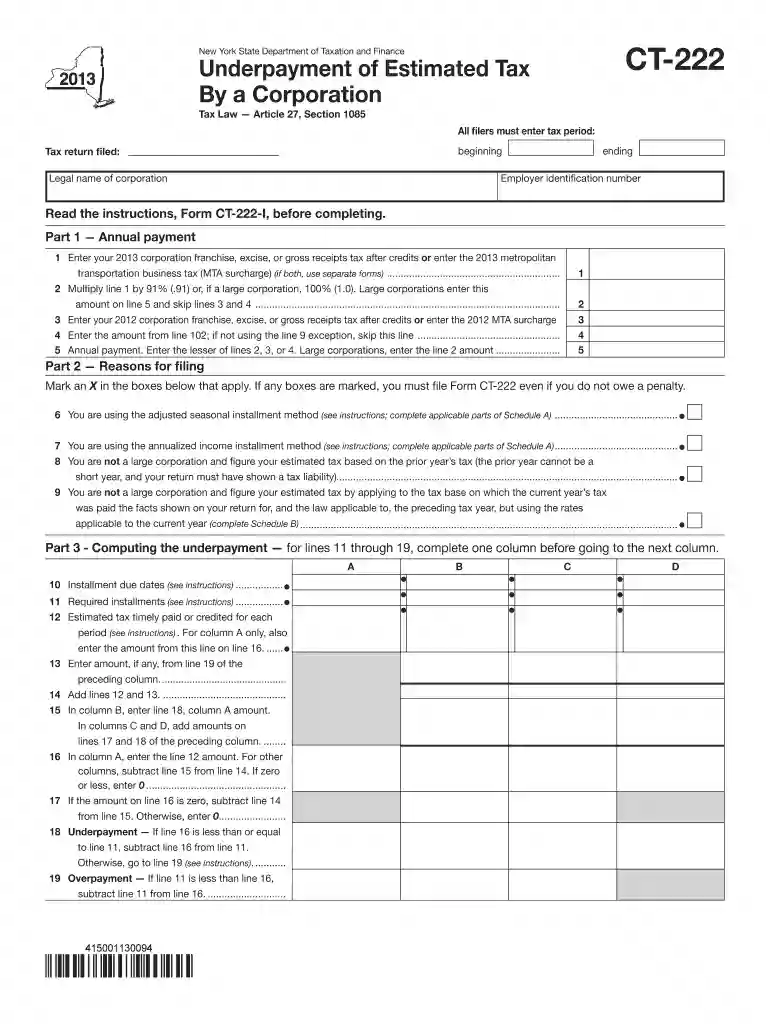
Ct 222 new york 2013 form-2026

Get Form
ct 222 new york 2013 form Preview on Page 1

Here's how it works

01. Edit your form online
Type text, add images, blackout confidential details, add comments, highlights and more.

02. Sign it in a few clicks
Draw your signature, type it, upload its image, or use your mobile device as a signature pad.

03. Share your form with others
Send it via email, link, or fax. You can also download it, export it or print it out.

Definition and Meaning

The CT-222 New York 2013 form is a state tax document issued by the New York State Department of Taxation and Finance. It is utilized specifically by corporations to report any underpayment of estimated taxes for the year 2013. The form is crucial for ensuring that appropriate tax payments have been made relative to the corporation's estimated tax liabilities.

Purpose and Usage

  • Reporting Underpayment: The form's primary function is to assist corporations in documenting and calculating any discrepancies in estimated tax payments throughout the fiscal year.
  • Penalty Calculation: It helps companies calculate penalties due to underpayment, adhering to the state's taxation standards.

Contextual Importance

Corporations need this form to maintain compliance with state tax laws, and avoid potential fines or legal complications that can arise from errors or omissions in tax reporting.

How to Use the CT-222 New York 2013 Form

Completing the CT-222 form involves several important steps, each requiring careful attention to detail to ensure accurate reporting.

  1. Gather Financial Data: Collect relevant financial records, including quarterly estimated tax payments, annual tax liabilities, and any tax credits applicable.
  2. Follow Instructions: Each section of the form comes with detailed instructions explaining what information is required and how to calculate any underpayment or penalty.
  3. Calculate Payments and Penalty: Determine the total estimated payments made and compare them against your annual tax liability to find any underpayment. Use the form to compute any penalties owed.
  4. Review for Accuracy: Double-check all entries for accuracy. Mistakes can result in further penalties or legal complications.

Practical Tips

  • Utilize accounting software to streamline the calculation process.
  • Consult a tax professional if the form's calculations or entries become complex or if penalties are incurred.

Steps to Complete the CT-222 New York 2013 Form

The CT-222 form follows a series of structured steps, which must be adhered to ensure compliance with tax regulations.

  1. Enter Identification Information: Include the corporation's name, address, federal employer identification number (EIN), and tax period details.
  2. Estimate Payments Record: Input data on all estimated tax payments made during the year.
  3. Annual Tax Liability Calculation: Compute the total tax liability for the fiscal year in question.
  4. Calculate Underpayment: Determine any underpayment by comparing tax liabilities against estimated payments.
  5. Penalty Assessment: Calculate any applicable penalties using figures derived from the underpayment section.
  6. Submit Completed Form: Ensure all sections are accurately filled and submit by the specified tax deadline.

Common Issues

  • Missing deadlines can incur additional penalties.
  • Incorrect calculations can lead to substantial fines.

Key Elements of the CT-222 New York 2013 Form

Understanding the CT-222 form requires familiarization with its core components and sections, each of which serves a specific role.

Major Sections

  • Corporate Identification: Ensures the correct entity is addressed.
  • Estimated and Actual Payments: Contains meticulous records of tax payments made.
  • Calculations and Penalties: Focuses on the computation of underpayments and associated penalties.

Critical Documents

Ensure all relevant tax documents from the previous and current fiscal years are ready for reference, including previous CT-222 forms if applicable.

Legal Use of the CT-222 New York 2013 Form

Using this form correctly ensures compliance with New York state's taxation rules.

Compliance and Legal Standards

  • Penalties for Inaccuracies: Legal ramifications for incorrect filings can include fines and increased scrutiny by tax authorities.
  • Corrective Filings: In cases of error, corrected filings are necessary; prompt correction mitigates potential legal consequences.

Required Documents

Proper completion of the CT-222 form demands various supporting documents.

Essential Documentation

  • Previous Year’s Tax Returns: These provide a foundation for estimating current liabilities.
  • Quarterly Payment Receipts: Necessary for accurate reporting of estimated payments.
  • Financial Statements: Aid in assessing overall performance and fiscal liabilities.

Who Typically Uses the CT-222 New York 2013 Form

This specific form is useful for a particular group of corporate taxpayers.

decoration image ratings of Dochub

Targeted Users

  • Corporations: As the form caters primarily to corporate tax needs and calculations.
  • Tax Professionals: Often used by accountants or tax consultants who manage corporate tax responsibilities.

Business Entity Types

Suitable for various corporate structures, including C corporations, S corporations, and other related entities that fall under New York State jurisdiction.

Filing Deadlines / Important Dates

Timeliness is crucial to avoid penalties when dealing with tax-related submissions.

Key Deadlines

  • Annual Submission Deadline: The form should be submitted by the date specified for the annual tax return to avoid penalties.
  • Extension Dates: If applicable, corporations might request extensions, but this requires advance planning and specific procedural adherence.

See more ct 222 new york 2013 form versions

We've got more versions of the ct 222 new york 2013 form form. Select the right ct 222 new york 2013 form version from the list and start editing it straight away!
Versions Form popularity Fillable & printable
2023 4.7 Satisfied (39 Votes)
2022 4.8 Satisfied (48 Votes)
2021 4.8 Satisfied (194 Votes)
2020 4.2 Satisfied (31 Votes)
2019 4.3 Satisfied (45 Votes)
2018 4.3 Satisfied (105 Votes)
2016 4.1 Satisfied (49 Votes)
2015 4.4 Satisfied (136 Votes)
2013 4.2 Satisfied (62 Votes)
2012 4.4 Satisfied (37 Votes)
be ready to get more

Complete this form in 5 minutes or less

Get form

Got questions?

We have answers to the most popular questions from our customers. If you can't find an answer to your question, please contact us.
Contact us
Form CT-400, Estimated Tax for Corporations. Official websites use ny.gov. A ny.gov website belongs to an official New York State government organization.
Corporations whose tax liability for the second preceding year ex- ceeds $1,000 are required to pay 25% of the tax liability for the second preceding year as a first installment of estimated tax for the current year (MFI).
Form CT-400 provides essential instructions for corporations in New York State to declare estimated taxes. It outlines filing requirements, payment mandates, and crucial deadlines. This guidance ensures compliance with tax regulations and assists corporations in properly managing their tax obligations.
Every corporation subject to the New York City General Corporation Tax or Business Corporation Tax (Title 11, Chapter 6, Subchapter 2 or Subchapter 3-A of the Administrative Code) must file a declaration (NYC-400) if its estimated tax for the current year can reasonably be expected to exceed $1,000.
FILE FORM NYC-4S Corporations (as defined in Section 11- 602.1 of the New York City Administra- tive Code) doing business, employing capital, or owning or leasing property in a corporate or organized capacity, or main- taining an office in New York City must file a General Corporation Tax return.

Security and compliance

At DocHub, your data security is our priority. We follow HIPAA, SOC2, GDPR, and other standards, so you can work on your documents with confidence.

Learn more
ccpa2
pci-dss
gdpr-compliance
hipaa
soc-compliance
be ready to get more

Complete this form in 5 minutes or less

Get form