




01. Edit your form online
Type text, add images, blackout confidential details, add comments, highlights and more.

Type text, add images, blackout confidential details, add comments, highlights and more.

Draw your signature, type it, upload its image, or use your mobile device as a signature pad.

Send it via email, link, or fax. You can also download it, export it or print it out.
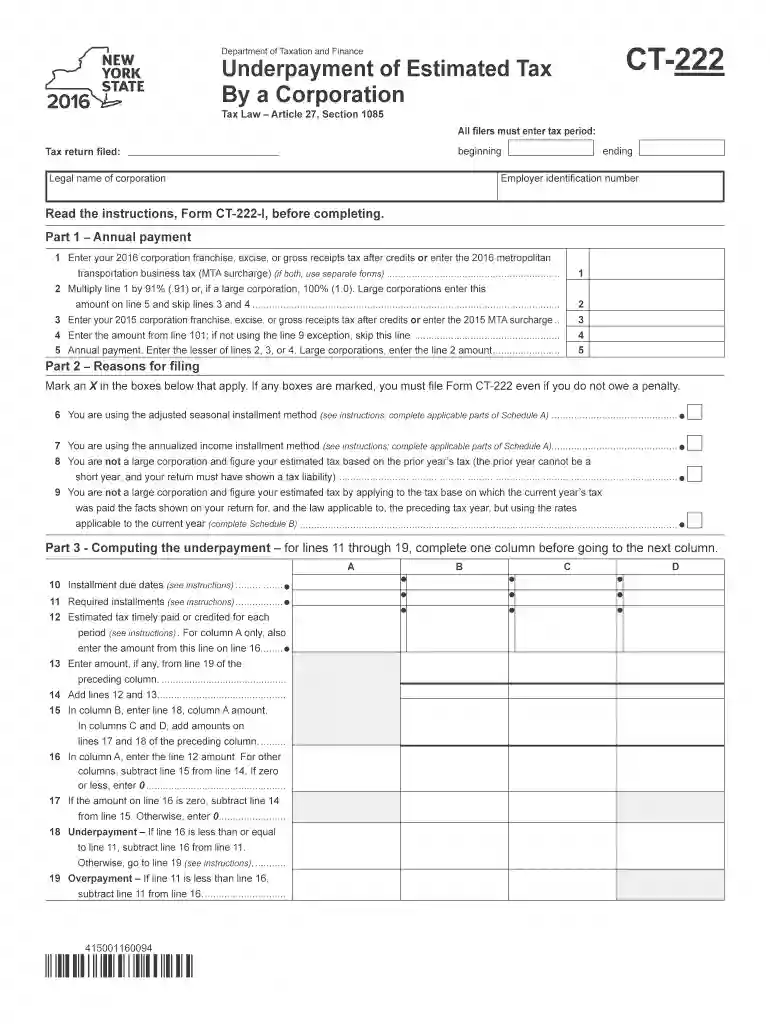
The CT-222 New York 2016 Form is a tax document used by corporations to report and calculate underpayment of estimated taxes according to New York Tax Law. This form is vital for ensuring compliance with state tax requirements and preventing penalties for underpayment. It contains sections for annual payment calculations, reasons for filing, and computations related to underpayment penalties.
Corporations using this form must provide extensive details, including their legal name and employer identification number. The CT-222 form also requires specifics about tax periods and payments, helping companies to accurately report their tax obligations.
To effectively use the CT-222 form, corporations should follow a step-by-step approach:
Gather Required Information: Collect all necessary details, such as the corporation's legal name, employer identification number, and financial records related to the estimated tax payments made throughout the year.
Understand Tax Periods: Identify the specific tax periods for the report, ensuring alignment with the corporation's fiscal year.
Prepare Calculations: Use the form to calculate any underpayment of estimated taxes. This involves using provided formulas to assess whether the payments fall below required amounts for designated periods.
Complete Sections Diligently: Each section of the form requires precision. Fill out details like annual payments, reasons for filing, and underpayment computation accurately.
Review for Accuracy: Double-check all entries for mistakes and confirm that calculations are correct to avoid potential penalties.
Completing the CT-222 form involves several essential steps:
Header Information: Enter the corporation's legal name and employer identification number at the top of the form.
Calculation of Estimated Tax Due: Use the provided formulas within the form to compute the estimated tax due for the specified period.
Payment History Documentation: Record all estimated tax payments made during the accounting period, ensuring that they match the amounts filed.
Compute Penalties: If underpayment is determined, compute the applicable penalties based on the form's guidelines.
Final Verification: Ensure all sections are complete, then conduct a final review to catch errors or discrepancies.
Submission: Submit the completed form to the New York State Department of Taxation and Finance by the designated deadline.
The CT-222 form is primarily used by corporations operating within New York State that are required to pay estimated taxes. It is commonly utilized by a variety of business entities:


Understanding relevant terminology is crucial for correctly completing the CT-222 form:
The CT-222 form is structured around several critical elements:
Adherence to filing deadlines is essential to avoid penalties and interest charges:
Late submissions can lead to significant penalties, emphasizing the importance of timely and accurate filing of the form.
Non-compliance with CT-222 form requirements can result in various penalties:
Corporations should prioritize understanding the penalties associated with the CT-222 form to ensure compliance and mitigate financial risks.
We've got more versions of the ct 222 new york 2016 form form. Select the right ct 222 new york 2016 form version from the list and start editing it straight away!
| Versions | Form popularity | Fillable & printable |
|---|---|---|
| 2023 | 4.7 Satisfied (39 Votes) | |
| 2022 | 4.8 Satisfied (48 Votes) | |
| 2021 | 4.8 Satisfied (194 Votes) | |
| 2020 | 4.2 Satisfied (31 Votes) | |
| 2019 | 4.3 Satisfied (45 Votes) | |
| 2018 | 4.3 Satisfied (105 Votes) | |
| 2016 | 4.1 Satisfied (49 Votes) | |
| 2015 | 4.4 Satisfied (136 Votes) | |
| 2013 | 4.2 Satisfied (62 Votes) | |
| 2012 | 4.4 Satisfied (37 Votes) |
At DocHub, your data security is our priority. We follow HIPAA, SOC2, GDPR, and other standards, so you can work on your documents with confidence.
Jan 15, 2021 For the taxable year beginning on January 1, 2020, Form. CT‑1040 has been updated to provide a check box for filers of federal Form 1310,
1 Enter your 2016 corporation franchise, excise, or gross receipts tax after credits or enter the 2016 metropolitan transportation business tax (MTA
BY REPORT: When the value of a procedure is indicated as By Report (BR), an Operative. Report must be submitted with the MMIS claim form for a payment


