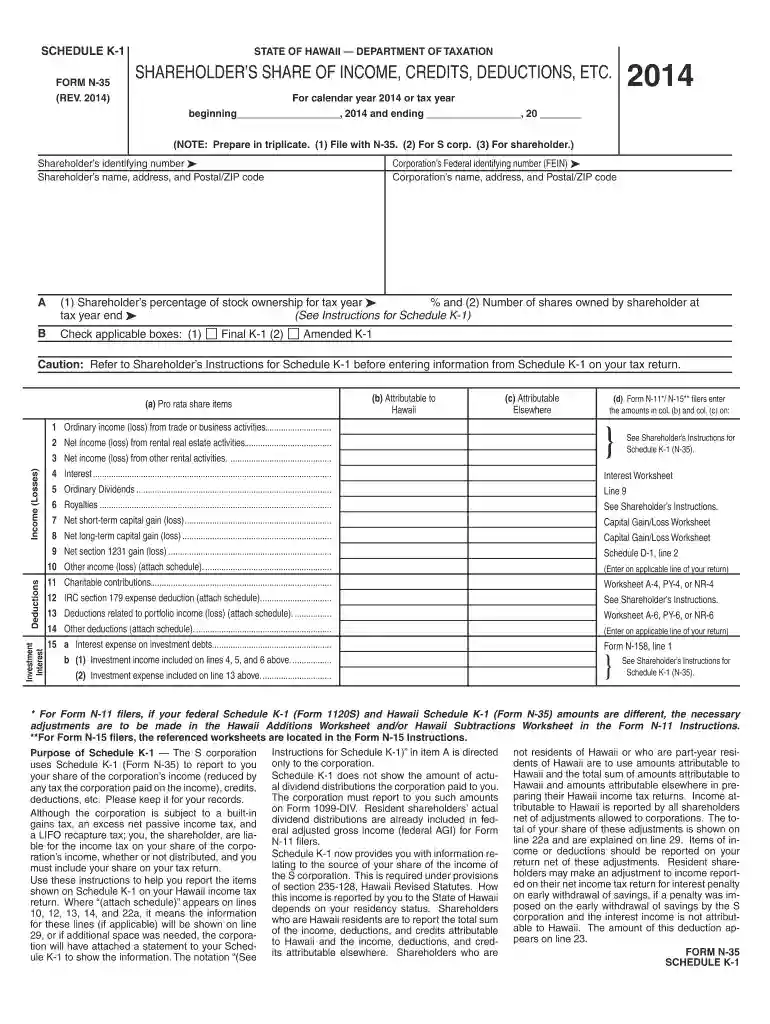
Schedule K-1 Form N-35 Rev 2014 Shareholder's - Hawaii-2026

Get Form
Schedule K-1 Form N-35 Rev 2014 Shareholder's - Hawaii Preview on Page 1

Here's how it works

01. Edit your form online
Type text, add images, blackout confidential details, add comments, highlights and more.

02. Sign it in a few clicks
Draw your signature, type it, upload its image, or use your mobile device as a signature pad.

03. Share your form with others
Send it via email, link, or fax. You can also download it, export it or print it out.

Definition and Purpose of the Schedule K-1 Form N-35 Rev 2014 Shareholder's - Hawaii

The Schedule K-1 Form N-35 Rev 2014 Shareholder's is a document issued by the State of Hawaii's Department of Taxation for the tax year 2014. This form is employed by S corporations to report each shareholder's share of income, credits, deductions, and other pertinent financial information. It serves as an essential record to ensure shareholders accurately report their individual earnings on their Hawaii tax returns.

How to Use the Schedule K-1 Form N-35 Rev 2014

Shareholders use the Schedule K-1 Form N-35 Rev 2014 to determine their personal income derived from an S corporation. The form includes details about ordinary income, capital gains, tax credits, and any necessary adjustments pertaining to Hawaii's income tax. Shareholders must incorporate this data into their personal tax filings, ensuring that all income is accurately declared according to state laws and IRS guidelines.

Using the Form for Tax Filings:

  • Report income from the S corporation as indicated on the K-1 form.
  • Apply deductions and credits listed to your state tax return.
  • Ensure all figures match with financial statements provided by the corporation.

Steps to Complete the Schedule K-1 Form N-35 Rev 2014

Completing the K-1 Form involves several steps to ensure accuracy and compliance with state requirements.

  1. Review Shareholder Information: Verify that all personal details are correct and match corporate records.
  2. Examine Income Details: Cross-check all figures reported under ordinary business income or losses.
  3. Analyze Credits and Deductions: Understand the breakdown of tax credits and deductions that apply to you.
  4. Complete Shareholder's Information: Ensure sections for your personal information and shareholder's share of corporate items are filled accurately.
  5. Validate Adjustments: Check for any state-specific adjustments or modifications that might affect your filing.

Who Typically Uses the Schedule K-1 Form N-35 Rev 2014

The primary users of the Schedule K-1 Form N-35 Rev 2014 are shareholders of S corporations operating within Hawaii. These shareholders need to report income and other financial data as part of their state tax responsibilities.


decoration image ratings of Dochub

Common User Scenarios:

  • Individual Shareholders: Hawaiian residents or those with a financial interest in a Hawaii-based S corporation.
  • Business Partners: Individuals who hold shares in such entities and need accurate tax reports.
  • Tax Advisors and Accountants: Professionals assisting in the preparation and submission of tax forms for clients.

Key Elements of the Schedule K-1 Form N-35 Rev 2014

Several principal components make up this form, each critical to providing a comprehensive account of financial details.

  • Ordinary Business Income or Loss: Represents net income or loss from normal operations.
  • Net Rental Real Estate Income or Loss: Details income or loss from property investments.
  • Other Net Rental Income or Loss: Reflects income from other rental properties.
  • Tax Credits: Describes credits available to reduce the tax liability of the shareholder.
  • Adjustments and Preferences: Accounts for various state-specific tax modifications.

State-Specific Rules for the Schedule K-1 Form N-35 Rev 2014

The rules governing the use of this form are determined by specific legislative measures within Hawaii, making compliance crucial for correct and effective tax submission.

Unique Requirements:

  • Hawaii Modifications: Be aware of specific changes or additions to federal income that affect state taxes.
  • Local Tax Credits: Utilize relevant tax credits that are specific to Hawaii's laws.
  • Compliance with State Deadlines: Know the important dates to avoid penalties for late submissions.

Examples of Using the Schedule K-1 Form N-35 Rev 2014

Fictitious scenarios illustrate the real-life applications of this important document, showing its impact on tax filing processes.

Practical Example:

  • Example A: A shareholder receives $10,000 in dividends and claims a $500 renewable energy tax credit listed on their K-1.
  • Example B: An S corporation reports a $2,000 loss, impacting the individual tax return to potentially lower the personal tax liability.

Penalties for Non-Compliance

Failure to utilize the Schedule K-1 Form N-35 Rev 2014 can result in a variety of consequences, underscoring the importance of adhering to all state requirements.

Potential Consequences:

  • Fines for incomplete or incorrect forms
  • Interest charges on late tax payments
  • Increased scrutiny or audits by tax authorities

Filing Deadlines and Important Dates

Understanding the critical deadlines associated with this form helps avoid unnecessary legal complications or financial penalties.

Key Dates:

  • Due Date for Submission: Generally aligns with federal tax deadlines but may include variations based on state requirements.
  • Extension Opportunities: Hawaii might offer extension options similar to federal processes, subject to approval.

Following these guidelines and understanding the specific intricacies of the Schedule K-1 Form N-35 Rev 2014 ensures a smooth and accurate tax reporting process for individuals involved with Hawaiian S corporations.

See more Schedule K-1 Form N-35 Rev 2014 Shareholder's - Hawaii versions

We've got more versions of the Schedule K-1 Form N-35 Rev 2014 Shareholder's - Hawaii form. Select the right Schedule K-1 Form N-35 Rev 2014 Shareholder's - Hawaii version from the list and start editing it straight away!
Versions Form popularity Fillable & printable
2023 4.1 Satisfied (53 Votes)
2022 4.5 Satisfied (30 Votes)
2021 4.9 Satisfied (28 Votes)
2020 4.4 Satisfied (147 Votes)
2019 4.3 Satisfied (95 Votes)
2018 4.4 Satisfied (266 Votes)
2017 4.3 Satisfied (58 Votes)
2016 4 Satisfied (57 Votes)
2015 4.4 Satisfied (459 Votes)
2014 4.1 Satisfied (31 Votes)
2005 4 Satisfied (51 Votes)
be ready to get more

Complete this form in 5 minutes or less

Get form

Got questions?

We have answers to the most popular questions from our customers. If you can't find an answer to your question, please contact us.
Contact us
Every individual doing business in Hawaii during the taxable year must file a return, whether or not the individual derives any taxable income from that business. Every individual receiving more than the allowed amounts of gross income listed below, must file a Hawaii state return.
How does Schedule K-1 affect personal taxes? In general, a K-1 can affect personal taxes in two ways: either by increasing a partners tax liability or by providing them with a tax deduction. It will likely increase their total tax liability for the year if the K-1 is associated with an income.
S corporations doing business in Hawaii can use a form N-35 to document and file their state income tax owed. The document is found on the website of the government of Hawaii.
Schedule K-1 is an IRS form used by partnerships, S corporations, and estates and trusts to declare the income, deductions, and credits that partners, shareholders, and beneficiaries have received in the tax year. Individual taxpayers transfer the financial information on their K-1s to their tax returns.
K-1 vs 1099 In other words, 1099 forms are relevant for reporting the income of the partnership as a whole. Schedule K-1 is relevant to the individuals of the partnership when reporting their share of the profit or loss on their income tax return.

Security and compliance

At DocHub, your data security is our priority. We follow HIPAA, SOC2, GDPR, and other standards, so you can work on your documents with confidence.

Learn more
ccpa2
pci-dss
gdpr-compliance
hipaa
soc-compliance

People also ask

Among those likely to receive a Schedule K-1 are: S corporation shareholders. Partners in limited liability corporations (LLCs), limited liability partnerships (LLPs), or other business partnerships. Investors in limited partnerships (LPs) or master limited partnerships (MLPs)
The Schedule K-1 is the form that reports the amounts passed to each party with an interest in an entity, like a business partnership or an S corporation. The parties use the information on the K-1 to prepare their separate tax returns.

Related links