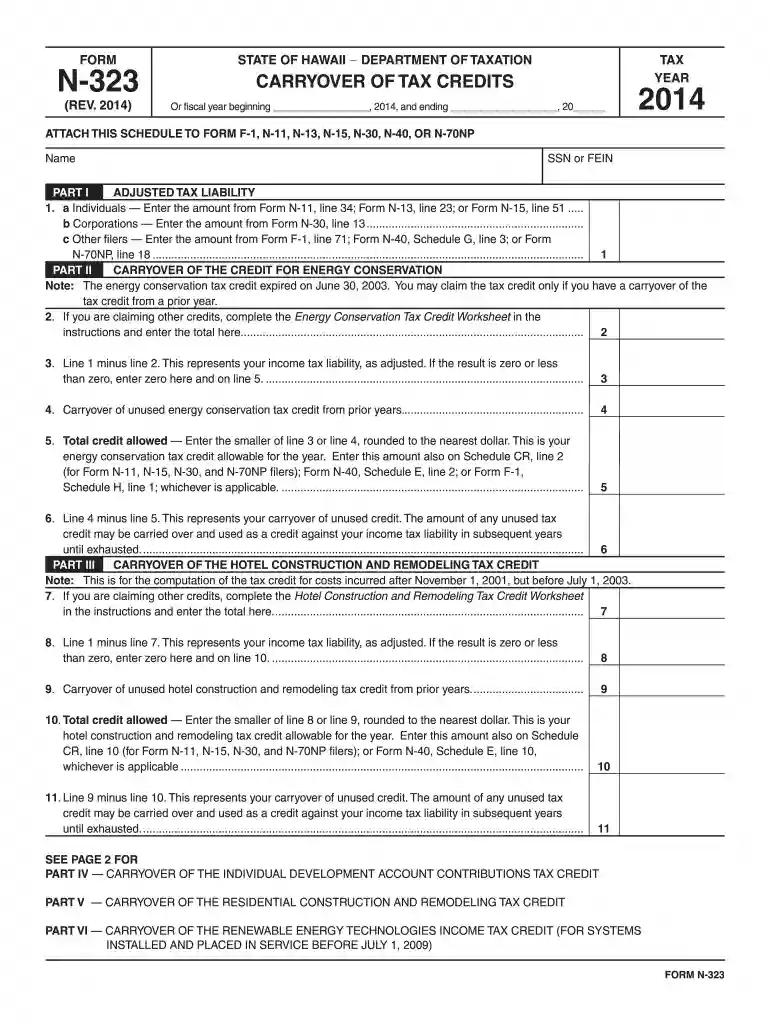
Form N-323, 2014, Carryover of Tax Credits-2026

Get Form
Form N-323, 2014, Carryover of Tax Credits Preview on Page 1

Here's how it works

01. Edit your form online
Type text, add images, blackout confidential details, add comments, highlights and more.

02. Sign it in a few clicks
Draw your signature, type it, upload its image, or use your mobile device as a signature pad.

03. Share your form with others
Send it via email, link, or fax. You can also download it, export it or print it out.

Definition and Purpose of Form N-323

Form N-323, 2014, Carryover of Tax Credits, is a document issued by the State of Hawaii Department of Taxation. It is used by individuals and corporations to report the carryover of various tax credits from prior years. This form is essential for managing tax obligations and claiming credits that could benefit taxpayers in reducing their liability. The form encompasses credits related to various fields such as energy conservation, hotel construction, individual development account contributions, residential construction, renewable energy technologies, and technology infrastructure renovation.

Key Elements of Form N-323

Several critical elements are included in Form N-323 that taxpayers must address:

  • Adjusted Tax Liability: This section requires information about the taxpayer's adjusted tax liability. Accurate completion is essential to determine the amount of credits usable within the tax year.
  • Specific Tax Credits: The form outlines various credits, including those earned for investments in energy conservation, residential construction, and more. Each credit has its eligibility requirements and calculation methods.
  • Carryover Calculations: There is a requirement to calculate and report any carryover of previously unused credits. This ensures that taxpayers utilize all available credits optimally.

Steps to Complete Form N-323

Completing Form N-323 involves several detailed steps. Taxpayers should follow these procedures:

  1. Gather Necessary Information: Collect all relevant documents concerning your tax credits, adjusted tax liability, and any carryover credits.
  2. Review Specific Credits: Identify the credits you are eligible to claim and understand any specific calculations or requirements.
  3. Calculate Adjusted Tax Liability: Enter accurate information regarding your adjusted tax liability to determine the credit amount you can utilize.
  4. Determine Carryover Amounts: Calculate any credits that can be carried over from previous tax years and record them correctly.
  5. Complete and Check the Form: Fill out all sections carefully, double-check calculations, and ensure all necessary data is entered.

Important Terms Related to Form N-323

Understanding several important terms is crucial when completing Form N-323:

  • Adjusted Tax Liability: The amount of tax owed after all applicable deductions and credits.
  • Carryover Credits: Credits that remain unused in the tax year and can be carried over to future years.
  • Specific Tax Credits: Targeted incentives provided to taxpayers for actions like energy conservation or residential construction improvements.

Eligibility Criteria for Form N-323

To utilize Form N-323, specific eligibility criteria must be met. These typically include:

  • Individuals and Businesses: Both personal taxpayers and corporate entities can use this form if they have eligible carryover credits.
  • Residence or Business in Hawaii: Since this form is a state-specific document, applicable entities should have tax obligations in Hawaii.
  • Previous Tax Year Credits: Possession of eligible credits from prior years that were not used during their respective years.
decoration image ratings of Dochub

IRS Guidelines and Compliance

Though Form N-323 is a state document, adherence to IRS guidelines is essential:

  • Consistency with Federal Filing: Ensure that information reported on Form N-323 aligns with federal tax filings to avoid discrepancies.
  • Documentation: Maintain thorough records supporting credit claims in case of an audit or in response to state inquiries.
  • Deadlines: Follow both state and federal deadlines diligently to prevent non-compliance issues.

Filing Deadlines and Important Dates

Taxpayers must be aware of critical deadlines concerning Form N-323:

  • Annual State Tax Deadline: Typically aligning with the federal deadline, often April 15, unless otherwise specified.
  • Extensions: If necessary, apply for extensions in advance while ensuring timely submission of the form to avoid penalties.
  • Carryover Submission: Specific deadlines for submitting carryover claims, often accompanying the standard state tax return.

State-Specific Rules for Form N-323

Hawaii presents unique rules influencing Form N-323:

  • Credit Limits: Different credits have defined limits and terms that affect how much can be claimed in a given year.
  • Special Programs: Specific state-driven initiatives may alter the general approach or introduce additional benefits associated with tax credits.
  • Compliance Requirements: Abide by specific state mandates that could include detailed recordkeeping and supporting documentation requirements.

Practical Examples of Using Form N-323

Employing real-world scenarios to understand the utility of Form N-323:

  • Energy Conservation Credits: A company investing in energy-efficient technologies carries over unused credits from a past year.
  • Hotel Construction Initiatives: A business receiving credits for hotel construction spreads the credit use across several taxable years.
  • Renewable Energy Investments: An individual installing solar panels claims renewable energy credits, recording unused portions as carryovers.

By carefully addressing these components and guidelines, taxpayers can effectively utilize Form N-323 to manage and optimize their tax credits in alignment with state regulations.

See more Form N-323, 2014, Carryover of Tax Credits versions

We've got more versions of the Form N-323, 2014, Carryover of Tax Credits form. Select the right Form N-323, 2014, Carryover of Tax Credits version from the list and start editing it straight away!
Versions Form popularity Fillable & printable
2023 4.9 Satisfied (56 Votes)
2022 4.8 Satisfied (40 Votes)
2021 4.8 Satisfied (97 Votes)
2020 4.3 Satisfied (74 Votes)
2019 4.3 Satisfied (104 Votes)
2018 4.4 Satisfied (262 Votes)
2017 4.4 Satisfied (192 Votes)
2015 4.2 Satisfied (72 Votes)
2014 4.4 Satisfied (404 Votes)
2013 4 Satisfied (54 Votes)
be ready to get more

Complete this form in 5 minutes or less

Get form

Got questions?

We have answers to the most popular questions from our customers. If you can't find an answer to your question, please contact us.
Contact us
It starts from the day you become entitled to the credit, typically the date of the tax invoice or the date the payment is made, depending on your accounting method. After four years, you can no longer amend or include a claim for that GST credit in your Business Activity Statement (BAS).
What happens to unused RD credits? Unused RD tax credits may still be available to eligible businesses if they file amended tax returns for the years in which they failed to claim the credit. Businesses can then carry forward the unused credits for up to 20 years after first carrying them back for one year.
Basically, if you couldnt use your capital loss on last years tax return, you can use it this year. For instance, if your taxable income was zero last year (income minus deductions and exemptions), you didnt get any benefit from the capital loss, so it carries over to this years return.
The federal tax codes carry forward provision doesnt have an expiration date, so you should be able to keep rolling over those 2025 credits indefinitely. Its possible the tax form you currently use to claim the credit (Form 5695) could disappear after 2025, but its unlikely.
Carryover refers to the process of transferring tax attributes, deductions, or credits from one tax year to the next.

Security and compliance

At DocHub, your data security is our priority. We follow HIPAA, SOC2, GDPR, and other standards, so you can work on your documents with confidence.

Learn more
ccpa2
pci-dss
gdpr-compliance
hipaa
soc-compliance
be ready to get more

Complete this form in 5 minutes or less

Get form

People also ask

Recovery of old tax credit debts There is some confusion in this area because the Act does NOT apply to tax debts. This is confirmed in the HMRC DM manual. The Act provides that recovery action for debts should commence within six years from the debt becoming payable.
A carryforward credit is the application of a tax credit to a future tax year. This provision exists so that businesses can take advantage of tax credits that were unused because of operating losses or IRS imposed limits on how much can be claimed in a single year.
Carryover is an accounting method by which the deductions and credits of a taxable year that are either not used in that year, or could not be considered entirely in that year, are then applied to reduce the tax liability of later/subsequent years.

Related links