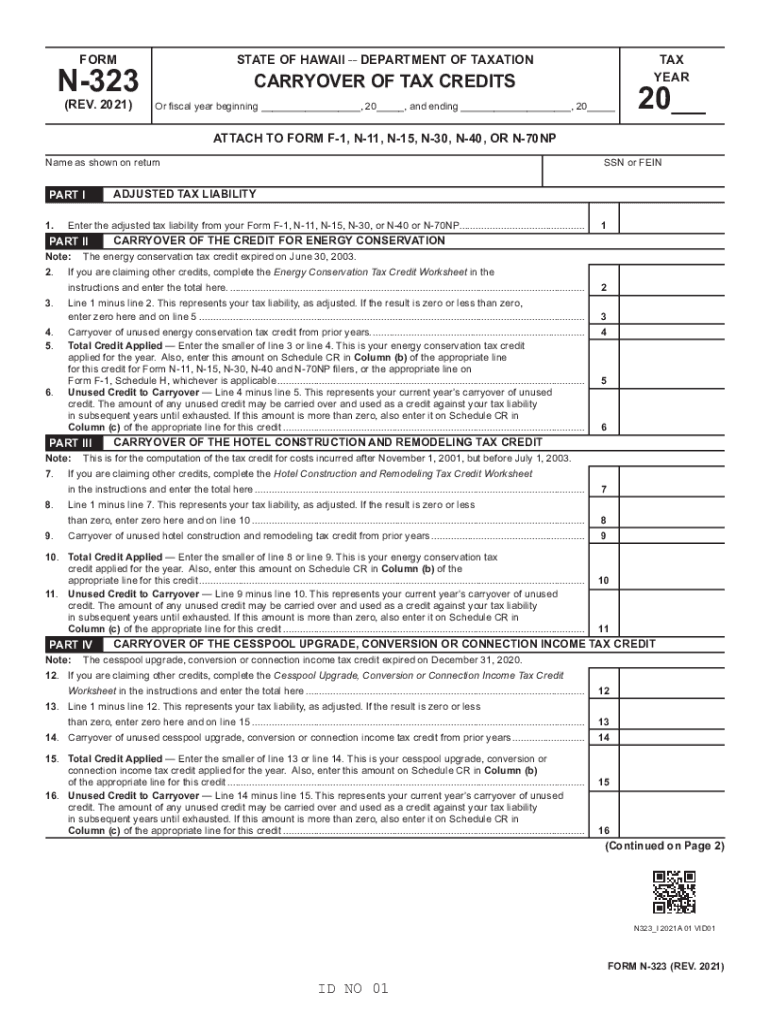
Form N-323, Rev. 2021, Carryover of Tax Credits - Hawaii.gov-2026

Get Form
n 323 Preview on Page 1

Here's how it works

01. Edit your n 323 online
Type text, add images, blackout confidential details, add comments, highlights and more.
02. Sign it in a few clicks
Draw your signature, type it, upload its image, or use your mobile device as a signature pad.
03. Share your form with others
Send it via email, link, or fax. You can also download it, export it or print it out.

How to use or fill out Form N-323, Rev. 2021, Carryover of Tax Credits - Hawaii.gov with DocHub

Form edit decoration
9.5
Ease of Setup
DocHub User Ratings on G2
9.0
Ease of Use
DocHub User Ratings on G2
  1. Click ‘Get Form’ to open it in the editor.
  2. Begin by entering your name as shown on your tax return at the top of the form.
  3. In Part I, input your Social Security Number (SSN) or Federal Employer Identification Number (FEIN) and your adjusted tax liability from the relevant forms.
  4. Proceed to Part II for the Energy Conservation Tax Credit. Complete the worksheet as instructed and enter totals in the designated fields.
  5. Continue through Parts III to VIII, filling out each section regarding various tax credits. Ensure you calculate carryovers accurately based on previous years' credits.
  6. Review all entries for accuracy before saving or exporting your completed form directly from our platform.

Start using our editor today to complete your Form N-323 efficiently and for free!

See more Form N-323, Rev. 2021, Carryover of Tax Credits - Hawaii.gov versions

We've got more versions of the Form N-323, Rev. 2021, Carryover of Tax Credits - Hawaii.gov form. Select the right Form N-323, Rev. 2021, Carryover of Tax Credits - Hawaii.gov version from the list and start editing it straight away!
Versions Form popularity Fillable & printable
2023 4.9 Satisfied (56 Votes)
2022 4.8 Satisfied (40 Votes)
2021 4.8 Satisfied (97 Votes)
2020 4.3 Satisfied (74 Votes)
2019 4.3 Satisfied (104 Votes)
2018 4.4 Satisfied (262 Votes)
2017 4.4 Satisfied (192 Votes)
2015 4.2 Satisfied (72 Votes)
2014 4.4 Satisfied (404 Votes)
2013 4 Satisfied (54 Votes)
be ready to get more

Complete this form in 5 minutes or less

Get form

Got questions?

We have answers to the most popular questions from our customers. If you can't find an answer to your question, please contact us.
Contact us
How much can I earn and still qualify? If you have:Your earned income (and adjusted gross income) has to be less than these amounts to receive any credit: No qualifying children $17,640 ($24,210 if married and filing a joint return) 1 qualifying child $46,560 ($53,120 if married and filing a joint return)2 more rows Feb 19, 2025
Every individual doing business in Hawaii during the taxable year must file a return, whether or not the individual derives any taxable income from that business. Every individual receiving more than the allowed amounts of gross income listed below, must file a Hawaii state return.
You must have a federal Adjusted Gross Income (AGI) below $60,000 ($40,000 if Single) to claim the Refundable Food/Excise Credit. Its worth from $70 to $220 per person depending on your AGI.
If you do not use the full Foreign Tax Credit amount available to you, you can carry the unused portion forward or back. A Foreign Tax Credit carryover can be applied to the previous year or up to 10 years after it was originally claimed.
You can prepare a Hawaii Tax Amendment on eFile.com, but you cannot submit it electronically; you need to print the Amendment from your account, sign it, and mail it to your state tax agency.
be ready to get more

Complete this form in 5 minutes or less

Get form

People also ask

Youll need to check your 1040 form to know if youve claimed either or both of the credits. Itll be on Earned Income Credit (EIC) line 27, Additional Child Tax Credit line 28. Select your product below to find your 1040 form: Note: If your TurboTax navigation looks different from whats described here, learn more.
The Hawaii Earned Income Tax Credit (EITC) provides income support for low to moderate-income taxpayers.
Any unused credit may be carried over to the following year, and succeeding years if necessary, until the credit has been exhausted.

Related links