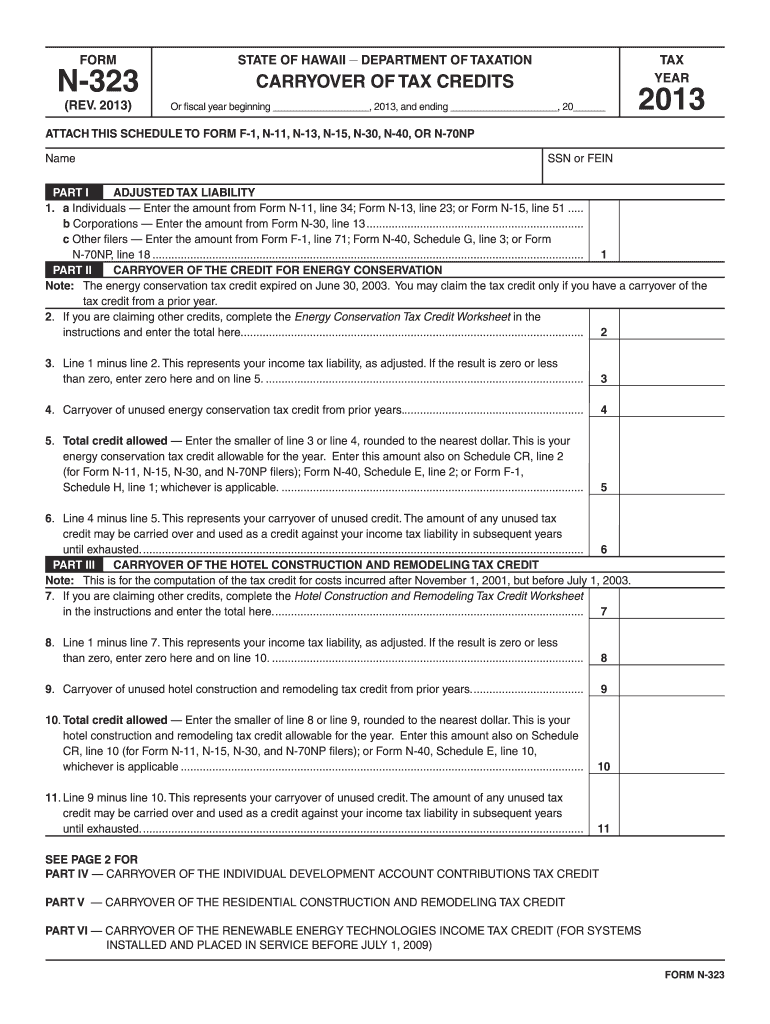
Form N-323, 2013, Carryover of Tax Credits - Hawaii.gov-2026

Get Form
Form N-323, 2013, Carryover of Tax Credits - Hawaii.gov Preview on Page 1

Here's how it works

01. Edit your form online
Type text, add images, blackout confidential details, add comments, highlights and more.
02. Sign it in a few clicks
Draw your signature, type it, upload its image, or use your mobile device as a signature pad.
03. Share your form with others
Send it via email, link, or fax. You can also download it, export it or print it out.

How to use or fill out Form N-323, 2013, Carryover of Tax Credits - Hawaii.gov with DocHub

Form edit decoration
9.5
Ease of Setup
DocHub User Ratings on G2
9.0
Ease of Use
DocHub User Ratings on G2
  1. Click ‘Get Form’ to open it in the editor.
  2. Begin by entering your name and SSN or FEIN at the top of the form. This information is essential for identification purposes.
  3. In Part I, provide your adjusted tax liability based on your filing status. Individuals should refer to specific lines from Forms N-11, N-13, or N-15 as indicated.
  4. Proceed to Part II for the Carryover of the Credit for Energy Conservation. If applicable, complete the Energy Conservation Tax Credit Worksheet and enter totals as instructed.
  5. Continue filling out Parts III through VII by following similar steps: calculate your income tax liability adjustments and carryovers based on previous years' credits.
  6. Review all entries for accuracy before saving or exporting your completed form directly from our platform.

Start using our editor today to fill out Form N-323 effortlessly and for free!

See more Form N-323, 2013, Carryover of Tax Credits - Hawaii.gov versions

We've got more versions of the Form N-323, 2013, Carryover of Tax Credits - Hawaii.gov form. Select the right Form N-323, 2013, Carryover of Tax Credits - Hawaii.gov version from the list and start editing it straight away!
Versions Form popularity Fillable & printable
2023 4.9 Satisfied (56 Votes)
2022 4.8 Satisfied (40 Votes)
2021 4.8 Satisfied (97 Votes)
2020 4.3 Satisfied (74 Votes)
2019 4.3 Satisfied (104 Votes)
2018 4.4 Satisfied (262 Votes)
2017 4.4 Satisfied (192 Votes)
2015 4.2 Satisfied (72 Votes)
2014 4.4 Satisfied (404 Votes)
2013 4 Satisfied (54 Votes)
be ready to get more

Complete this form in 5 minutes or less

Get form

Got questions?

We have answers to the most popular questions from our customers. If you can't find an answer to your question, please contact us.
Contact us
You can claim the Child Tax Credit by entering your children and other dependents on Form 1040, U.S. Individual Income Tax Return, and attaching a completed Schedule 8812, Credits for Qualifying Children and Other Dependents.
The refundable food/excise tax credit may be claimed for each individual who: Was physically present in Hawaii for more than nine months during the taxable year; Is not claimed and is not eligible to be claimed as a dependent by any taxpayer for federal or Hawaii individual income tax purposes; and Was not
To claim the solar tax credit, youll need first to determine if youre eligible, then complete IRS Form 5695 and finally add your renewable energy tax credit information to Schedule 3 and Form 1040.
Hawaii State Credit 35% (up to $5,000) You also get a 35% Hawaii tax credit, capped at $5,000 per system. This credit reduces what you owe on your state taxes. File using Form N‑342 with your Hawaii return.
In 2021, that credit was expanded to give families up to $3,600, much of it in the form of monthly checks, instead of an annual lump sum. The 2021 expansion allowed the poorest families in the country, those who dont file income taxes, to access the child tax credit for the first time in its history.

Security and compliance

At DocHub, your data security is our priority. We follow HIPAA, SOC2, GDPR, and other standards, so you can work on your documents with confidence.

Learn more
ccpa2
pci-dss
gdpr-compliance
hipaa
soc-compliance
be ready to get more

Complete this form in 5 minutes or less

Get form

People also ask

This refund size typically goes to taxpayers who: Filed early in 2025 using e-file. Opted for direct deposit. Claimed Earned Income Tax Credit (EITC), Child Tax Credit (CTC), or education credits.
Families must have at least one qualifying child under 6 years old at the end of the tax year, must file a California state tax return, and meet the requirements of the CalEITC. Taxpayers do not need to have earned income to be eligible however, you must otherwise meet CalEITC and YCTC requirements.

Related links