




01. Edit your form online
Type text, add images, blackout confidential details, add comments, highlights and more.

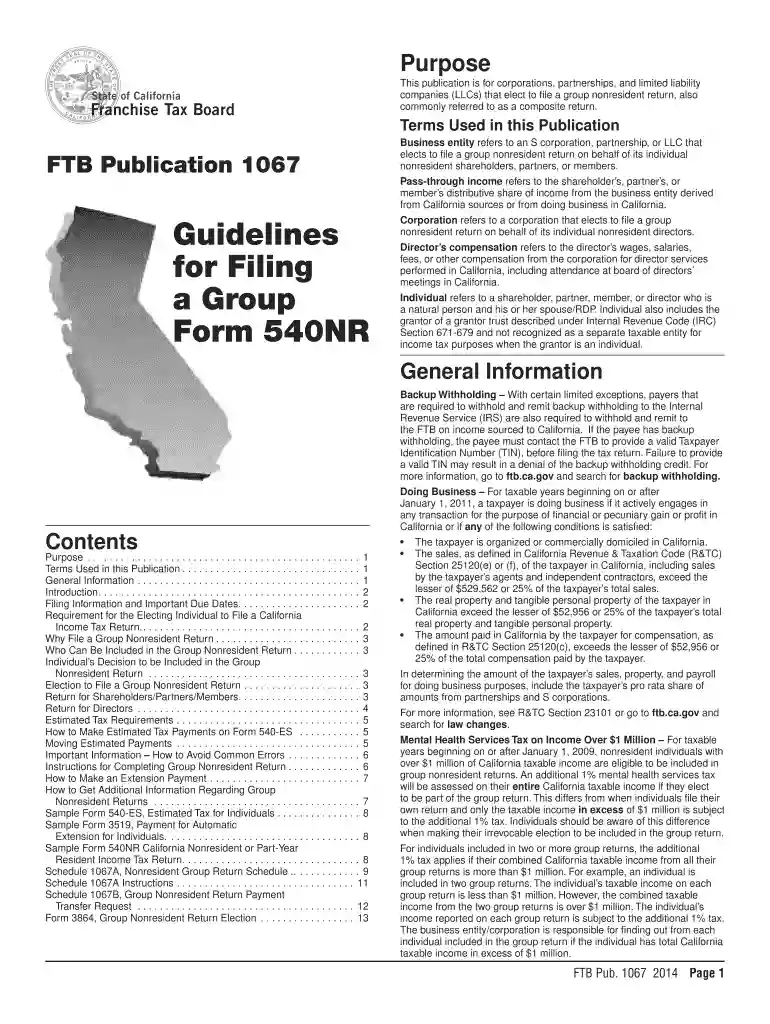
Type text, add images, blackout confidential details, add comments, highlights and more.

Draw your signature, type it, upload its image, or use your mobile device as a signature pad.

Send it via email, link, or fax. You can also download it, export it or print it out.
The CA form is a tax document used in California for filing group nonresident returns, also known as composite returns, for business entities such as corporations, partnerships, and limited liability companies (LLCs). This form allows businesses to report and pay state taxes on behalf of nonresident shareholders, partners, or members, simplifying the tax process and ensuring compliance with state tax laws.
To effectively use the CA form, businesses must understand the specific requirements set by the California Franchise Tax Board (FTB). This involves detailed preparation and careful completion of the form to ensure accuracy and compliance.
Businesses can acquire the CA form through various channels, ensuring accessibility for different preferences and situations.
Completing the CA form involves a series of important steps designed to gather accurate information and ensure full compliance with tax regulations.
The form is primarily used by business entities that have stakeholders residing outside of California.


Understanding key terms related to the CA form is essential for accurate completion and compliance.
Legal compliance is crucial when using the CA form, as it involves group tax filings under California law.
To correctly complete the CA form, businesses must focus on several crucial sections.
Meeting filing deadlines is essential when managing the CA form to avoid potential penalties and ensure timely tax payments.
Failure to comply with the requirements related to the CA form can lead to substantial penalties.
This comprehensive guide outlines key aspects of the CA form, offering businesses the information needed to effectively manage group nonresident returns in California.
We've got more versions of the ca 1067 2014 form form. Select the right ca 1067 2014 form version from the list and start editing it straight away!
| Versions | Form popularity | Fillable & printable |
|---|---|---|
| 2025 | 4.2 Satisfied (52 Votes) | |
| 2023 | 4.8 Satisfied (20 Votes) | |
| 2022 | 4.2 Satisfied (44 Votes) | |
| 2020 | 4.8 Satisfied (45 Votes) | |
| 2019 | 4.4 Satisfied (120 Votes) | |
| 2018 | 4.3 Satisfied (62 Votes) | |
| 2017 | 4.2 Satisfied (50 Votes) | |
| 2016 | 4.4 Satisfied (137 Votes) | |
| 2015 | 4.3 Satisfied (38 Votes) | |
| 2014 | 4 Satisfied (29 Votes) | |
| 2013 | 4.2 Satisfied (63 Votes) | |
| 2012 | 4 Satisfied (39 Votes) | |
| 2011 | 4 Satisfied (52 Votes) | |
| 2010 | 4.2 Satisfied (60 Votes) |
At DocHub, your data security is our priority. We follow HIPAA, SOC2, GDPR, and other standards, so you can work on your documents with confidence.
2014 Form 10-K Insert. Inside. (in millions, except EPS). 2014. 2013. Total revenue. $19,540. $20,006. Equipment sales. 3,104. 3,358. Annuity revenue. 16,436.
Apr 18, 2016 Enter the total of any: a . California estimated tax payment you made (Form 540-ES) for 2015, b . Overpayment from your 2014 California group
Main Form of Transportation (Q19) by Region. A survey question added in the 2022 data collection wave asked respondents about their main form of transportation.


