




01. Edit your form online
Type text, add images, blackout confidential details, add comments, highlights and more.

Type text, add images, blackout confidential details, add comments, highlights and more.

Draw your signature, type it, upload its image, or use your mobile device as a signature pad.

Send it via email, link, or fax. You can also download it, export it or print it out.
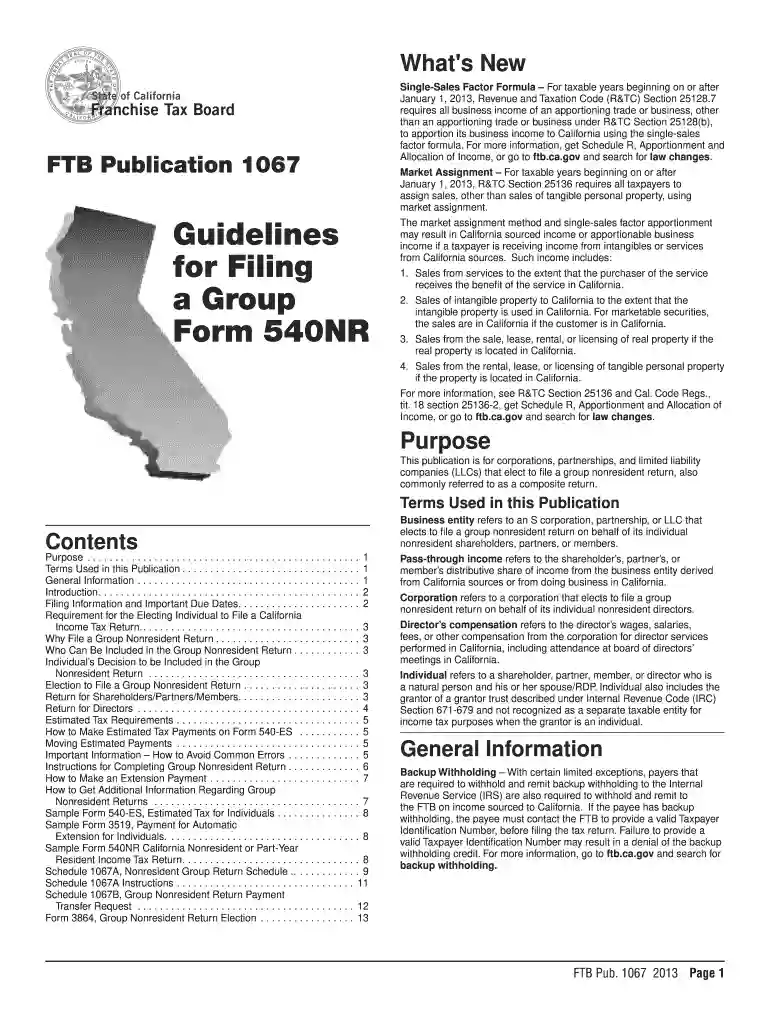
The "2013 CA 1067A Form" is a schedule used in conjunction with the California FTB Publication 1067. It supports corporations, partnerships, and LLCs in filing a group nonresident return by detailing the income apportionment and responsibilities for nonresident shareholders, partners, or members. This form plays a pivotal role in summarizing the tax liabilities, ensuring proper income distribution according to California’s tax regulations, and simplifying the process for businesses.
Filing the 2013 CA 1067A form is particularly relevant for corporations or entities that have multiple nonresident stakeholders. It facilitates the collective assessment of taxable income to efficiently process the state tax obligations. To use the form, entities must gather accurate income data and apply the single-sales factor formula to determine the California-sourced income. This form guides organizations through the calculation of each nonresident member's share of the income to ensure compliance with state tax laws.
The 2013 CA 1067A form is legally mandated for specific business formats that participate in group nonresident tax filings within California. It ensures that the entity complies with the state's fiscal policies, effectively reporting income attributable to nonresidents. The legal use of this form helps avoid understating tax liabilities and ensures the corporation or entity adheres to the California Franchise Tax Board's requirements.
The form is predominantly used by:


Non-compliance with filing requirements for the 2013 CA 1067A form may result in:
We've got more versions of the 2013 ca 1067a form form. Select the right 2013 ca 1067a form version from the list and start editing it straight away!
| Versions | Form popularity | Fillable & printable |
|---|---|---|
| 2025 | 4.2 Satisfied (52 Votes) | |
| 2023 | 4.8 Satisfied (20 Votes) | |
| 2022 | 4.2 Satisfied (44 Votes) | |
| 2020 | 4.8 Satisfied (45 Votes) | |
| 2019 | 4.4 Satisfied (120 Votes) | |
| 2018 | 4.3 Satisfied (62 Votes) | |
| 2017 | 4.2 Satisfied (50 Votes) | |
| 2016 | 4.4 Satisfied (137 Votes) | |
| 2015 | 4.3 Satisfied (38 Votes) | |
| 2014 | 4 Satisfied (29 Votes) | |
| 2013 | 4.2 Satisfied (63 Votes) | |
| 2012 | 4 Satisfied (39 Votes) | |
| 2011 | 4 Satisfied (52 Votes) | |
| 2010 | 4.2 Satisfied (60 Votes) |
At DocHub, your data security is our priority. We follow HIPAA, SOC2, GDPR, and other standards, so you can work on your documents with confidence.
The Secretary of Defense shall inform the President of the qualifications needed by a person serving in that office to carry out effectively the duties and
Apr 18, 2017 Nonresident individuals with over $1 million of California taxable income are eligible to be included in group nonresident returns . An


