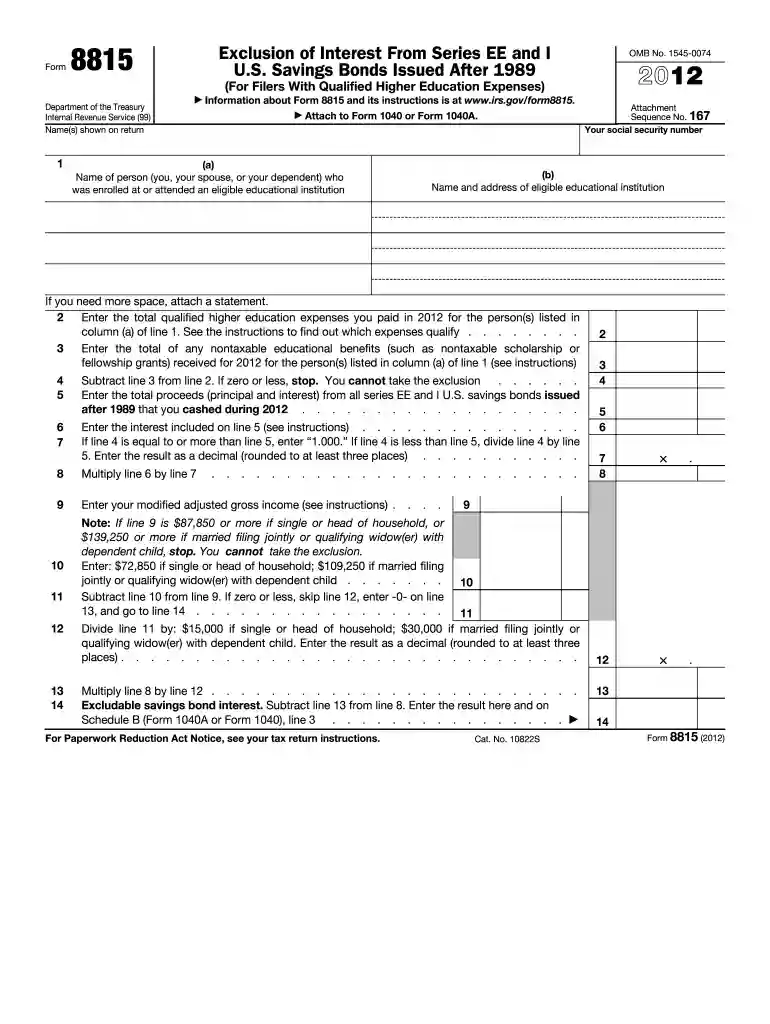
2012 form 8815-2026

Get Form
2012 form 8815 Preview on Page 1

Here's how it works

01. Edit your form online
Type text, add images, blackout confidential details, add comments, highlights and more.

02. Sign it in a few clicks
Draw your signature, type it, upload its image, or use your mobile device as a signature pad.

03. Share your form with others
Send it via email, link, or fax. You can also download it, export it or print it out.

Definition & Purpose of the 2012 Form 8815

The 2012 Form 8815 is specifically used to calculate the exclusion of interest from Series EE and I U.S. Savings Bonds issued after 1989. Taxpayers who cashed these bonds in 2012 and used the funds for qualified higher education expenses can benefit from this form. Its primary function is to ensure that eligible individuals can exclude part or all of the interest earned on these bonds, reducing their taxable income. Key eligibility criteria include income limits and specific filing statuses, all designed to support educational expenses through tax relief.

Eligibility Criteria for Using Form 8815

To use the 2012 Form 8815, taxpayers must meet several requirements:

  • Qualified Savings Bonds: Only interest from Series EE and I bonds issued after 1989 can be excluded.
  • Educational Expenses: Proceeds must be used for qualified higher education expenses in the same year as cashing the bonds.
  • Income Limits: There are modified adjusted gross income limits that affect eligibility.
  • Filing Status: Certain filing statuses, such as married filing separately, are ineligible for the exclusion. These restrictions aim to ensure that the form is applied correctly and benefits those it was intended to assist with educational funding.
decoration image ratings of Dochub

Steps to Complete the 2012 Form 8815

Completing the 2012 Form 8815 involves several key steps:

  1. Collect Qualified Expenses and Bond Proceeds: Compile information on bond interest and qualified educational expenses for the year.
  2. Calculate Exclusion: Follow the form instructions to determine the allowable exclusion of interest from taxable income.
  3. Complete the Form: Fill out each section accurately, ensuring all calculations align with IRS instructions.
  4. Attach to Tax Return: File the completed form with your annual tax return to claim the exclusion.

These steps ensure the process is straightforward but requires careful attention to detail to avoid errors in tax reporting.

Required Documents for Filing

Several documents are necessary when preparing to complete the 2012 Form 8815:

  • Proof of Bond Cashing: Documents showing the total interest earned from Series EE and I bonds.
  • Records of Educational Expenses: Receipts or statements proving the educational expenses for the year.
  • Tax Records: Previous year's tax returns may help verify income eligibility criteria. Having these documents on hand will expedite the form completion process and ensure accurate reporting to the IRS.

Common Terms Associated with Form 8815

Understanding certain terms is essential when dealing with the 2012 Form 8815:

  • Series EE and I Bonds: Specific U.S. savings bonds eligible for the interest exclusion.
  • Qualified Higher Education Expenses: Costs such as tuition, fees, and some room and board expenses.
  • Modified Adjusted Gross Income (MAGI): A modified version of adjusted gross income used to determine eligibility for certain tax benefits. Grasping these terms will facilitate a smoother form filing process and ensure compliance with IRS regulations.

IRS Guidelines on Reporting and Exclusions

The IRS provides clear guidelines for taxpayers using the 2012 Form 8815:

  • Interest Exclusion Calculations: Follow IRS instructions carefully to calculate the amount of interest that can be excluded.
  • Documentation Requirements: Maintain thorough records in case of an audit or additional queries by the IRS.
  • Deadlines: Ensure the form is submitted along with the annual tax return by the typical tax filing deadline, unless extended. Adhering to these guidelines helps ensure that the reporting is accurate and that taxpayers can maximize their exclusions legally.

Filing Methods for the 2012 Form 8815

There are several ways to submit the 2012 Form 8815:

  • Electronically: Use tax software compatible with IRS e-file systems.
  • By Mail: Send the form along with your paper tax return to the specified IRS address.
  • In-Person: File directly at an IRS office if available and preferable. These options provide flexibility depending on individual preferences and access to technology.

Penalties for Non-Compliance

Non-compliance with the filing and reporting requirements of Form 8815 can result in:

  • Interest on Unpaid Taxes: If the exclusion is improperly claimed, additional taxes plus interest could accrue.
  • Accuracy-Related Penalties: Misreported information might lead to further penalties.
  • Audit Risks: Improper claims can increase the likelihood of an IRS audit. Therefore, ensuring accuracy and adherence to IRS guidelines is crucial to avoid these negative outcomes.

These comprehensive coverage aspects ensure taxpayers have the necessary knowledge and tools to effectively utilize the 2012 Form 8815 for their tax benefit related to educational expenses.

See more 2012 form 8815 versions

We've got more versions of the 2012 form 8815 form. Select the right 2012 form 8815 version from the list and start editing it straight away!
Versions Form popularity Fillable & printable
2023 4.9 Satisfied (33 Votes)
2022 4.4 Satisfied (45 Votes)
2021 4.8 Satisfied (82 Votes)
2020 4.3 Satisfied (58 Votes)
2019 4.4 Satisfied (155 Votes)
2018 4 Satisfied (43 Votes)
2017 4.3 Satisfied (115 Votes)
2016 4.1 Satisfied (34 Votes)
2015 4.2 Satisfied (52 Votes)
2014 4.1 Satisfied (61 Votes)
2013 4.1 Satisfied (42 Votes)
2012 4 Satisfied (52 Votes)
2011 4 Satisfied (28 Votes)
be ready to get more

Complete this form in 5 minutes or less

Get form

Got questions?

We have answers to the most popular questions from our customers. If you can't find an answer to your question, please contact us.
Contact us
The interest you earn on corporate bonds is generally always taxable. Most all interest income earned on municipal bonds is exempt from federal income taxes. When you buy muni bonds issued by the state where you file state taxes, the interest you earn is usually also exempt from state income taxes.
Note: You only get a 1099-INT if you actually got the interest on a savings bond. If you are waiting until your EE or I bond matures (finishes its life) to take the interest on it, you will not get a 1099-INT for that bond until we actually pay you the interest.
If you cashed series EE or I U.S. savings bonds this year that were issued after 1989, you may be able to exclude from your income part or all of the interest on those bonds. Use Form 8815 to figure the amount of any interest you may exclude.
Cashing in I Bonds If you cash in I bonds this year, you must report the interest on line 2b of your 2024 Form 1040 and pay tax to the extent you didnt otherwise include the interest income in a prior year.
Must I pay tax on what the bond earns? You choose whether to report each years earnings or wait to report all the earnings when you get the money for the bond. If you use the money for qualified higher education expenses, you may not have to pay tax on the earnings.

Security and compliance

At DocHub, your data security is our priority. We follow HIPAA, SOC2, GDPR, and other standards, so you can work on your documents with confidence.

Learn more
ccpa2
pci-dss
gdpr-compliance
hipaa
soc-compliance
be ready to get more

Complete this form in 5 minutes or less

Get form

People also ask

I cashed some Series E, Series EE, and Series I savings bonds. How do I report the interest? In general, you must report the interest in income in the taxable year in which you redeemed the bonds to the extent you did not include the interest in income in a prior taxable year.
To qualify for the exclusion, the bonds must be series EE or I U.S. savings bonds issued after 1989 in your name, or, if you are married, they may be issued in your name and your spouses name. Also, you must have been age 24 or older before the bonds were issued.
You can skip paying taxes on interest earned with Series EE and Series I savings bonds if youre using the money to pay for qualified higher education costs. That includes expenses you pay for yourself, your spouse or a qualified dependent. Only certain qualified higher education costs are covered, including: Tuition.

Related links