Form 8815 2017-2026

Get Form
form 8815 2017 Preview on Page 1

Here's how it works

01. Edit your form online
Type text, add images, blackout confidential details, add comments, highlights and more.

02. Sign it in a few clicks
Draw your signature, type it, upload its image, or use your mobile device as a signature pad.

03. Share your form with others
Send it via email, link, or fax. You can also download it, export it or print it out.

How to use or fill out form 8815 2017 with our platform

Form edit decoration
9.5
Ease of Setup
DocHub User Ratings on G2
9.0
Ease of Use
DocHub User Ratings on G2
  1. Click ‘Get Form’ to open it in the editor.
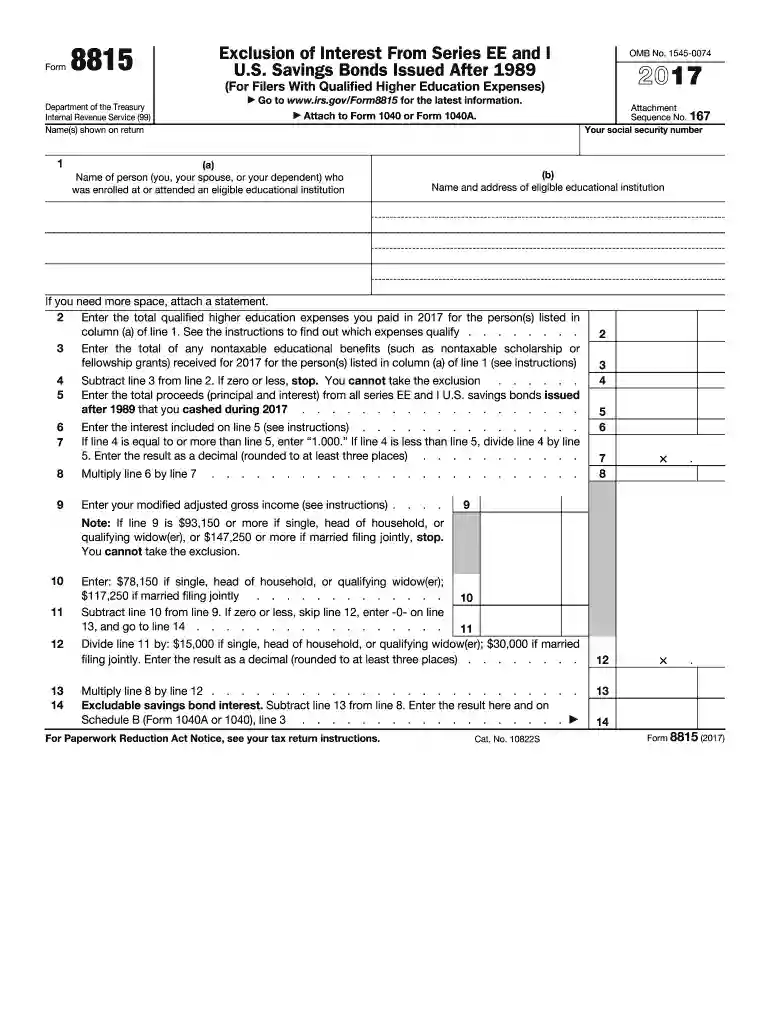
  2. In Line 1, enter the name of the person who attended an eligible educational institution. Include their social security number and the name and address of the institution in Column (b).
  3. For Line 2, input the total qualified higher education expenses paid in 2017 for the individual listed in Line 1. Ensure these expenses qualify as per IRS guidelines.
  4. On Line 3, enter any nontaxable educational benefits received for the same individual. This includes scholarships or grants that do not count as taxable income.
  5. Proceed to Line 6 and enter the total proceeds from all series EE and I U.S. savings bonds cashed during 2017.
  6. Complete Lines 9 through 12 by calculating your modified adjusted gross income and following the instructions provided for each line.

Start using our platform today to easily fill out Form 8815 and streamline your tax filing process!

See more form 8815 2017 versions

We've got more versions of the form 8815 2017 form. Select the right form 8815 2017 version from the list and start editing it straight away!
Versions Form popularity Fillable & printable
2023 4.9 Satisfied (33 Votes)
2022 4.4 Satisfied (45 Votes)
2021 4.8 Satisfied (82 Votes)
2020 4.3 Satisfied (58 Votes)
2019 4.4 Satisfied (155 Votes)
2018 4 Satisfied (43 Votes)
2017 4.3 Satisfied (115 Votes)
2016 4.1 Satisfied (34 Votes)
2015 4.2 Satisfied (52 Votes)
2014 4.1 Satisfied (61 Votes)
2013 4.1 Satisfied (42 Votes)
2012 4 Satisfied (52 Votes)
2011 4 Satisfied (28 Votes)
be ready to get more

Complete this form in 5 minutes or less

Get form

Got questions?

We have answers to the most popular questions from our customers. If you can't find an answer to your question, please contact us.
Contact us
Income from bonds issued by state, city, and local governments (municipal bonds, or munis) is generally free from federal taxes. Market discount for municipal bonds is taxable interest income and not tax-exempt interest income. You will, however, have to report this income when filing your taxes.
If you cashed series EE or I U.S. savings bonds this year that were issued after 1989, you may be able to exclude from your income part or all of the interest on those bonds. Use Form 8815 to figure the amount of any interest you may exclude.
An electronic indorsement in the Type 26 or Type 28 records is required, consistent with check image deposit guidelines. Paying agents must continue to apply the paying agent stamp on the front of the savings bond and complete the owner and paying agent information on the back of the bond.
You can get your cash for an EE or I savings bond any time after you have owned it for 1 year. However, the longer you hold the bond, the more it earns for you (for up to 30 years for an EE or I bond). Also, if you cash in the bond in less than 5 years, you lose the last 3 months of interest.
You should have no problem cashing in savings bonds at any federally chartered bank, thrift, savings and loan, or credit union.

Security and compliance

At DocHub, your data security is our priority. We follow HIPAA, SOC2, GDPR, and other standards, so you can work on your documents with confidence.

Learn more
ccpa2
pci-dss
gdpr-compliance
hipaa
soc-compliance
be ready to get more

Complete this form in 5 minutes or less

Get form

People also ask

You can skip paying taxes on interest earned with Series EE and Series I savings bonds if youre using the money to pay for qualified higher education costs. That includes expenses you pay for yourself, your spouse or a qualified dependent. Only certain qualified higher education costs are covered, including: Tuition.
You can choose not to pay federal income tax on them until you cash them or they mature, whichever is first. Under certain conditions, you can avoid federal income tax on interest by using the interest to pay for higher education.
I cashed some Series E, Series EE, and Series I savings bonds. How do I report the interest? In general, you must report the interest in income in the taxable year in which you redeemed the bonds to the extent you did not include the interest in income in a prior taxable year.

Related links