
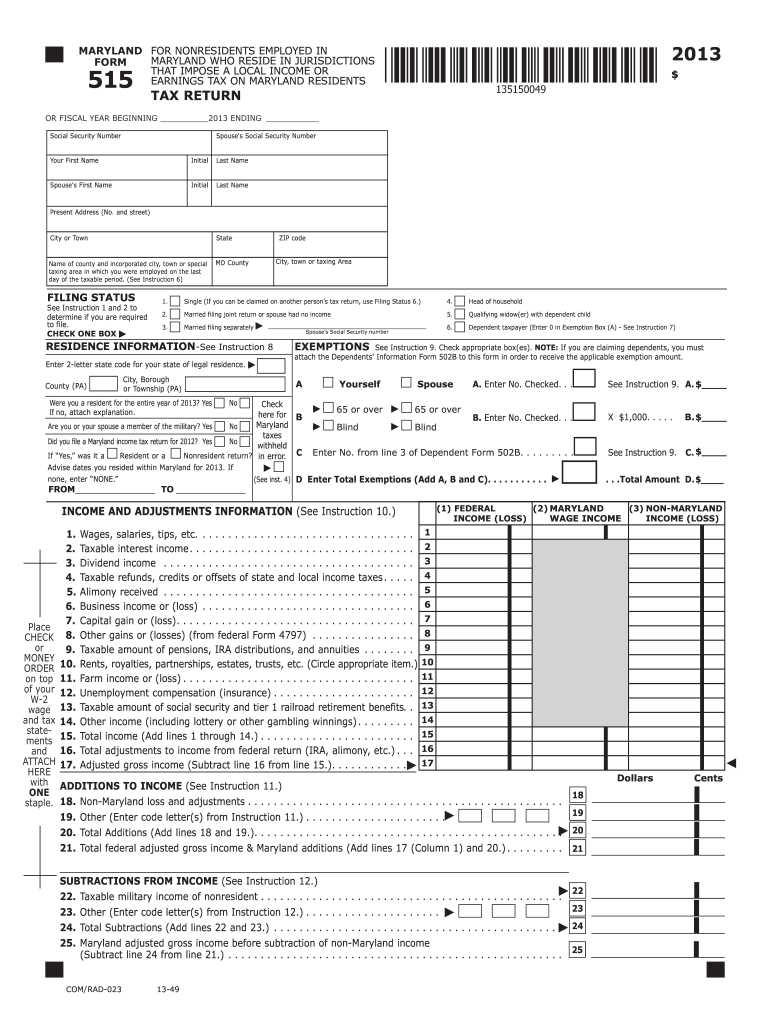







Definition & Meaning
The "jurisdictions that impose a local income or earnings tax on Maryland residents 2013 form" refers to Form 515, which is crucial for nonresidents who work in Maryland but reside in jurisdictions that impose a local tax on Maryland residents. This form provides guidelines on the obligations and calculations needed for reporting and paying local income taxes to avoid double taxation and fulfill legal tax requirements. Understanding its purpose ensures that nonresidents manage their tax responsibilities effectively, adhering to both state and local taxation rules.
How to Use the Form
To properly use Form 515, individuals should collect all financial records related to their income earned within Maryland. This includes wages, dividends, and any other relevant sources of income.
-
Personal Information: Enter your name, social security number, and address accurately.
-
Income Reporting: Report all Maryland-earned income on the income section of the form to ensure transparency and compliance.
-
Tax Computation: Utilize the instructions within the form to compute your taxable income, adjusting for any deductions or exemptions that apply.
-
Local Tax Calculations: Calculate the local taxes based on the jurisdiction's specific rates as outlined.
-
Filing and Payment: Complete the form with accuracy and ensure timely submission to avoid penalties, using the form’s instructions for any additional steps.
Practical Example
Consider Jane Doe, a resident of Pennsylvania working in Maryland. She would utilize Form 515 to calculate her specific tax liabilities within Maryland while ensuring her jurisdiction's local taxes are accounted for. She follows the steps above and ensures all entries are precise before submission.
Steps to Complete the Form
Complete Form 515 by following these steps:
- Gather Documentation: Collect W-2s, 1099s, and other source documents that report income earned in Maryland.
- Fill Out Personal Information: Input your basic personal details, ensuring all information matches public records.
- Report Income: Document your full gross income earned in Maryland, detailing all sources comprehensively.
- Deductions and Exemptions: Apply relevant deductions or exemptions, each supported by documentation, in the deductions section.
- Compute Taxes: Use the form’s tax tables to calculate your Maryland income taxes and any applicable credits.
- Final Calculations: Complete the local tax calculation segment using specific jurisdictional rates.
- Review and Submit: Double-check all the information for accuracy before submission either online or via mail.
Important Terms Related
Understanding key terms ensures competent completion of Form 515:
- Gross Income: The total income from all sources before deductions.
- Exemptions: Specific amounts that reduce taxable income due to various factors.
- Deductions: Qualifying expenses that can be subtracted from gross income.
- Credit: Direct reductions from the amount of tax owed.
- Withholding: Income tax withheld from wages or other payments by the payer.
Eligibility Criteria
Form 515 applies broadly to:
- Nonresidents: Individuals residing outside Maryland but earning income within.
- Municipality Residents: Individuals in jurisdictions taxing Maryland residents.
- Varied Occupations: Employees, consultants, or sole proprietors with Maryland-based income meet eligibility.


Filing Deadlines / Important Dates
Staying informed about deadlines is critical for compliance:
- Standard Due Date: Typically April 15 for tax year filings, aligning with the IRS deadline.
- Extensions: Apply for an extension if needed, generally providing an additional six months.
Form Submission Methods
Forms can be submitted through various channels:
- Online: Using Maryland’s official tax website or authorized e-filing services.
- Mail: Sending completed forms to the Maryland Comptroller’s office.
- In-Person: Delivery at designated Maryland state tax offices for expedited processing.
Required Documents
Ensure you have the following documents:
- W-2 Forms: Detailing employment income.
- 1099 Forms: Reporting other types of income.
- Local Tax Documentation: Proof of tax paid or owed to local jurisdictions.
- Deductions Documents: Backup for all deductions claimed.
Penalties for Non-Compliance
Failure to file or inaccurate reporting can result in:
- Monetary Fines: Additional fees or interest accrued on taxes owed.
- Legal Consequences: Potential audits or enforcement actions by Maryland tax authorities.
- Reputation Risks: Risk of impact on credit scores and public records.
Ensuring diligent preparation and adherence to guidelines significantly mitigates these risks.


