




01. Edit your form online
Type text, add images, blackout confidential details, add comments, highlights and more.

Type text, add images, blackout confidential details, add comments, highlights and more.

Draw your signature, type it, upload its image, or use your mobile device as a signature pad.

Send it via email, link, or fax. You can also download it, export it or print it out.
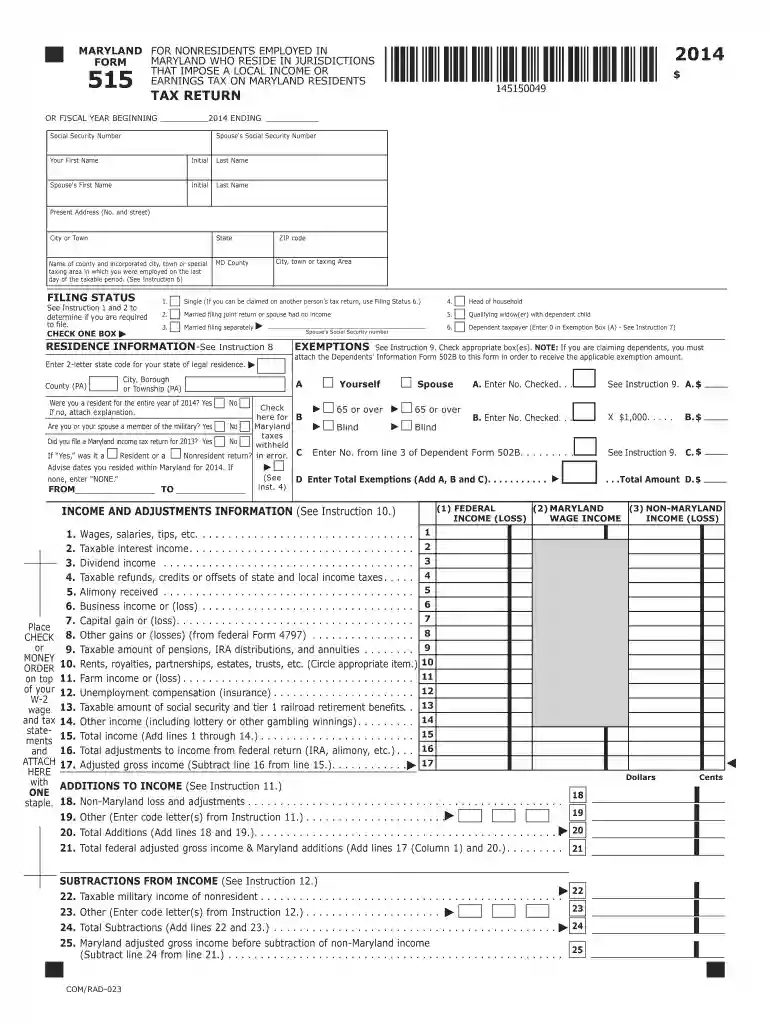
Form 515 for the year 2014 is a tax form used by nonresidents working in Maryland, who reside in jurisdictions that impose a local income tax on Maryland residents. This form is critical for ensuring that individuals working in Maryland but living in neighboring jurisdictions comply with local tax regulations. It provides the structure for reporting income, claiming exemptions, and determining tax liabilities and potential credits.
The core purpose of Form 515 is to ensure cross-jurisdictional tax compliance. Nonresident individuals use it to declare income earned in Maryland and calculate corresponding tax obligations. This form addresses scenarios where dual taxation might occur, providing a legal framework for minimizing undue tax burdens.
Imagine a scenario where a Virginia resident commutes to Maryland for work. This resident would need to file Form 515 to account for taxes due in Maryland, ensuring that local income taxes of both jurisdictions are harmoniously addressed. The form helps clarify tax responsibilities, potentially providing relief via credits for taxes paid to the resident state.
Nonresidents begin by collecting pertinent financial documents, such as W-2s and any relevant 1099 forms. Once these documents are assembled, taxpayers proceed to fill out Form 515, inputting details related to their income earned in Maryland, adjustments, and deductions.
Following these steps allows for comprehensive and accurate form completion, ensuring legal compliance.
Taxpayers have multiple options for submitting their Form 515. They can choose traditional mail or engage in online submissions via e-filing systems. Both methods require careful attention to detail to prevent errors. Submission through online platforms may expedite processing and provide confirmation receipts.
E-filing offers several benefits, from convenience to quicker processing times. Electronic submissions also tend to reduce errors due to automated calculations and checks.
Form 515 comprises several critical sections:
Ensuring accuracy across these sections is vital. Errors can lead to processing delays or potential audits. Taxpayers should double-check all entries for consistency with supporting documents like pay stubs and financial statements.
To complete Form 515 effectively, taxpayers must have:
These documents support income claims and deductions, providing the evidence necessary for verifying tax compliance. They ensure that all entered amounts can be substantiated in case of queries by tax authorities.
Failure to file Form 515 accurately or on time may result in penalties, ranging from fines to accrued interest on unpaid taxes. More severe errors can trigger audits, leading to additional scrutiny and potential legal ramifications.
Allocate sufficient time to prepare and review the form before submission. Consulting with tax professionals may provide insights into complex cases, reducing the likelihood of non-compliance.


To determine eligibility for Form 515, the taxpayer must reside outside Maryland but earn income within the state. This primarily applies to cross-state commuters and those working remotely for Maryland-based companies.
Certain situations, such as owning property in Maryland or having dual employment locations, can affect eligibility. Thorough assessment of an individual's residency status and work location is necessary for accurate form filing.
Form 515 ensures compliance with Maryland’s tax regulations for nonresidents. It guarantees that taxes are calculated based on specific state guidelines, reducing the risk of discrepancies between states.
The form is designed to mitigate double taxation by allowing filers to claim credits for taxes paid to their home state, effectively balancing tax liabilities between jurisdictions.
By thoroughly understanding these segments and adhering to guidelines, individuals can ensure a smooth, compliant tax filing experience using Form 515 for the year 2014.
We've got more versions of the form 515 2014 form. Select the right form 515 2014 version from the list and start editing it straight away!
| Versions | Form popularity | Fillable & printable |
|---|---|---|
| 2023 | 4.9 Satisfied (51 Votes) | |
| 2022 | 4.9 Satisfied (40 Votes) | |
| 2021 | 4.6 Satisfied (57 Votes) | |
| 2020 | 4.9 Satisfied (22 Votes) | |
| 2019 | 4.2 Satisfied (64 Votes) | |
| 2018 | 4.4 Satisfied (223 Votes) | |
| 2017 | 4.4 Satisfied (70 Votes) | |
| 2016 | 4.1 Satisfied (53 Votes) | |
| 2015 | 4.2 Satisfied (71 Votes) | |
| 2014 | 4.4 Satisfied (32 Votes) | |
| 2013 | 4.2 Satisfied (73 Votes) | |
| 2011 | 4.3 Satisfied (64 Votes) |
At DocHub, your data security is our priority. We follow HIPAA, SOC2, GDPR, and other standards, so you can work on your documents with confidence.
The latest versions of IRS forms, instructions, and publications. If a PDF file wont open, try downloading the file to your device and opening it using DocHubRead more
Dec 19, 2013 Social security and Medicare tax for 2014. The social security tax rate is 6.2% each for the employee and em- ployer, unchanged from 2013.Read more
Apr 15, 2015 515. Withholding on distributions. If you are claiming an exemption from withholding on a distribution from a. U.S. corporation with respectRead more


