
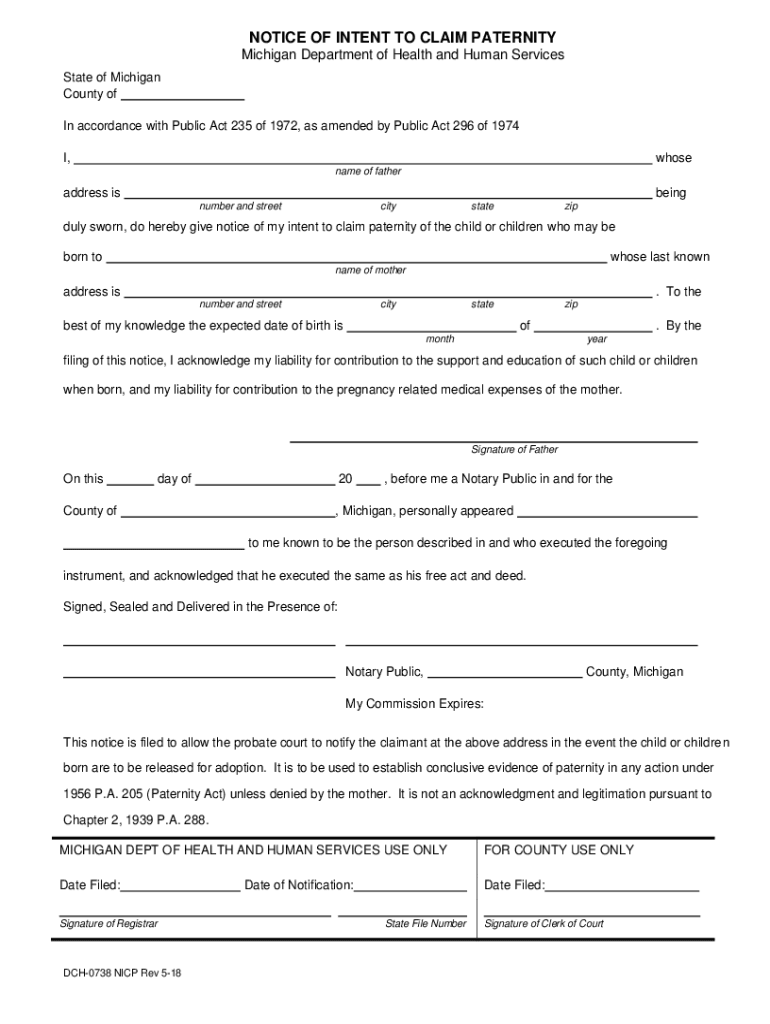







Definition & Meaning
The "Notice of Intent to Claim Paternity" issued by the Michigan Department of Health and Human Services is a legal document that enables an individual to formally declare their intent to recognize their paternity concerning an unborn child. This notice is a foundational step in claiming paternal rights and responsibilities, ensuring that the father is acknowledged in matters related to child support and the child’s wellbeing.
Key Considerations
- Legal Recognition: This notice acts as a preliminary acknowledgment of the individual's paternity, offering the groundwork for further legal actions, if necessary.
- Responsibilities: By filing this notice, the father also acknowledges potential responsibilities, including child support and medical expenses related to the mother's pregnancy.
How to Use the NOTICE OF INTENT TO CLAIM PATERNITY
Using this notice involves specific steps to ensure that the intent to claim paternity is recognized legally.
Step-by-Step Instructions
-
Obtain the Form: First, acquire the form directly from the Michigan Department of Health and Human Services or through their official channels.
-
Complete the Form: Fill in the required personal details accurately, including the names of both parents and the child (if known).
-
Submit the Form: Submit the completed form as per the instructions provided, ensuring it is filed with the appropriate state department.
Important Points
- Ensure all information is correct to avoid any legal discrepancies.
- The form must be submitted before the birth of the child to be effective.
Steps to Complete the NOTICE OF INTENT TO CLAIM PATERNITY
Completing the notice is a straightforward yet crucial process that requires attention to detail.
Required Steps
-
Prepare Personal Details: Gather all personal identification information necessary for the form.
-
Detail Relationship Information: Clearly outline the relationship details between the parties involved, including the expected date of delivery if applicable.
-
Sign the Form: Affix your signature to the document, indicating your formal acknowledgment of paternity intent.
-
Witness or Notarization: Depending on the specific requirements, the form may need to be witnessed or notarized to verify authenticity.
Common Mistakes
- Failing to date the form correctly
- Omitting any required sections or information, leading to processing delays
Legal Use of the NOTICE OF INTENT TO CLAIM PATERNITY
This form serves multiple legal purposes, solidifying the father’s involvement and rights.
Legal Functions
- Child Support: Establishes a legal basis for future child support claims.
- Custody and Visitation: Utilized in determining custody and visitation rights, ensuring that the father's role is legally recognized.
Who Typically Uses the NOTICE OF INTENT TO CLAIM PATERNITY
This document is primarily used by fathers seeking formal recognition of their parentage.


Typical Users
- Expectant Fathers: Individuals who wish to assert their parental rights and responsibilities proactively.
- Legal Guardians: In certain cases, guardians may file on behalf of the father to ensure parental rights are secured.
State-Specific Rules for the NOTICE OF INTENT TO CLAIM PATERNITY
In Michigan, specific rules govern the operation and submission of this notice.
Michigan Regulations
- Filing Deadline: The notice should typically be filed before the child's birth to be legally effective.
- Official Channels: Must be submitted through designated official channels for recognition.
Important Terms Related to NOTICE OF INTENT TO CLAIM PATERNITY
Understanding key terms associated with this form is essential for proper usage.
Terms and Definitions
- Paternity: The legal acknowledgment of the father-child relationship.
- Legal Notice: A formal declaration submitted to state authorities to assert legal rights.
Examples of Using the NOTICE OF INTENT TO CLAIM PATERNITY
Real-world applications provide insight into the practical use of this document.
Practical Scenarios
- A father wanting to ensure inclusion in birth certificate details.
- A situation where a father needs to affirm his commitment to supporting the child legally.
Key Elements of the NOTICE OF INTENT TO CLAIM PATERNITY
The document contains critical elements necessary for proper execution.
Essential Sections
- Identification Information: Includes personal details of the mother and father.
- Declaration Statement: An official declaration of the intent to claim paternity, including specific personal affirmations.
Who Issues the Form
The Michigan Department of Health and Human Services is responsible for issuing and managing this form.
Role of the Issuing Body
- Official Authority: Ensures that the form is obtained, processed, and maintained correctly as per state requirements.
- Guidance and Support: Offers assistance in completing the form correctly and submitting it through appropriate channels.


