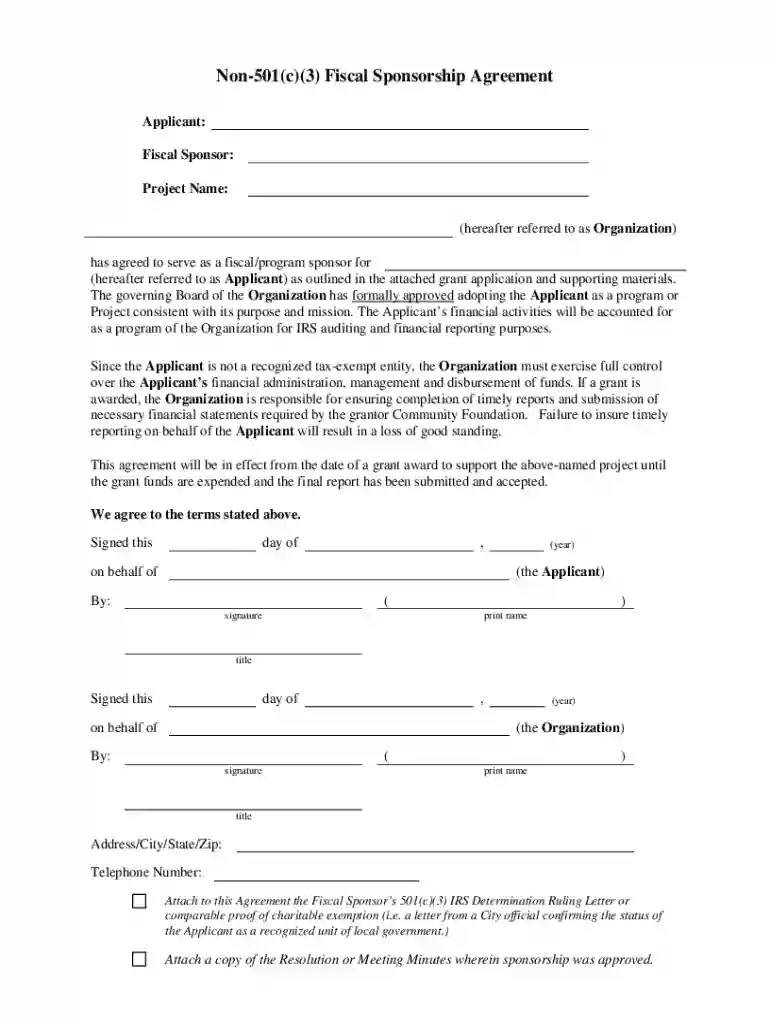
Siouxcenter DocumentCenterViewNon-501(c)(3) Fiscal Sponsorship Agreement - Sioux Center, Iowa 2026

Get Form
siouxcenter DocumentCenterViewNon-501(c)(3) Fiscal Sponsorship Agreement - Sioux Center, Iowa Preview on Page 1

Here's how it works

01. Edit your form online
Type text, add images, blackout confidential details, add comments, highlights and more.

02. Sign it in a few clicks
Draw your signature, type it, upload its image, or use your mobile device as a signature pad.

03. Share your form with others
Send it via email, link, or fax. You can also download it, export it or print it out.

Definition & Meaning

The Sioux Center DocumentCenterView Non-501(c)(3) Fiscal Sponsorship Agreement in Sioux Center, Iowa, refers to a legal document that outlines the commitments between a fiscal sponsor and an applicant. This agreement is essential for managing financial activities for projects that do not qualify for 501(c)(3) tax-exempt status. The agreement is foundational for ensuring that both parties adhere to financial compliance and regulatory requirements while delineating the fiscal sponsor's control over financial administration, including grant reporting and fund usage.

How to Obtain the Agreement

Securing the Sioux Center DocumentCenterView Non-501(c)(3) Fiscal Sponsorship Agreement can typically be done through the appropriate municipal or legal office in Sioux Center, Iowa. Generally, interested parties should:

  1. Contact the Relevant Authority:
    • Reach out to the city's legal department or the entity managing nonprofit agreements for Sioux Center.
  2. Visit the Official Website:
    • The Sioux Center city website may have downloadable forms or further instructions.
  3. Request via Email or Phone:
    • Direct communication channels like emails or phone calls can facilitate an application.

Steps to Complete the Agreement

Completing this agreement involves several meticulous steps to ensure proper submission:

  1. Gather Necessary Information:
    • Include details about the applicant and the specific project in need of sponsorship.
  2. Review Compliance Requirements:
    • Ensure compliance with financial reporting and administration regulations.
  3. Fill Out the Form:
    • Accurately complete each section, detailing responsibilities, and terms.
  4. Check for Required Signatures:
    • Obtain signatures from all necessary parties to validate the document.
  5. Submit to Proper Authorities:
    • Submit the finalized agreement to the municipal office for review and approval.

Who Typically Uses the Agreement

The primary users of the Sioux Center DocumentCenterView Non-501(c)(3) Fiscal Sponsorship Agreement include:


  • Small Organizations:
    • Projects lacking 501(c)(3) status but requiring fiscal oversight.
  • Community Groups:
    • Local initiatives seeking funding without establishing a separate organization.
  • Sponsors:
    • Larger entities offering fiscal management and oversight to these projects.
decoration image ratings of Dochub

Important Terms Related to the Agreement

Several critical terms govern this type of fiscal sponsorship agreement:

  • Fiscal Sponsor:
    • An entity that manages funds and administers projects without the projects having separate legal status.
  • Applicant:
    • The organization or individual seeking sponsorship.
  • Non-501(c)(3):
    • Projects that do not qualify for tax-exempt status under section 501(c)(3).
  • Financial Compliance:
    • Adhering to required grant reporting and usage of funds.

Key Elements of the Agreement

Major components of the Sioux Center DocumentCenterView Non-501(c)(3) Fiscal Sponsorship Agreement include:

  • Control of Funds:
    • The sponsor maintains full control over the financial aspect of the project.
  • Term Duration:
    • Specifies the effective period from grant award until final reporting.
  • Responsibilities:
    • Clearly defines the duties of both the sponsor and the applicant.

Legal Use of the Agreement

The agreement has several legal implications:

  • Regulatory Adherence:
    • Ensures compliance with local and state laws for financial administration.
  • Grant Reporting:
    • Mandates periodic reporting to demonstrate proper use of funds.
  • Dispute Resolution:
    • Provides a framework for addressing disagreements between parties involved.

Examples of Using the Agreement

Real-world applications of this agreement might involve:

  • Community Gardens:
    • Local projects needing oversight to secure community or government grants.
  • Arts & Culture Projects:
    • Initiatives requiring management of funds for festivals or exhibitions.
  • Public Health Campaigns:
    • Efforts looking for structured financial guidance without formal nonprofit status.
be ready to get more

Complete this form in 5 minutes or less

Get form

Got questions?

We have answers to the most popular questions from our customers. If you can't find an answer to your question, please contact us.
Contact us
Usually, fiscal sponsorships occur between two organizations doing similar work. However, any 501(c)(3) can serve as a fiscal sponsor for any other non-profit.
Section 501(c)(3) is the portion of the US Internal Revenue Code that allows for federal tax exemption of nonprofit organizations that meet the codes requirements. These nonprofits may be considered public charities, private foundations, or private operating foundations, which well explain in more detail later.
Key Differences Between 501(c) and 501(c)(3) Organizations Tax-Exempt Status: Both types of organizations are tax-exempt, but only 501(c)(3) organizations are eligible to receive tax-deductible contributions from donors.
A fiscal sponsorship is an arrangement between an NFP with 501(c)(3) tax-exempt status (the sponsor NFP) and another party without tax-exempt status. Often, the other party is an organization, group, or individual that wants to conduct a charitable project or activity.
The IRS determination letter notifies a nonprofit organization that its application for federal tax exemption under Section 501(c)(3) has been approved. This is an exciting day for an emerging nonprofit! Having your IRS determination letter in hand affords your nonprofit organization several unique advantages.

Security and compliance

At DocHub, your data security is our priority. We follow HIPAA, SOC2, GDPR, and other standards, so you can work on your documents with confidence.

Learn more
ccpa2
pci-dss
gdpr-compliance
hipaa
soc-compliance

People also ask

Fiscal sponsorship is a budgetary and legal framework where a nonprofit entity offers its legal and tax-exempt status to a project that aligns with its mission, but doesnt have its own IRS tax-exempt status. The Poise Foundation provides this essential framework, aiding projects with their operational facets as well.
Fiscal sponsorship is an alternative to forming a nonprofit 501(c)(3) corporation that allows individuals or groups to engage in charitable activities and give donors the ability to take a charitable contribution deduction, without spending the time and resources to incorporate, apply for tax-exempt status, and
Exempt purposes - Internal Revenue Code Section 501(c)(3) The exempt purposes set forth in section 501(c)(3) are charitable, religious, educational, scientific, literary, testing for public safety, fostering national or international amateur sports competition, and preventing cruelty to children or animals.

Related links