




01. Edit your form online
Type text, add images, blackout confidential details, add comments, highlights and more.

Type text, add images, blackout confidential details, add comments, highlights and more.

Draw your signature, type it, upload its image, or use your mobile device as a signature pad.

Send it via email, link, or fax. You can also download it, export it or print it out.
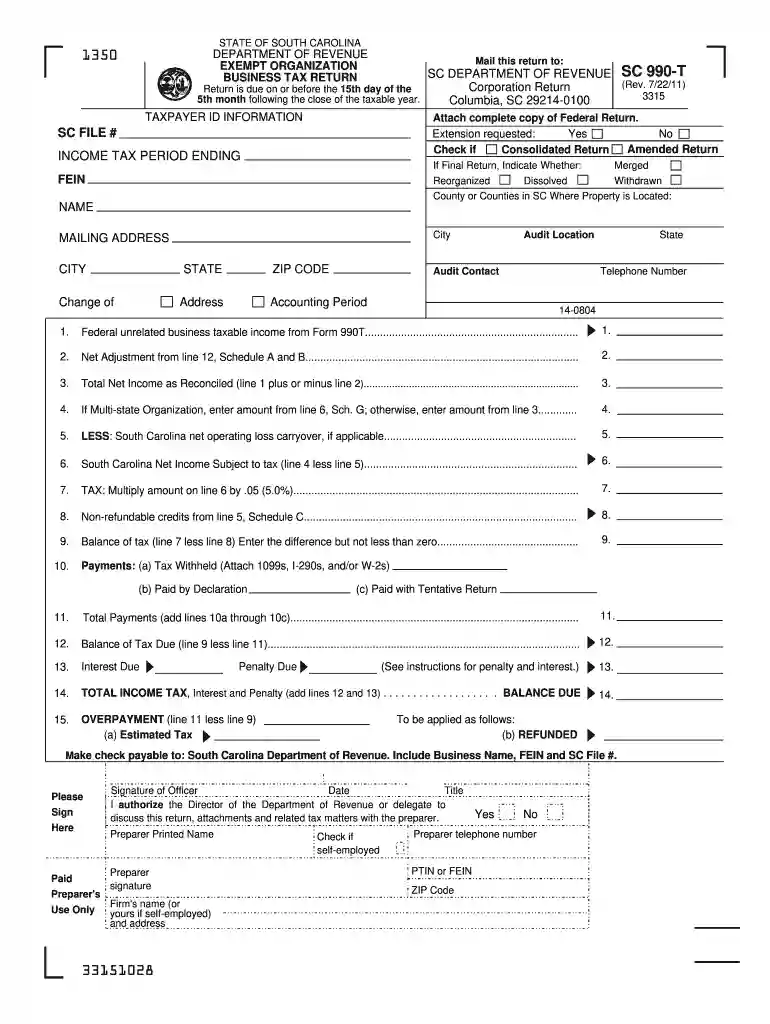
The SC990-T form, officially known as the South Carolina Exempt Organization Business Tax Return, is used by organizations to report unrelated business income. This form is essential for exempt organizations, such as nonprofits, that need to declare income from activities not directly related to their primary exempt purpose. By completing this form, organizations can calculate and pay any taxes due on their unrelated business income.
Consider a nonprofit organization that operates a gift shop. Even though the organization is exempt from tax, the income from the gift shop is considered unrelated business income and must be reported using the SC990-T form to determine if any taxes are owed.
Organizations must accurately document unrelated business income, adjustments, and applicable deductions on the SC990-T form. This requires a thorough understanding of what constitutes unrelated business income according to IRS guidelines.
Completing the SC990-T form requires attention to detail to ensure compliance and accuracy. Organizations must follow specific steps to correctly fill out the form.
Accurate documentation is crucial when preparing the SC990-T form. Organizations must ensure they have all necessary documents to support their income and expense claims.
Timeliness is critical in filing the SC990-T form. Missing deadlines can lead to penalties and interest charges.
Proper use of the SC990-T form ensures compliance with state tax laws and avoids potential legal issues for the organization.
Non-compliance with SC990-T filing requirements can result in severe financial repercussions for exempt organizations.
Organizations have several options for submitting the SC990-T form. Choosing the appropriate method depends on the organization's resources and preferences.
While the SC990-T form is specific to South Carolina, state-specific nuances can impact filing requirements and procedures.
Choosing between digital and paper versions of the SC990-T form can affect efficiency and accuracy.
We've got more versions of the sc990 t 2011 form form. Select the right sc990 t 2011 form version from the list and start editing it straight away!
| Versions | Form popularity | Fillable & printable |
|---|---|---|
| 2024 | 4.3 Satisfied (34 Votes) | |
| 2023 | 4.4 Satisfied (41 Votes) | |
| 2023 | 4.6 Satisfied (37 Votes) | |
| 2022 | 4.8 Satisfied (62 Votes) | |
| 2022 | 4.8 Satisfied (48 Votes) | |
| 2021 | 4.8 Satisfied (121 Votes) | |
| 2021 | 4.8 Satisfied (145 Votes) | |
| 2021 | 4.8 Satisfied (131 Votes) | |
| 2021 | 4.8 Satisfied (121 Votes) | |
| 2020 | 4.9 Satisfied (38 Votes) | |
| 2019 | 4.3 Satisfied (157 Votes) | |
| 2019 | 4.4 Satisfied (215 Votes) | |
| 2019 | 4.4 Satisfied (96 Votes) | |
| 2019 | 4.2 Satisfied (24 Votes) | |
| 2019 | 4 Satisfied (41 Votes) |
At DocHub, your data security is our priority. We follow HIPAA, SOC2, GDPR, and other standards, so you can work on your documents with confidence.
May 4, 2022 2011. 19. Hobert O. Regulation of terminal differentiation programs in the nervous system. Annu Rev Cell Dev Biol. 2011;27:681-96. 20. LouviRead more
Form 990-T to report gross unrelated business taxable income of $1,000 or more claim a refund,


