







Understanding the TC-38 Tax Credit
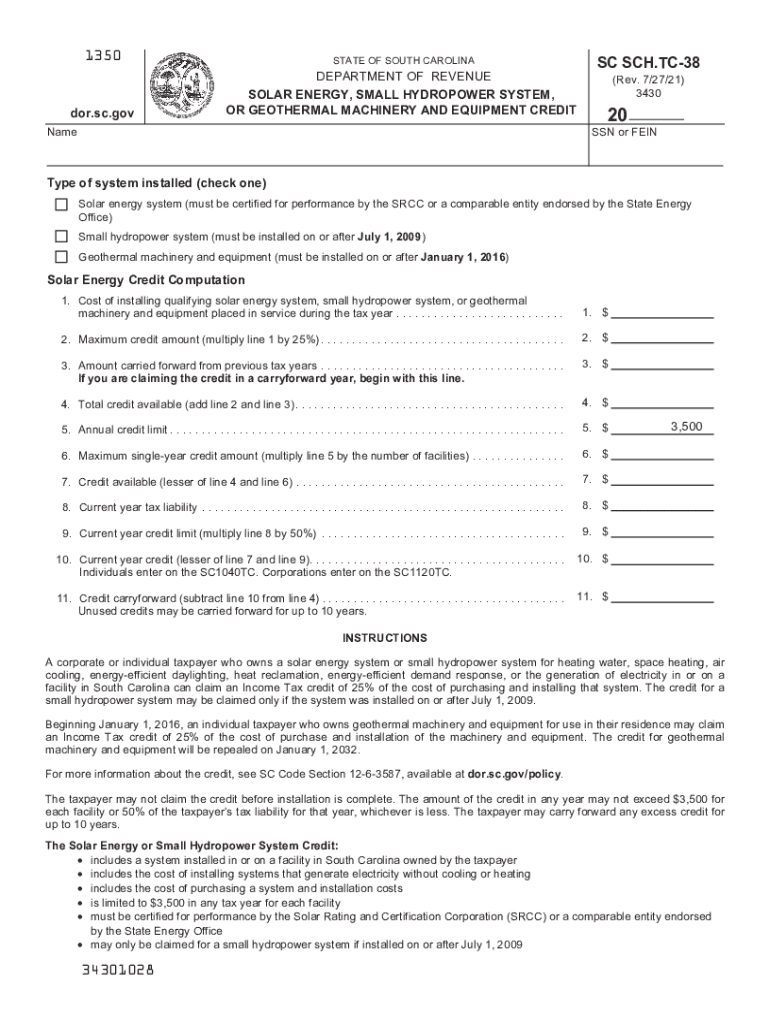
The TC-38 is a tax credit form provided by the South Carolina Department of Revenue, focusing on encouraging investments in renewable energy systems. This tax credit applies to solar energy systems, small hydropower systems, and geothermal machinery and equipment. By understanding the details and nuances of the TC-38, taxpayers can effectively utilize this credit to offset the costs associated with installing qualified energy systems.
Eligibility Criteria for the TC-38
To qualify for the TC-38 tax credit, taxpayers must meet specific eligibility requirements. This includes being a resident or business entity operating within South Carolina and having installed eligible energy systems at their property. The credit allows for 25% of the installation costs to be claimed, with a cap at $3,500 per facility. It's important to ensure that the equipment installed meets the necessary standards and certifications to qualify for the credit.


Required Documentation
Filing for the TC-38 requires specific documentation to support the claim. Taxpayers need to provide invoices or receipts indicating the total installation costs and proof of payment. Additionally, certification documents confirming that the installed systems meet state and federal energy standards must be included. Accurate and thorough documentation ensures a smoother claim process and acceptance by the Department of Revenue.
How to Complete the TC-38 Form
Filing the TC-38 involves several steps, from gathering necessary documentation to accurately completing the form itself. Below is a step-by-step guide to completing the TC-38:
-
Gather all relevant documentation: Prior to filling out the form, collect all invoices, receipts, and certification documents for the installed systems.
-
Complete taxpayer information: Fill in your or your entity's details, including name, address, tax identification number, and contact information.
-
Detail the energy system: Provide specifics about the energy system installed, such as system type, installation date, and certification details.
-
Calculate eligible expenses: Report the total amount spent on installation and calculate the allowable 25% credit, not exceeding the $3,500 limit.
-
Review and submit: Double-check the form for accuracy and completeness before submitting.
State-Specific Rules for TC-38
While the TC-38 is a state-specific credit offered in South Carolina, understanding how state provisions impact its usage is vital. Rules may stipulate qualifying conditions, such as the type of property or the nature of the energy systems installed. Keeping up to date with state guidelines ensures compliance and maximizes the benefit from the program.
Common Use Cases for TC-38
The TC-38 is commonly utilized by homeowners and businesses aiming to reduce their carbon footprint while receiving financial benefits. For instance, a homeowner installing a solar energy system to reduce electricity costs can take advantage of the tax credit to lessen out-of-pocket expenses. Similarly, businesses investing in geothermal systems may benefit from both energy savings and a tax credit.
Legal Considerations of the TC-38
Understanding the legal aspects of the TC-38 ensures taxpayers meet all compliance requirements. This includes ensuring that certifications for installed systems are obtained and maintained. Moreover, it’s critical to adhere to filing deadlines and ensure all submissions are accurate to avoid penalties or disqualification.
Filing Deadlines for the TC-38
Timely filing of the TC-38 is essential. The form must be submitted alongside the state tax return for the year in which the energy system was installed. Keeping track of annual tax filing deadlines ensures that taxpayers do not miss the opportunity to claim the credit.
Penalties for Non-Compliance
Failing to comply with TC-38 requirements can result in denial of the credit or potential penalties. This includes submitting inaccurate information or missing documentation. Taxpayers must ensure all information is documented and submitted correctly to avoid these issues.
By understanding and properly leveraging the TC-38 form, individuals and business entities can benefit from substantial tax savings while contributing to a more sustainable environment.




