







Definition & Meaning
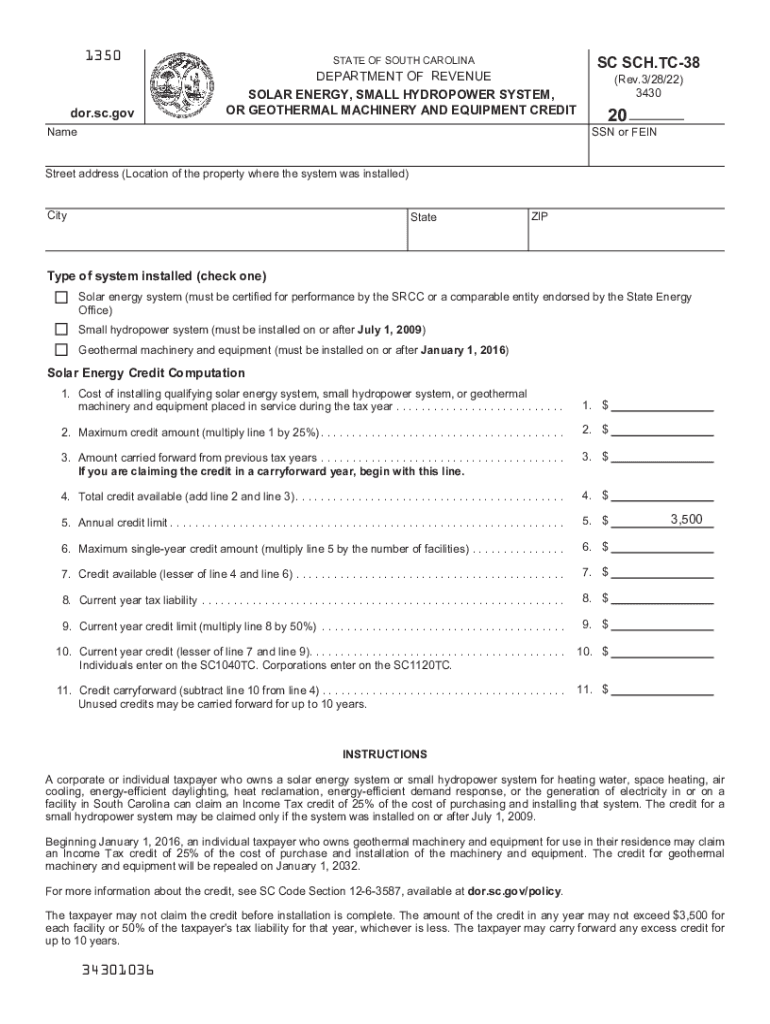
The "SC SC Solar Credit" refers to the South Carolina Solar Energy Systems Credit, a state-level tax incentive designed to promote the installation of solar energy systems. The credit targets individuals and businesses in South Carolina, providing financial assistance by offsetting a portion of the installation costs. This credit aims to encourage the use of renewable energy sources and to reduce dependence on traditional fossil fuels, aligning with environmental sustainability objectives.
Eligibility Criteria
Eligibility for the SC SC Solar Credit is specific to taxpayers who install solar energy systems in South Carolina. To qualify, the solar installation must be within state boundaries, and the system should be intended for use by the taxpayer claiming the credit. The credit covers a range of installations, including solar photovoltaic systems, small hydropower systems, and geothermal machinery. Moreover, only those who can provide proper certification of the eligible system are entitled to claim the credit, which must align with local and state energy standards.


Key Elements of the SC SC Solar Credit
The SC SC Solar Credit comprises several essential components designed to maximize its impact. Key elements include:
- Credit Rate and Limits: The credit equals 25% of the installation costs with a ceiling of $3,500 per facility per tax year.
- Carryforward Options: If the credit exceeds the tax liability, the unused portions can be carried forward to future tax years.
- Certification Requirements: Systems must be certified by recognized energy authorities to verify eligibility.
- Eligible Costs: Include all reasonable expenses associated with the solar system installation.
Steps to Complete the SC SC Solar Credit
Completing the SC SC Solar Credit involves several critical steps:
- Determine Eligibility: Verify if the solar system complies with the state's eligibility criteria.
- Calculate Credit: Compute the credit as 25% of eligible installation costs, ensuring it does not surpass the $3,500 annual limit.
- Collect Documentation: Gather all necessary documents, including system certification and installation receipts.
- File with State Tax: Complete the relevant South Carolina tax form sections to claim the credit, attaching all supporting documentation.
- Submit: Electronically file or mail your tax documents by the deadline to avoid penalties.
Required Documents
- System purchase and installation receipts
- Certification of the eligible system
- Completed tax form sections indicating the credit claim
Application Process & Approval Time
The application process for the SC SC Solar Credit is straightforward but requires strict adherence to guidelines. Taxpayers should fill out the necessary forms, ensuring to detail the specifics of their installation and include any certification statements. The approval process involves state tax authorities reviewing the submitted documentation for accuracy. Typically, once filed, decisions are rendered concurrent with the processing of annual state tax returns, although the exact timeline can vary depending on submission dates and any required follow-ups.
Legal Use of the SC SC Solar Credit
The SC SC Solar Credit must be used legally and in accordance with South Carolina tax laws. Claimants should ensure that their installation meets all local building codes and energy certifications. Improper claims may result in penalties or disqualification from future credits. Moreover, since the credit is aligned with state energy and environmental policies, all installations must address the stipulated legal and regulatory frameworks.
State-Specific Rules for the SC SC Solar Credit
South Carolina has particular regulations governing the SC SC Solar Credit. These rules require that:
- The installation must occur on property owned or leased by the claimant.
- Systems adhere to South Carolina’s building and energy codes.
- Claimants must reside or have a principal business presence within the state.
These state-specific provisions ensure that the credit is used as intended, promoting the state's renewable energy goals.
Examples of Using the SC SC Solar Credit
Several real-world examples illustrate the application of the SC SC Solar Credit. For instance, a South Carolina homeowner installing a 5 kW solar photovoltaic system at the cost of $20,000 would apply the 25% credit rate, resulting in a maximum allowable credit of $3,500, subject to the state’s tax liability limits. Similarly, businesses engaging in large-scale solar installations can offset operational costs, contributing to energy savings and environmental resilience.
Business Entity Types Benefiting from SC SC Solar Credit
Various business structures, such as LLCs, corporations, and partnerships, can benefit from this credit. These entities often leverage the solar credit to improve their sustainability profile and reduce operational energy expenses, thus furthering corporate social responsibility goals. Businesses considering renewable energy investments should consult tax professionals to understand how the SC SC Solar Credit fits into broader fiscal strategies.




