South carolina angel investor credit 2026

Get Form
south carolina angel investor credit Preview on Page 1

Here's how it works

01. Edit your form online
Type text, add images, blackout confidential details, add comments, highlights and more.

02. Sign it in a few clicks
Draw your signature, type it, upload its image, or use your mobile device as a signature pad.

03. Share your form with others
Send it via email, link, or fax. You can also download it, export it or print it out.

How to use or fill out South Carolina Angel Investor Credit with our platform

Form edit decoration
9.5
Ease of Setup
DocHub User Ratings on G2
9.0
Ease of Use
DocHub User Ratings on G2
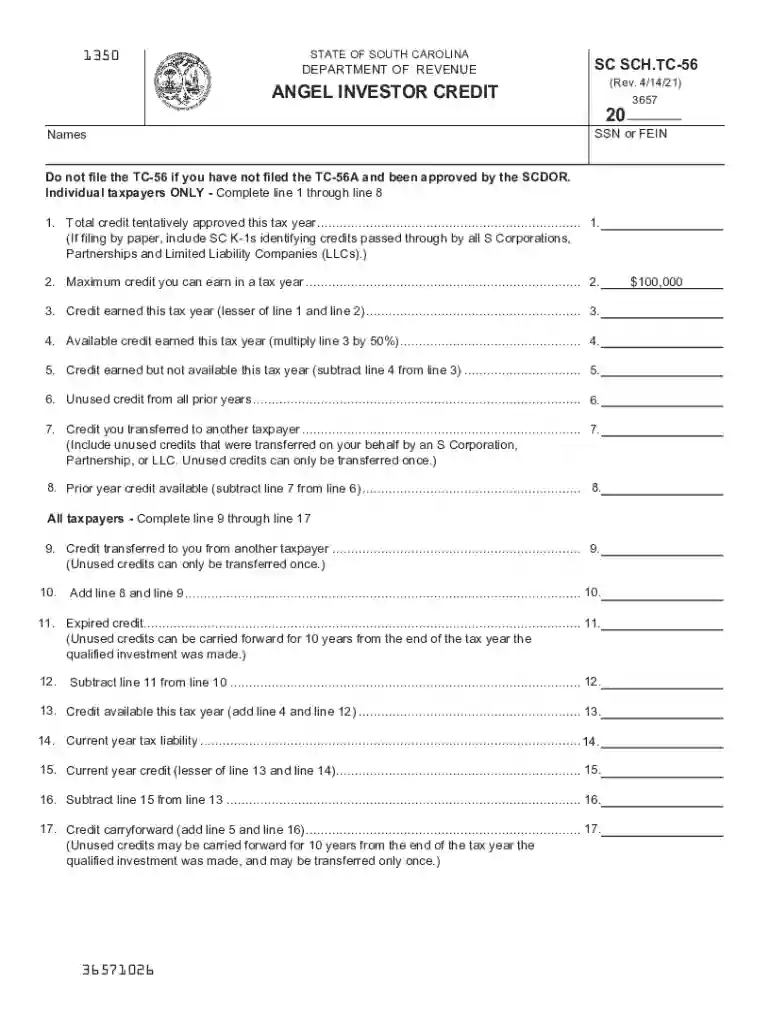
  1. Click ‘Get Form’ to open the South Carolina Angel Investor Credit form in the editor.
  2. Begin by completing lines 1 through 8 if you are an individual taxpayer. Enter the total credit tentatively approved this tax year on line 1, and ensure to include SC K-1s if filing by paper.
  3. On line 2, input the maximum credit you can earn in a tax year, which is $100,000. For line 3, enter the lesser of line 1 and line 2 to determine your credit earned this year.
  4. Multiply the amount from line 3 by 50% for line 4 to find out how much credit can be applied this year. Line 5 will require you to subtract line 4 from line 3 for any unused credits.
  5. For lines 6 through 8, report any unused credits from prior years and calculate your available credits accordingly.
  6. All taxpayers should complete lines 9 through 17. Start with any credits transferred to you on line 9 and follow through with calculations as instructed for each subsequent line.

Start using our platform today to easily fill out your South Carolina Angel Investor Credit form online for free!

See more south carolina angel investor credit versions

We've got more versions of the south carolina angel investor credit form. Select the right south carolina angel investor credit version from the list and start editing it straight away!
Versions Form popularity Fillable & printable
2023 4.4 Satisfied (41 Votes)
2023 4.6 Satisfied (37 Votes)
2022 4.8 Satisfied (48 Votes)
2022 4.8 Satisfied (62 Votes)
2021 4.8 Satisfied (121 Votes)
2021 4.8 Satisfied (145 Votes)
2021 4.8 Satisfied (131 Votes)
2020 4.9 Satisfied (38 Votes)
2019 4.4 Satisfied (215 Votes)
2019 4.4 Satisfied (96 Votes)
2019 4.3 Satisfied (157 Votes)
2019 4 Satisfied (41 Votes)
2019 4.2 Satisfied (24 Votes)
2018 4.8 Satisfied (63 Votes)
be ready to get more

Complete this form in 5 minutes or less

Get form

Got questions?

We have answers to the most popular questions from our customers. If you can't find an answer to your question, please contact us.
Contact us
The Angel Tax Incentive is designed to encourage more angel investments from the private sector into early stage companies in technology space. As such, ATIOs role is to ensure that start-ups seeking investments from accredited angel investors are eligible and that investments made into these companies are genuine.
Making a greater impact throughout South Carolina The U.S. Treasury designed the New Markets Tax Credit Program to increase private sector capital flow to businesses, nonprofits, community facilities, and other important projects in communities lacking investment.
Typically angel investors invest in several different startups hoping that one or two will be successful. The ones that arent successful create capital losses that are tax deductible, and those can be used to offset gains on the companies that are thriving.
An Angel Investor can claim a nonrefundable Income Tax Credit of 35% of qualified investments made in a qualified business between 2013 and 2025.
Angel Investor tax credits are offered to increase the availability and accessibility of venture capital, particularly for ventures at the seed capital investment stage. Businesses must first obtain Qualifying Business certification before investors can apply.

Security and compliance

At DocHub, your data security is our priority. We follow HIPAA, SOC2, GDPR, and other standards, so you can work on your documents with confidence.

Learn more
ccpa2
pci-dss
gdpr-compliance
hipaa
soc-compliance

People also ask

The student must be enrolled in an eligible institution within 12 months of graduating high school. The credit is available for four consecutive years from the date of enrollment, whether the student takes a break or not. A nonresident taxpayer may claim the credit, as long as the qualifying student is a resident.
The Bottomline. To wrap up, the government levies an angel tax on the capital raised by start-ups, specifically on the excess amount raised above the businesss fair market value. An effective rate of 30.9% is applicable to this amount. However, this rate will be abolished in the financial year 2025-26.
Angel investor tax credits are the most common incentives states offer to private investors of startup businesses, though some states have other types of incentives. Angel investor tax credits. Half of U.S. states currently offer angel investor or early stage equity and/or subordinate debt tax credits (Table H-1).

Related links