




01. Edit your form online
Type text, add images, blackout confidential details, add comments, highlights and more.

Type text, add images, blackout confidential details, add comments, highlights and more.

Draw your signature, type it, upload its image, or use your mobile device as a signature pad.

Send it via email, link, or fax. You can also download it, export it or print it out.
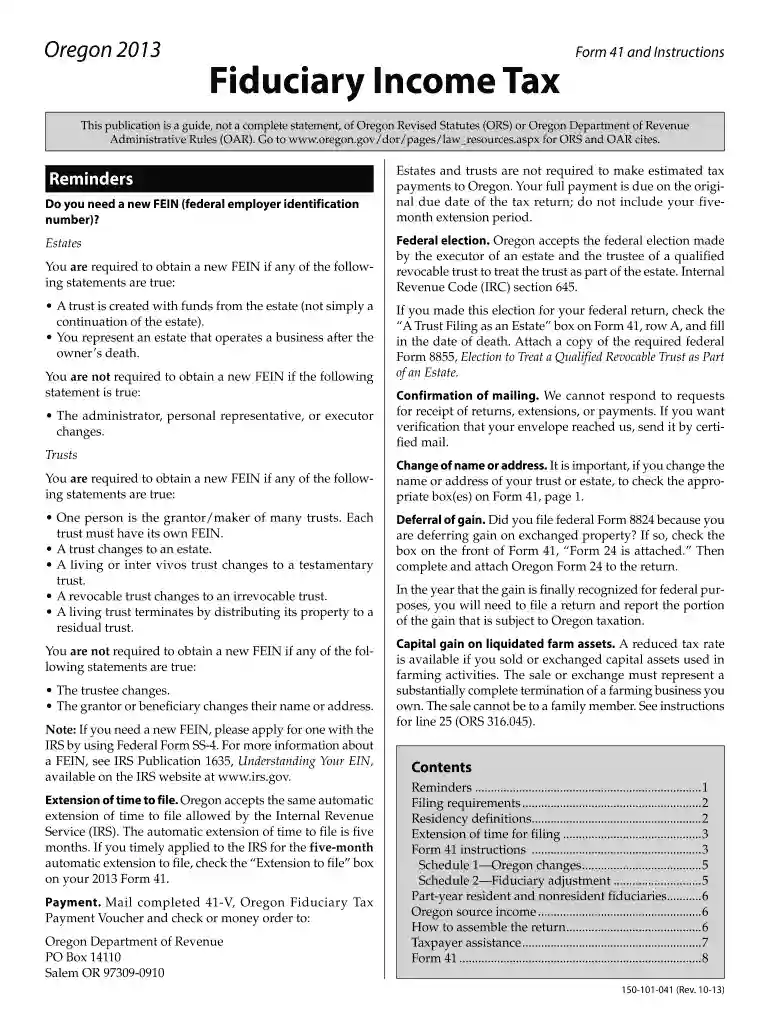
Oregon Form 41 for the year 2013 is a fiduciary income tax return form used specifically for estates and trusts. This form is essential for reporting income, deductions, and other pertinent financial details related to fiduciary interests in the state of Oregon. Its primary purpose is to ensure compliance with state tax regulations by accurately reflecting the financial activities of estates and trusts. Through this form, the state of Oregon can assess the appropriate taxes due based on the financial data provided.
Gather Required Documentation: Before starting, ensure you have all necessary documents, including income statements, deduction records, and any credits related to the fiduciary entity.
Obtain a Federal Employer Identification Number (FEIN): An FEIN is essential for formal identification of the estate or trust. Follow IRS guidelines to secure this number if not already obtained.
Fill Out Income Information:
Document Deductions and Credits:
Calculate Tax Due:
Review for Accuracy and Completeness: Carefully check all sections for errors or omissions that could result in processing delays or penalties.
Submit the Form: File the form with the Oregon Department of Revenue either online, by mail, or in person following submission guidelines.
Filing the Oregon Form 41 for 2013 must adhere to deadlines to avoid penalties. Typically, the deadline matches the federal filing deadline for tax returns, usually April 15 of the following year. Extensions may be granted under specific conditions, but these must be requested proactively to be considered.
Form 41 is used strictly for fiduciary tax reporting in Oregon. It's legally required to ensure accurate and timely payment of taxes by estates and trusts. Failure to comply with filing requirements can result in penalties, interest on overdue taxes, and potential legal ramifications. It's essential to understand the legal responsibilities associated with using this form.
Each part demands precise information and careful attention to detail to ensure proper tax assessment and payment.
Oregon has specific state laws governing fiduciary income tax that may not align with federal regulations. For instance, adjustments to taxable income or specific fiduciary adjustments unique to Oregon should be made as instructed. Understanding these nuances helps prevent errors and ensures compliance with state tax law.
For practical application, consider a trust established to manage financial affairs for a beneficiary. The income generated through investments held under the trust must be reported accurately using Form 41. Deducting expenses related to managing these assets can significantly impact the taxable income, showcasing the form's critical role in fiduciary financial management.
While Oregon Form 41 relates to state taxes, adherence to IRS guidelines for federal reporting is also necessary. Estates and trusts might need to file federal returns, and ensuring consistency between federal and state filings is crucial. This entails using the same FEIN and aligning income and deductions reported on both state and federal forms.
Filing Form 41 requires specific documents, such as:
Ensuring these documents are complete and accurate aids in the smooth processing of the form and minimizes the risk of errors.
Form 41 is exclusively for estates and trusts with financial activities occurring in Oregon. Both revocable and irrevocable trusts are required to file if they meet the income thresholds as stipulated by Oregon tax law. Understanding who is required to file helps in avoiding unnecessary penalties.


Failing to submit Oregon Form 41 or doing so inaccurately can result in significant fines, calculated based on the overdue taxes and duration of delay. Interest on unpaid taxes continues to accrue, thus amplifying the financial impact. Ensuring timely and accurate filing mitigates these risks and promotes fiscal responsibility for fiduciary entities.
We've got more versions of the oregon form 41 2013 form. Select the right oregon form 41 2013 version from the list and start editing it straight away!
| Versions | Form popularity | Fillable & printable |
|---|---|---|
| 2025 | 4.3 Satisfied (39 Votes) | |
| 2024 | 4.1 Satisfied (32 Votes) | |
| 2023 | 4.8 Satisfied (60 Votes) | |
| 2022 | 4.7 Satisfied (58 Votes) | |
| 2021 | 4.9 Satisfied (31 Votes) | |
| 2020 | 4.4 Satisfied (113 Votes) | |
| 2015 | 4.4 Satisfied (186 Votes) | |
| 2014 | 3.9 Satisfied (49 Votes) | |
| 2013 | 4.3 Satisfied (40 Votes) | |
| 2012 | 4 Satisfied (50 Votes) |
At DocHub, your data security is our priority. We follow HIPAA, SOC2, GDPR, and other standards, so you can work on your documents with confidence.
Form OR-41, Oregon Fiduciary Income Tax Return
If a deduction for the other states tax was claimed on Form 1041, it must be added to income on Oregon Form OR-41, Schedule 2, line 47. Received final


