




01. Edit your form online
Type text, add images, blackout confidential details, add comments, highlights and more.

Type text, add images, blackout confidential details, add comments, highlights and more.

Draw your signature, type it, upload its image, or use your mobile device as a signature pad.

Send it via email, link, or fax. You can also download it, export it or print it out.
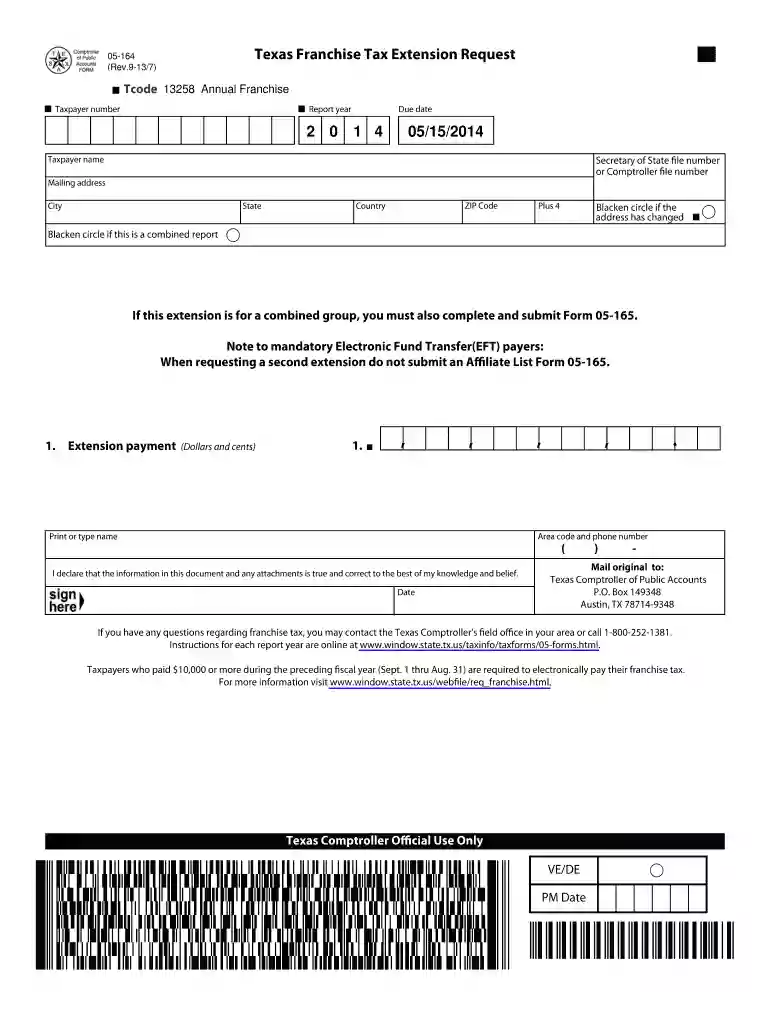
The Texas Franchise Tax Form, often referred to as Form 05-164, is used by businesses operating in Texas to report and pay their franchise tax obligations. The form serves as a mechanism for the Texas Comptroller of Public Accounts to collect revenue from qualifying entities for the privilege of doing business in the state. This tax is based on the entity's margin, and it helps fund state operations.
Businesses can obtain the Texas Franchise Tax Form through several channels, ensuring ease of access:
Completing the Texas Franchise Tax Form involves several key steps to ensure accurate reporting and payment:
The deadline for filing the Texas Franchise Tax Form typically falls on May 15 each year. To accommodate businesses needing additional time, the Texas Comptroller’s office allows for an extension request:
Understanding the structure and elements of the Texas Franchise Tax Form is crucial for accurate completion:
The Texas Franchise Tax Form must be used in compliance with state laws and guidelines:
While the core Texas Franchise Tax Form remains consistent, there are instances where alternative forms or previous versions may be applicable:
Different types of businesses utilize the Texas Franchise Tax Form in various scenarios:
We've got more versions of the tx form franchise 2013 form. Select the right tx form franchise 2013 version from the list and start editing it straight away!
At DocHub, your data security is our priority. We follow HIPAA, SOC2, GDPR, and other standards, so you can work on your documents with confidence.
Tax Franchise Income Tax Fuel. Tax Franchise Income Tax Individual Income Tax Property Tax Form IA 148 Tax Credits. Phone 515-281-3114
Apr 2, 2025 As a pioneer in Power Tools, Outdoor Power Equipment, Floorcare and Cleaning Products, 2024 represents final exercise of residual phantom
Forms for reporting Texas franchise tax use our downloadable .PDF reports, 2013 report year forms and instructions


