




01. Edit your form online
Type text, add images, blackout confidential details, add comments, highlights and more.

Type text, add images, blackout confidential details, add comments, highlights and more.

Draw your signature, type it, upload its image, or use your mobile device as a signature pad.

Send it via email, link, or fax. You can also download it, export it or print it out.
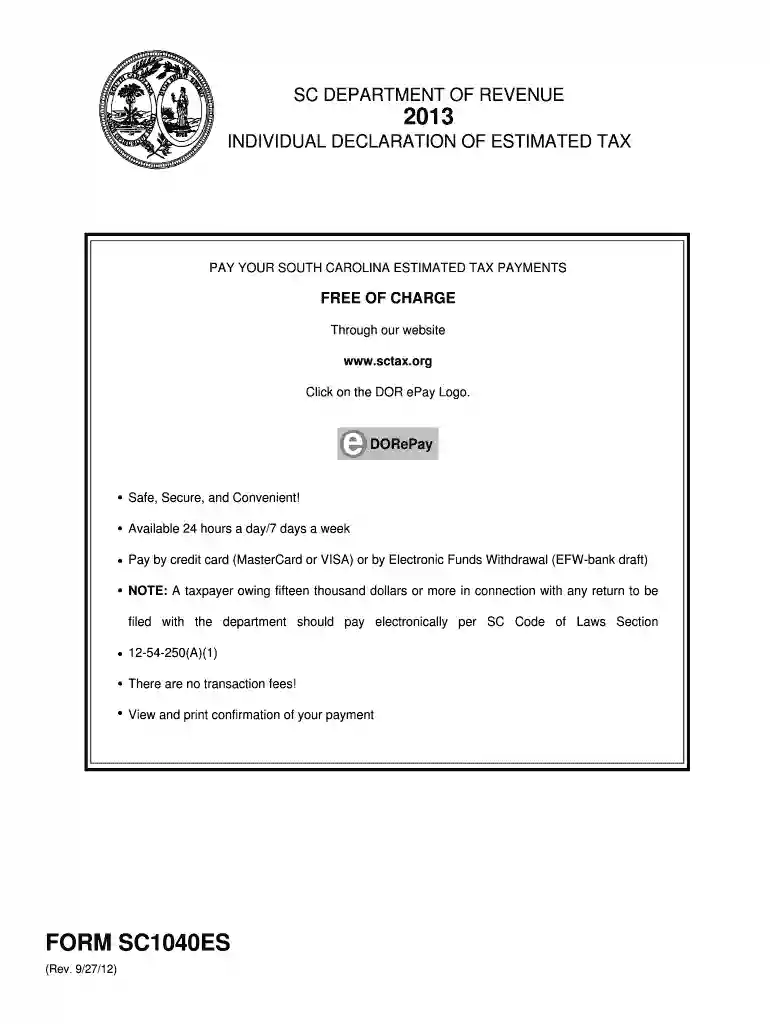
The SC Form Estimated Tax 2013 is a tax declaration document used by individuals in South Carolina to report and pay their estimated taxes for the year 2013. Designed by the South Carolina Department of Revenue, this form is a crucial tool for taxpayers who anticipate owing $100 or more in state taxes. It guides how to compute estimated taxes, outlines payment options, and specifies deadlines. Nonresidents and certain taxpayer groups have distinct rules to follow, reflecting the variety of scenarios in tax compliance.
Using the SC Form Estimated Tax 2013 involves a few structured steps, ensuring accurate filing:
Completing the SC Form Estimated Tax 2013 can be streamlined through careful adherence to guidelines:
Understanding the terms associated with this form is vital:
The SC Form Estimated Tax 2013 outlines critical deadlines:
Failing to comply with the SC Form Estimated Tax 2013 requirements can result in:
This form is primarily used by:
South Carolina imposes unique rules:
Consider scenarios where the form is utilized:
We've got more versions of the sc form estimated tax 2013 form. Select the right sc form estimated tax 2013 version from the list and start editing it straight away!
| Versions | Form popularity | Fillable & printable |
|---|---|---|
| 2025 | 4.1 Satisfied (47 Votes) | |
| 2024 | 4.1 Satisfied (21 Votes) | |
| 2023 | 4.9 Satisfied (28 Votes) | |
| 2022 | 4.8 Satisfied (86 Votes) | |
| 2021 | 4.3 Satisfied (160 Votes) | |
| 2020 | 4.4 Satisfied (199 Votes) | |
| 2019 | 4.2 Satisfied (48 Votes) | |
| 2018 | 4.2 Satisfied (26 Votes) | |
| 2017 | 4.3 Satisfied (121 Votes) | |
| 2016 | 4.4 Satisfied (416 Votes) | |
| 2015 | 4 Satisfied (53 Votes) | |
| 2013 | 4 Satisfied (20 Votes) | |
| 2012 | 4.3 Satisfied (71 Votes) |
At DocHub, your data security is our priority. We follow HIPAA, SOC2, GDPR, and other standards, so you can work on your documents with confidence.
Self-employed people who do not have South Carolina tax withheld from their income must file a Declaration of Estimated Tax for the year.
Find and download forms and publications, Activity Estimated Tax


