




01. Edit your form online
Type text, add images, blackout confidential details, add comments, highlights and more.

Type text, add images, blackout confidential details, add comments, highlights and more.

Draw your signature, type it, upload its image, or use your mobile device as a signature pad.

Send it via email, link, or fax. You can also download it, export it or print it out.
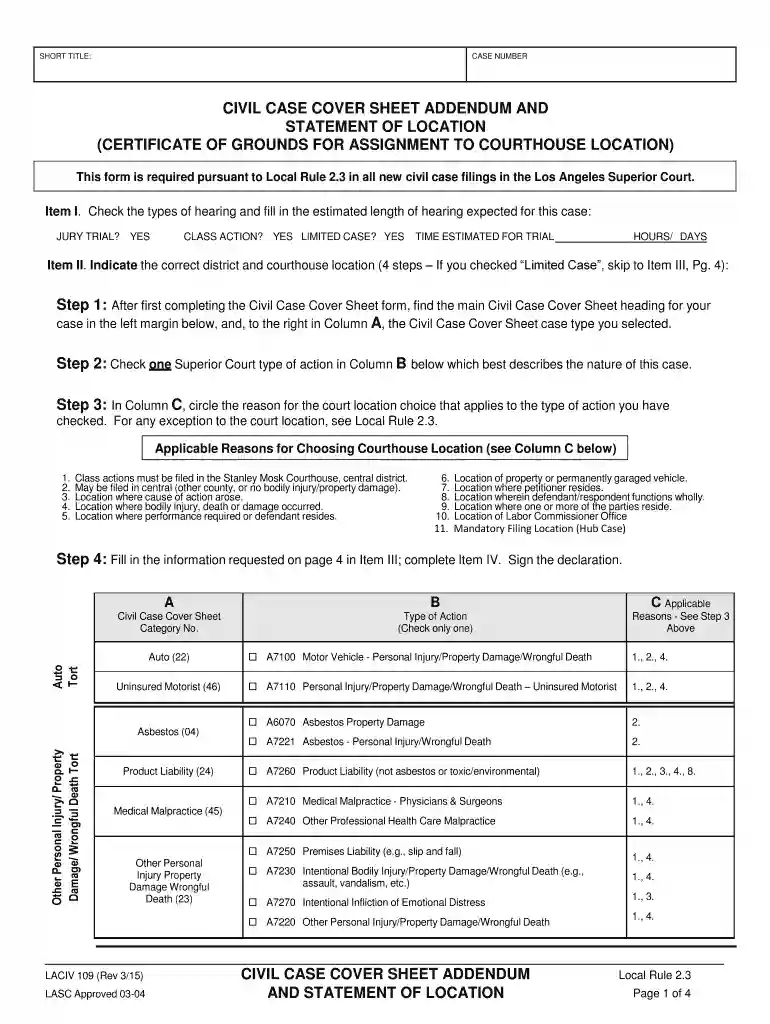
The Statement of Location is a critical document used primarily in legal proceedings to specify the geographical jurisdiction where a legal case is to be filed. Typically, it forms part of the Civil Case Cover Sheet Addendum, especially in civil filings within jurisdictions like the Los Angeles Superior Court. The purpose of this document is to ensure the appropriate courthouse is selected for legal proceedings based on various factors, including the nature of the case and the residence of the involved parties. By accurately designating the case location, it supports judicial efficiency and compliance with legal procedural requirements.
Using the Statement of Location involves several key steps:
The form provides a standardized method of determining the appropriate legal venue, aiding compliance with court requirements and minimizing errors in civil case submissions.
Completing the Statement of Location requires attention to detail:
Accuracy is paramount to prevent jurisdictional challenges and delays in case proceedings.
Understanding the key elements is essential for accurate form completion:
Each section of the form provides clarity and justification for legal venue decisions, reducing ambiguity and potential jurisdictional disputes.
Legally, the Statement of Location ensures that civil cases are filed in appropriate judicial venues. It is a tool for compliance with procedural laws, preventing unnecessary transfers and jurisdictional disputes. Filing in the wrong venue can lead to case dismissals or expensive relocations, thus making the proper use of this statement critical. The legal framework relies heavily on the accuracy and truthfulness of this document to streamline judicial processes and uphold the judiciary's procedural integrity.
While the general framework remains, state-specific rules may dictate nuances in completing the Statement of Location. For instance, California's Los Angeles Superior Court requires adherence to particular guidelines for the Civil Case Cover Sheet Addendum. Differences in rule applications may arise concerning case types eligible for certain venues, or additional documentation required. Familiarity with local court rules and consulting legal counsel can ensure adherence to regional procedural requirements.
Primarily, lawyers and legal professionals preparing civil case filings on behalf of clients utilize this document. It's also relevant for pro se litigants (those representing themselves) in civil proceedings. Understanding who commonly completes and submits this form helps to identify resources that may assist in its proper execution, including legal aid organizations or court clerks.


Practical examples highlight the document's usage:
Such examples demonstrate how the Statement of Location aids strategic legal planning and procedural effectiveness.
Failure to correctly fill out the Statement of Location might result in legal consequences such as:
Understanding these potential penalties underscores the importance of precision and adherence to guidelines when completing this form.
We've got more versions of the STATEMENT OF LOCATION form. Select the right STATEMENT OF LOCATION version from the list and start editing it straight away!
At DocHub, your data security is our priority. We follow HIPAA, SOC2, GDPR, and other standards, so you can work on your documents with confidence.
The single constraint shown above expresses that for each lorry and location, the lorry should visit that location at most once. These kind of expressionsRead more
After June 2003, the Certificate of Title was replaced with the Statement of Ownership and Location (SOL) and that was replaced with the Statement of Ownership.Read more
Application for Statement of Ownership and Location. Texas Department of Housing and Community Affairs (800) 500-7074, (512) 475-2200. Address City State ZIP


