




01. Edit your form online
Type text, add images, blackout confidential details, add comments, highlights and more.

Type text, add images, blackout confidential details, add comments, highlights and more.

Draw your signature, type it, upload its image, or use your mobile device as a signature pad.

Send it via email, link, or fax. You can also download it, export it or print it out.
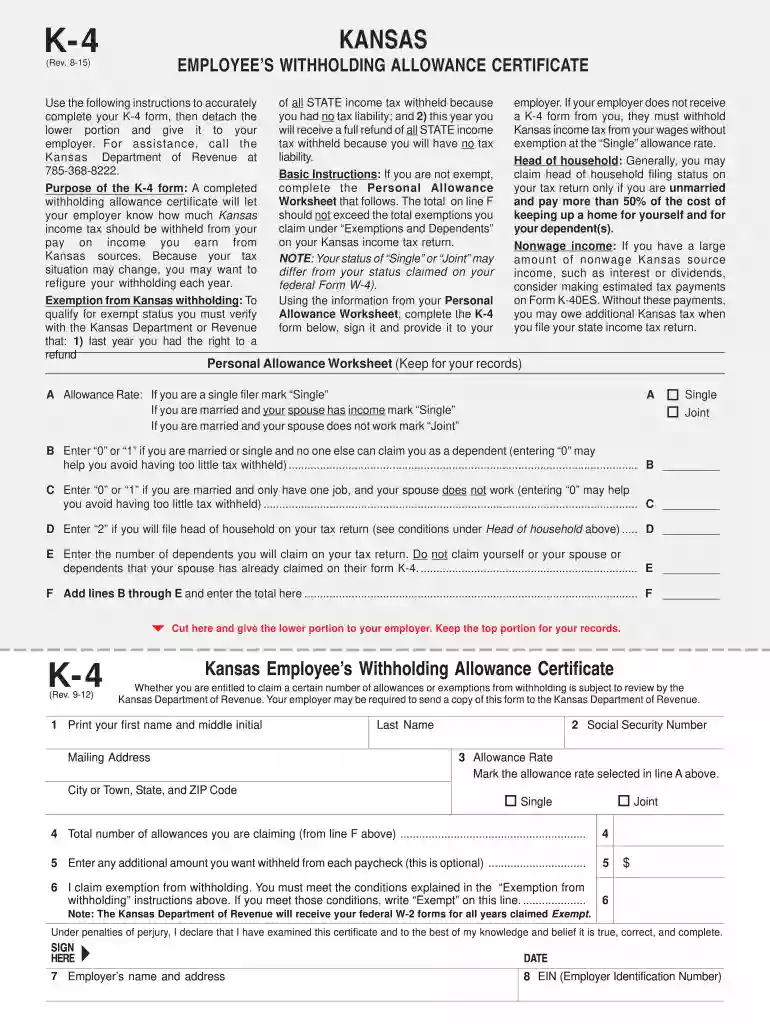
The K-4 form, or Kansas Employee's Withholding Allowance Certificate, is designed for employees within the state of Kansas to specify the amount of income tax to be withheld from their paychecks. Originating for use in 2007, the form remains crucial for individuals aiming to tailor their withholding based on personal and financial circumstances. The primary intent of the K-4 form is to ensure that the correct tax amount is withheld, thus preventing large tax bills or excessive refunds during tax filing season.
To effectively use the K-4 fillable form 2007, employees should begin by reviewing their financial situation, including income sources and potential deductions. Here are the steps to properly fill out the form:
Personal Information: Enter your full name, social security number, and address to ensure accuracy in record-keeping.
Allowance Calculation: Use the accompanying Personal Allowance Worksheet to determine the number of allowances you are eligible to claim based on dependents, additional income, or deductions.
Exemption Requests: Indicate if you are eligible for exemption from withholding, ensuring you meet all necessary criteria.
Final Review: Double-check the information for any errors before submitting it to your employer.
Consider a newly employed graduate who wants to optimize their tax withholding. By accurately completing the K-4 form, they can ensure that their paycheck reflects their current financial status, which could include factors like student loan interest deductions.
Completing the K-4 form requires precise attention to detail and a clear understanding of personal tax obligations. Follow these detailed steps:
Gather Necessary Documents: Collect previous tax returns, pay stubs, and details of any additional incomes.
Understand Allowance Options: Familiarize yourself with what constitutes an allowance and the impact it has on your paycheck.
Complete the Worksheet: Use the Personal Allowance Worksheet provided with the form. It aids in claiming dependents and other exemptions.
Fill Out the Form: Provide all required information accurately to avoid processing delays.
Consult IRS Publications: Review IRS publications for additional guidance on allowances and exemptions.
Understanding the terminology associated with the K-4 form is crucial for correct completion:
The K-4 form is specifically designed for use in Kansas and thus adheres to Kansas state tax rules. It is essential to understand:
Certain elements are crucial to the K-4 form's completion:
Employees should be informed about the timelines for submitting the K-4 form:
Filing the K-4 form inaccurately or failing to file it can result in penalties:
We've got more versions of the K 4 fillable form 2007 form. Select the right K 4 fillable form 2007 version from the list and start editing it straight away!
At DocHub, your data security is our priority. We follow HIPAA, SOC2, GDPR, and other standards, so you can work on your documents with confidence.
Form07.13.23.fillable.pdfhttps://bmb.natsci.msu.edu/assets/files/undergraduate/BMB%20491US23.fillable.pdfhttps:
Employees with Kansas source wages hired after Dec . 31, 2007 are required to complete and submit Kansas Form K-4 to their employer on or before the date ofRead more


