




01. Edit your form online
Type text, add images, blackout confidential details, add comments, highlights and more.

Type text, add images, blackout confidential details, add comments, highlights and more.

Draw your signature, type it, upload its image, or use your mobile device as a signature pad.

Send it via email, link, or fax. You can also download it, export it or print it out.
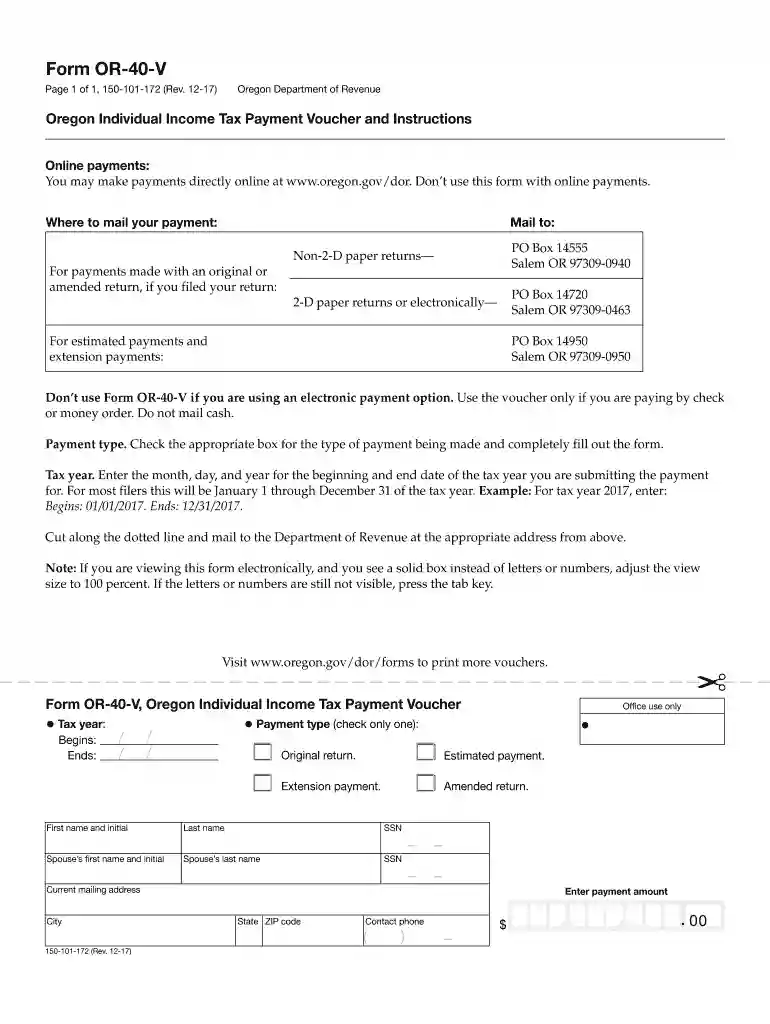
Form OR-40-V, Oregon Individual Income Tax Payment Voucher, is utilized for submitting state tax payments via check or money order. This form ensures that payments are accurately processed by the Oregon Department of Revenue. It's crucial for taxpayers who opt for non-digital payment methods to understand its purpose. The form’s design requires crucial details such as the taxpayer's personal information, the tax year, payment type, and the amount being paid. It is specifically used for remitting payments associated with Oregon state income tax returns, including scenarios where an electronic payment is not feasible.
Gather Required Information: Before beginning, ensure you have your Social Security Number, tax year details, and the specific payment amount ready.
Fill In Personal Information: Enter your full name, Social Security Number, and address accurately. This information ensures that the payment is correctly aligned with your tax records.
Specify Tax Year and Payment Type: Clearly indicate the tax year for which the payment is being made. Select the appropriate payment type — whether it's for estimated tax, an extension payment, or additional payment.
Determine the Payment Amount: Calculate the exact amount you owe. This can include tax due based on your return or any adjustments received from the Oregon Department of Revenue.
Check the Form for Completion: Review the form to ensure all sections are filled out completely and accurately to avoid processing delays.
Include Payment: Attach your check or money order, ensuring it aligns with the specified payment amount. Include your Social Security Number and "Form OR-40-V" on the check/money order for reference.
Mail the Form: Send the completed form and payment to the specified address on the form instructions. Remember, each payment type may have a different mailing address.
Oregon Department of Revenue Website: The form can be downloaded from the official website. This is the most direct and recommended source for obtaining the most current version.
Tax Preparation Software: Some tax software may include printable versions of state forms such as Form OR-40-V. Ensure your software is updated to access the latest forms.
Local Tax Offices: Physical copies may be available at local tax assistance centers or financial institutions that provide tax-related support during the tax season.
Form OR-40-V is legally required for individuals making Oregon state tax payments via non-electronic methods. It must accompany any tax payment, ensuring proper crediting to your tax account. The legal use mandates that the form be accurate and submitted with each relevant payment to avoid potential penalties or delayed processing of your payment.
Oregon has specific guidelines on how state taxes are paid and documented. Taxpayers must be aware that:
General Tax Payment Deadline: Aligns with the federal tax deadline on April 15, unless otherwise designated in the form instructions.
Extension Payment Deadline: If you’re filing for an extension, the payment with Form OR-40-V is due by the original filing date.
Estimated Tax Payments: These are generally due quarterly, following specific dates provided by the Oregon Department of Revenue.
When filling out Form OR-40-V, ensure you have the following:
Failure to submit the payment with Form OR-40-V when needed may result in:
Interest Charges: Applied to any unpaid tax amount, calculated according to Oregon law.
Late Payment Penalties: Assessed if the payment is not postmarked by the due date.
Delay in Processing Refunds or Returns: Delays may occur if the payment is not properly credited to your account due to omissions or errors on the form.
Ensure that payments are submitted timely and accurately to mitigate potential financial consequences.
The Oregon Individual Income Tax Payment Voucher is most commonly used by:
Individual Taxpayers: Those who owe additional state income taxes beyond what was withheld or estimated.
Self-Employed Individuals: Who often make quarterly estimated payments.
Taxpayers Filing Extensions: To cover anticipated taxes owed when they file for an extension of their Oregon tax return.


We've got more versions of the Form OR-40-V - oregon form. Select the right Form OR-40-V - oregon version from the list and start editing it straight away!
At DocHub, your data security is our priority. We follow HIPAA, SOC2, GDPR, and other standards, so you can work on your documents with confidence.


