




01. Edit your form online
Type text, add images, blackout confidential details, add comments, highlights and more.

Type text, add images, blackout confidential details, add comments, highlights and more.

Draw your signature, type it, upload its image, or use your mobile device as a signature pad.

Send it via email, link, or fax. You can also download it, export it or print it out.
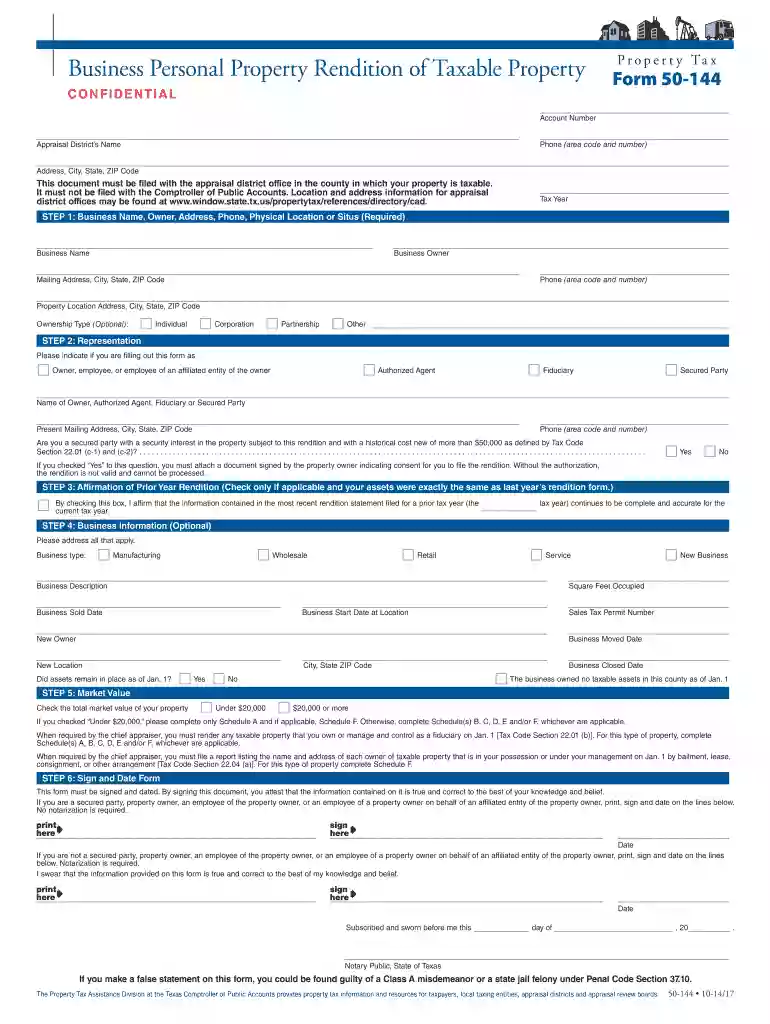
The Texas Form 50-144, primarily known as the Business Personal Property Rendition, is a state-mandated tax document used by businesses to report taxable personal property to the local appraisal district in Texas. This form is essential for ensuring compliance with Texas tax laws and requires detailed reporting of business assets to determine their taxable value. Its purpose is to provide a comprehensive account of a business's personal property, such as equipment, machinery, and supplies, allowing for accurate property tax assessments.
Businesses must follow specific procedures when using the 2014 fillable version of Form 50-144. Here is a step-by-step guide:
Completing the Texas Form 50-144 involves several detailed steps to ensure compliance and accuracy. Here’s how to complete it effectively:
Adhering to the filing deadlines for the Texas Form 50-144 is crucial to avoid penalties. Typically, the deadline for submission falls on April 15 of each tax year. Businesses should verify specific dates with their local appraisal district, as extensions or exceptions may apply under certain conditions.
Failure to file Form 50-144 accurately or on time can result in substantial penalties. These may include financial fines and interest on unpaid taxes, as well as additional charges for willful misreporting or fraudulent declarations. Ensuring timely and truthful submission mitigates the risk of these penalties.
Any business holding taxable personal property within Texas must file Form 50-144. This includes corporations, partnerships, and sole proprietors. Detailed disclosure of all personal business assets is mandatory, ensuring no items are omitted from the report. The requirements are universal under state law, applying to all eligible entities regardless of size or industry.
This form is requisite for a range of business types, including but not limited to:


We've got more versions of the Texas form 50 144 fillable 2014 form. Select the right Texas form 50 144 fillable 2014 version from the list and start editing it straight away!
| Versions | Form popularity | Fillable & printable |
|---|---|---|
| 2025 | 4.2 Satisfied (57 Votes) | |
| 2024 | 4.9 Satisfied (59 Votes) | |
| 2023 | 4.3 Satisfied (54 Votes) | |
| 2022 | 4.3 Satisfied (54 Votes) | |
| 2021 | 4.8 Satisfied (137 Votes) | |
| 2020 | 4.3 Satisfied (229 Votes) | |
| 2019 | 4.2 Satisfied (44 Votes) | |
| 2018 | 4.4 Satisfied (145 Votes) | |
| 2017 | 4.1 Satisfied (74 Votes) | |
| 2016 | 4.2 Satisfied (42 Votes) | |
| 2015 | 4.2 Satisfied (44 Votes) | |
| 2014 | 4.3 Satisfied (60 Votes) | |
| 2011 | 4 Satisfied (56 Votes) | |
| 2007 | 4 Satisfied (52 Votes) |
At DocHub, your data security is our priority. We follow HIPAA, SOC2, GDPR, and other standards, so you can work on your documents with confidence.
If you fail to furnish your correct TIN to a requester, you are subject to a penalty of $50 for each such failure unless your failure is due to reasonableRead more
The first three options, 75/25, 50/50 and 30/70, allow the radio to operate in a fixed ratio on every frame. In other words, this ratio represents the.Read more
Use this form to render tangible personal property used for income production that you own or manage and control as a fiduciary on Jan. 1 of this year


