




01. Edit your form 14653 online
Type text, add images, blackout confidential details, add comments, highlights and more.

Type text, add images, blackout confidential details, add comments, highlights and more.

Draw your signature, type it, upload its image, or use your mobile device as a signature pad.

Send form 14654 via email, link, or fax. You can also download it, export it or print it out.
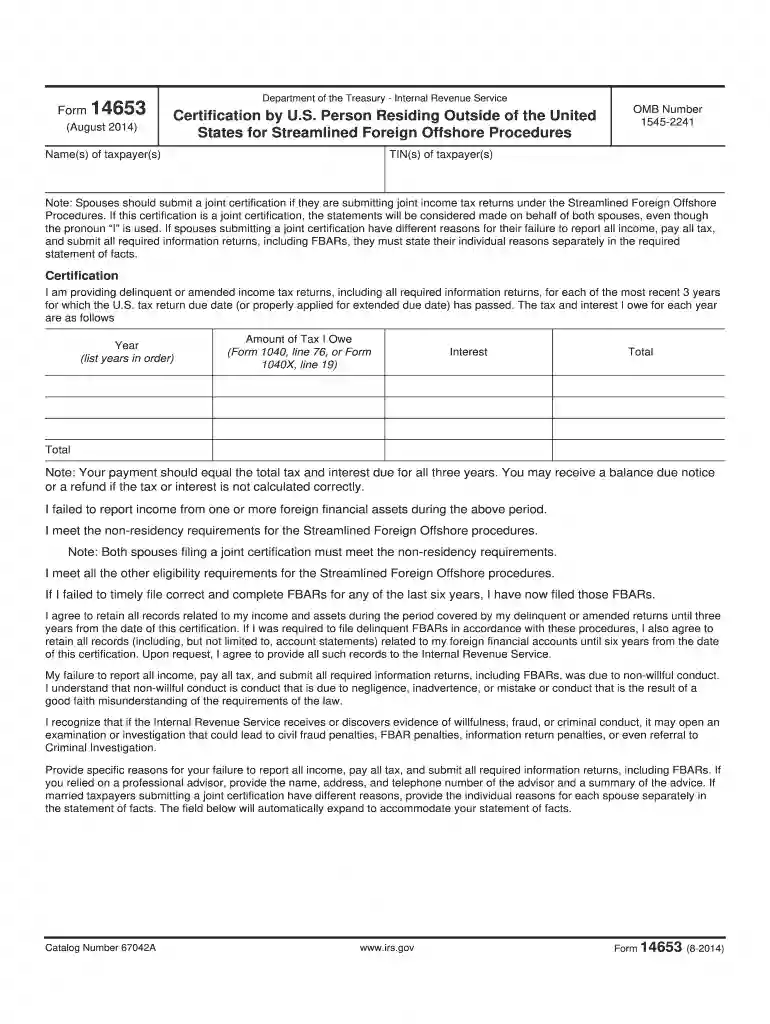
Form 14653, officially known as the "Certification by U.S. Person Residing Outside of the United States for Streamlined Foreign Offshore Procedures," is used by taxpayers to address specific tax reporting obligations. This form is part of a streamlined procedure intended to help U.S. persons residing abroad rectify their tax compliance concerning offshore accounts. It involves providing previously unreported income from foreign financial assets and certifying non-willful conduct in failing to report this income.
Acquiring Form 14653 is a straightforward process. The form is available for download directly from the IRS website. Taxpayers can access it under the forms and publications section by entering the form number in the search bar. Additionally, those using professional tax filing software might have access to the form within their software suite.
To accurately complete Form 14653, follow these detailed steps:
Form 14653 is mainly used by U.S. persons living outside the United States who need to address previous omissions in reporting foreign financial assets or income. Common users include expatriates, dual citizens, and accidental Americans who may not have been fully aware of their U.S. tax obligations.
The IRS provides specific guidelines to ensure accurate completion of Form 14653:
Understanding terminology associated with Form 14653 enhances comprehension and ensures accuracy:
While there are no specific deadlines for filing Form 14653, timing is critical:
Failing to adhere to Form 14653 requirements can lead to significant penalties:
It is important to approach Form 14653 with diligence and accuracy, considering professional advice where necessary to mitigate risks and ensure proper compliance with U.S. tax laws applicable to foreign financial interests.
We've got more versions of the form 14653 form. Select the right form 14653 version from the list and start editing it straight away!
At DocHub, your data security is our priority. We follow HIPAA, SOC2, GDPR, and other standards, so you can work on your documents with confidence.
Complete and sign Form 14653, Certification by U.S. Person Residing Outside of the United States for. Streamlined Foreign Offshore Procedures (shown later). Read more
This will enhance CDCs capabilities in detecting and tracking foodborne illness and help restore state and local capacity to monitor foodborne illness and.Read more
Complete and sign a statement on the Certification by U.S. Person Residing Outside of the U.S. (Form 14653) PDF DocHubing (1) that you are eligible for theRead more


