




01. Edit your form online
Type text, add images, blackout confidential details, add comments, highlights and more.

Type text, add images, blackout confidential details, add comments, highlights and more.

Draw your signature, type it, upload its image, or use your mobile device as a signature pad.

Send it via email, link, or fax. You can also download it, export it or print it out.
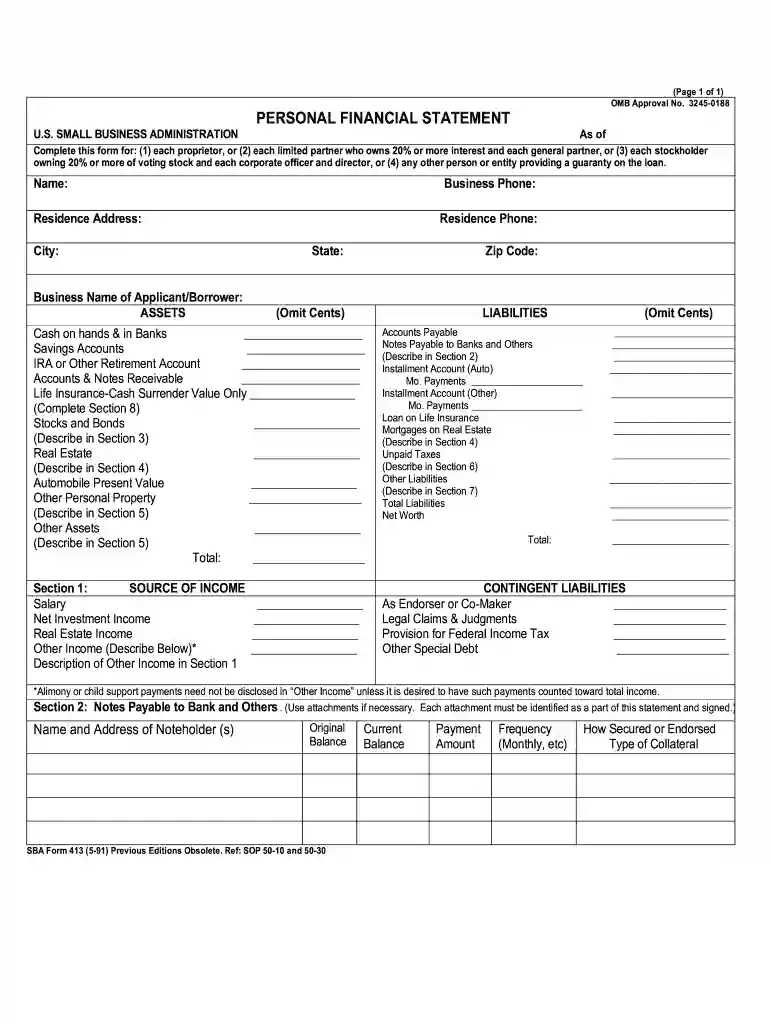
The OMB Approval No 3 Personal Financial Statement is an essential document used by the U.S. Small Business Administration (SBA) to evaluate the financial status and creditworthiness of individuals involved in a business seeking a loan. It provides a detailed overview of the assets, liabilities, income sources, and contingent liabilities of the applicants or guarantors. By gathering this information, the SBA aims to assess whether the business and its associated individuals have the financial capacity and stability required for loan approval. This form is a critical step in the lending process, ensuring that both the lender and borrower understand the financial obligations and risks involved.
Effectively using the OMB Approval No 3 requires understanding its purpose and completing it accurately. Here's a step-by-step guide:
Gather Information: Collect all financial documents such as bank statements, investment portfolios, loan information, and other assets.
Fill Section I - Assets and Liabilities: Record all personal assets and liabilities, including cash, real estate, investments, and debts.
Fill Section II - Income and Expenses: Include all sources of income, such as salaries, rental incomes, and other earnings, and detail regular expenses.
Sign and Date: Ensure all information is correct, sign, and date the form before submission.
Review and Submit: Double-check for accuracy and completeness. Submit the form to the requesting financial institution or SBA office.
This structured approach ensures that all necessary information is provided, which is vital for the accurate assessment of financial health.
To access the OMB Approval No 3 Personal Financial Statement, you can follow these steps:
Completing this financial statement requires attention to detail. Follow this procedure:
Read Instructions Carefully: Start by understanding the form's requirements and fields.
Fill Out Identifying Information: Provide personal and business names, addresses, and contact details accurately to avoid processing delays.
Inventory Financial Data: Enter assets like real estate, vehicles, and business equity in designated sections.
Liabilities Assessment: Record all debts, credits, and liabilities, including mortgages and credit cards.
Review and Correct: Check for clerical errors, miscalculations, or omissions before submission.
Critical components of the form include:
Each section is designed to provide a comprehensive view of an individual's financial situation.
Understanding the legal implications of this form is crucial for compliance and accuracy:
Some essential terms to understand include:
These terms help clarify the financial conditions and obligations documented within the form.
This form is commonly used by:
Understanding who uses this form helps align its completion with appropriate financial strategies and requests.


Real-world scenarios illustrating the form's use:
These examples highlight the form's importance in various financial and business contexts.
We've got more versions of the OMB Approval No 3245-0188 PERSONAL FINANCIAL STATEMENT form. Select the right OMB Approval No 3245-0188 PERSONAL FINANCIAL STATEMENT version from the list and start editing it straight away!
| Versions | Form popularity | Fillable & printable |
|---|---|---|
| 2024 | 4.8 Satisfied (26 Votes) | |
| 2021 | 4.8 Satisfied (140 Votes) | |
| 2018 | 4.3 Satisfied (105 Votes) | |
| 2014 | 4.4 Satisfied (540 Votes) | |
| 2012 | 4.3 Satisfied (105 Votes) | |
| 2011 | 4.3 Satisfied (35 Votes) | |
| 2008 | 4.4 Satisfied (71 Votes) | |
| 2005 | 4 Satisfied (36 Votes) | |
| 2000 | 4 Satisfied (42 Votes) | |
| 1994 | 4.4 Satisfied (70 Votes) | |
| 1991 | 4.4 Satisfied (31 Votes) |
At DocHub, your data security is our priority. We follow HIPAA, SOC2, GDPR, and other standards, so you can work on your documents with confidence.
OMB APPROVAL NO. 3245-0188. Complete this form for: (1) each proprietor, or (2) each limited partner who owns 20% or more interest and each general partner,
Feb 13, 2025 This form is used to assess repayment ability and creditworthiness of applicants. OMB Control Number: 3245-0188


