




01. Edit your personal financial statement online
Type text, add images, blackout confidential details, add comments, highlights and more.

Type text, add images, blackout confidential details, add comments, highlights and more.

Draw your signature, type it, upload its image, or use your mobile device as a signature pad.

Send personal financial statement template via email, link, or fax. You can also download it, export it or print it out.
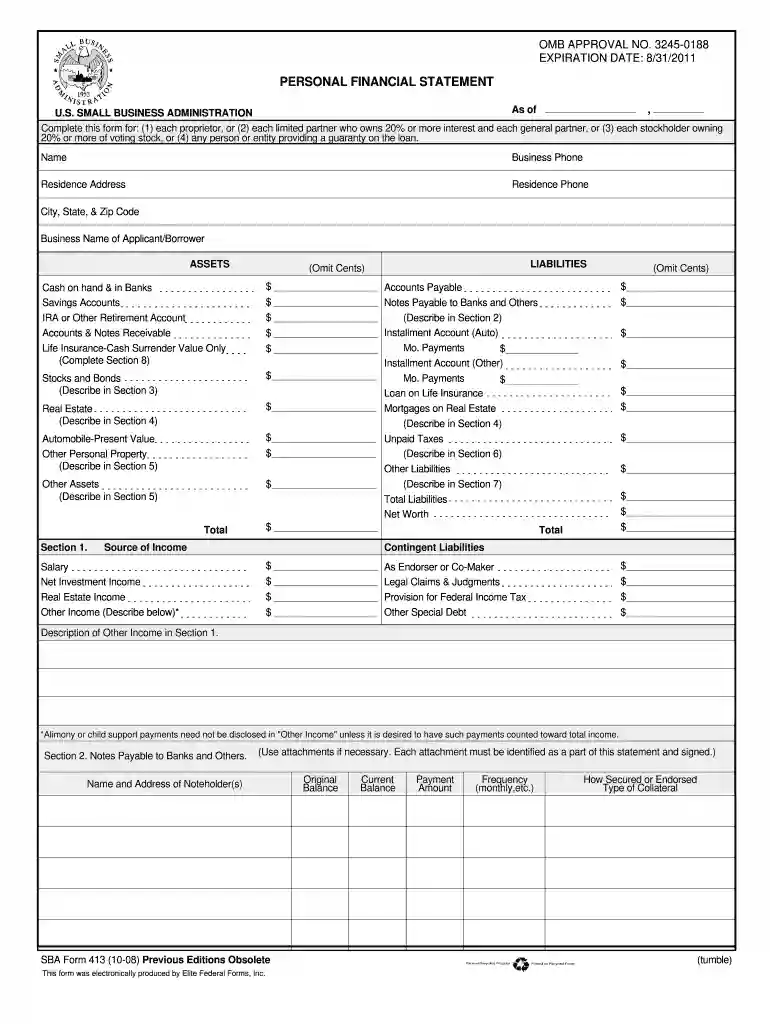
A personal financial statement (PFS) is a formal document used to summarize an individual's financial standing at a specific point in time. The "personal financial statement template 2008 form" serves as an organized format for individuals to report their assets, liabilities, income, and expenses. This template is critical for personal or business loan applications as it provides lenders with a comprehensive view of a borrower's financial health and creditworthiness.
Key components of a personal financial statement include:
The 2008 form is particularly recognized for personal financial assessments, providing a structured approach necessary for applicants engaging in financial transactions, especially when seeking loans.
Understanding the components of the personal financial statement template 2008 form is essential for accurately filling it out. Each section plays a role in providing a comprehensive picture of one’s financial health.
Personal Details: This includes your name, address, contact information, and social security number, which helps identify the individual submitting the statement.
Asset Details: A thorough breakdown of various asset types is vital. Common assets typically reported include:
Liabilities Section: Lenders analyze the liabilities section to evaluate financial risk. Include:
Income Information: This section should reflect total monthly income from all sources, allowing lenders to assess financial inflows against obligations.
Net Worth Calculation: It’s critical to compute and disclose net worth accurately, as it significantly impacts lending decisions.
Familiarity with terminologies associated with the personal financial statement template enhances comprehension and completion of the form.
Understanding these terms helps in accurately reporting financial status, making the document more useful for both the applicant and the lender.
Completing the personal financial statement template involves several sequential actions to ensure accuracy and completeness.
Following these steps will yield a comprehensive personal financial statement, instilling confidence in lenders regarding your financial status when applying for loans or managing personal finance.
Understanding practical applications of the personal financial statement template is crucial for potential users. Here are several examples indicating how the form is typically utilized:
Loan Applications: Individuals seeking mortgages or personal loans provide a personal financial statement to demonstrate their financial position and repayment capability.
Business Financing: Entrepreneurs may use the form to attract investors or secure business loans, showcasing personal investment in the business alongside business finances for a comprehensive view.
Financial Planning: Individuals can use the personal financial statement for personal finance assessment, helping to identify areas for improvement in spending or saving.
Estate Planning: The form becomes a relevant tool for individuals organizing their estate, particularly when evaluating worth and preparing for inheritance considerations.
Divorce Proceedings: In legal matters such as divorces, the form may be necessary to assess shared liabilities and assets, aiding in fair distribution decisions.
These examples illustrate how the personal financial statement serves various purposes, making it a vital document not only for loans but also for broader financial assessments and strategies.
We've got more versions of the personal financial statement form. Select the right personal financial statement version from the list and start editing it straight away!
| Versions | Form popularity | Fillable & printable |
|---|---|---|
| 2024 | 4.8 Satisfied (26 Votes) | |
| 2021 | 4.8 Satisfied (140 Votes) | |
| 2018 | 4.3 Satisfied (105 Votes) | |
| 2014 | 4.4 Satisfied (540 Votes) | |
| 2012 | 4.3 Satisfied (105 Votes) | |
| 2011 | 4.3 Satisfied (35 Votes) | |
| 2008 | 4.4 Satisfied (71 Votes) | |
| 2005 | 4 Satisfied (36 Votes) | |
| 2000 | 4 Satisfied (42 Votes) | |
| 1994 | 4.4 Satisfied (70 Votes) | |
| 1991 | 4.4 Satisfied (31 Votes) |
With DocHub, it’s quite simple. The editor offers users an add-on called DocHub for Gmail, which you can find in the Google Workspace Marketplace without being charged. Install it and grant it access to your Google account. Open your email with your pfs form template attached and click on the add-on button in the right-side panel. Log in to your DocHub account, and import the form to our editor, where you can complete it and sign.
If you store your paperwork in Google Drive, there is no need to download your personal financial statement template pdf on the computer and upload it back to our editor. A much simpler way is to set up a browser extension created by DocHub to simplify this flow. The extension allows editing PDFs right in your web browser. Alternatively, you can integrate your DocHub and Gmail accounts for more efficient modifying.
At DocHub, your data security is our priority. We follow HIPAA, SOC2, GDPR, and other standards, so you can work on your documents with confidence.





Summary information relating to income, expenditures, assets and liabilities on the main ICAO Funds and the combined total of all. Funds are shown in StatementsRead more
Complete this form for: (1) each proprietor, or (2) each limited partner who owns 20% or more interest and each general partner, or (3) each stockholder owning.Read more


