




01. Edit your form online
Type text, add images, blackout confidential details, add comments, highlights and more.

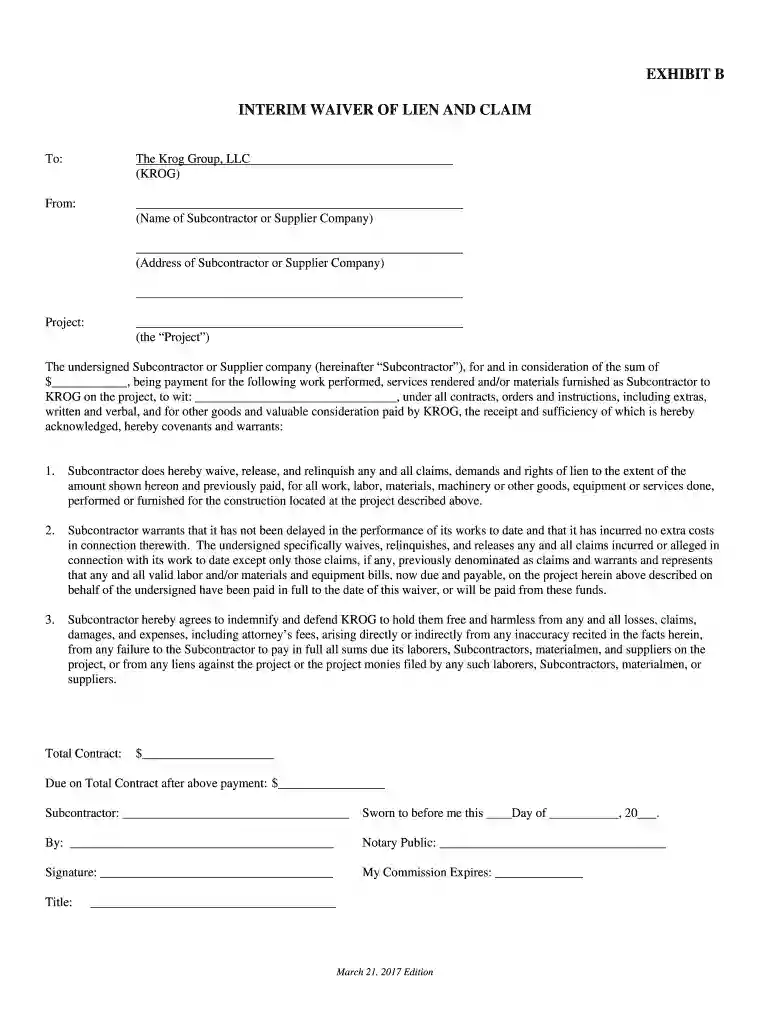
Type text, add images, blackout confidential details, add comments, highlights and more.

Draw your signature, type it, upload its image, or use your mobile device as a signature pad.

Send it via email, link, or fax. You can also download it, export it or print it out.
The "Interim Waiver of Lien and Claim" is a legal document used primarily in the construction industry. It acts as a temporary relinquishment of lien rights by a subcontractor or supplier in favor of a contractor, like The Krog Group, LLC. By signing this document, the subcontractor acknowledges the receipt of payment for services rendered or materials provided up to a specified date and waives any lien or claim against the property involved in the project. This waiver ensures that no financial or legal claims will be made for the period covered by the waiver, thus protecting the property owner and contractor from potential legal disputes over outstanding payments for that specific time frame.
Using the "Interim Waiver of Lien and Claim" requires careful attention to detail to ensure all parties' rights and obligations are clearly defined and protected.
Identify the Parties: Clearly list the names and contact information of all parties involved, including the subcontractor, contractor, and property owner.
Specify the Project and Payment Details: Include detailed descriptions of the project, work performed, and the payment amount received. Reference specific invoices or payment records to avoid ambiguity.
Accurately Date the Document: Indicate the effective date of the waiver. This specifies the time period the waiver covers regarding payment and work performed.
Signatures: Ensure all required signatures are provided, including those of authorized representatives from each party involved. This underscores the legal enforceability of the waiver.
Completing the "Interim Waiver of Lien and Claim" involves several crucial steps to ensure its validity.
Gather Necessary Information: Compile all relevant details about the project, including work completed and payments made up to the waiver date.
Fill Out the Waiver Form: Input all required information carefully, including project identification, payment details, and the parties' details.
Review the Document: Check the document for accuracy and completeness, ensuring all information accurately reflects the agreement between parties.
Sign and Date: Obtain necessary signatures from all parties. All signatories should date the document, confirming their acknowledgment of its terms.
Distribute Copies: Ensure all parties receive a copy of the signed document, maintaining transparency and a clear record of the transaction.
This document is predominantly used in the construction industry, involving various stakeholders such as:
By using this waiver, these parties protect their interests and facilitate smooth project operations without legal entanglements over payment disputes.


The following are essential components of the "Interim Waiver of Lien and Claim":
The "Interim Waiver of Lien and Claim" serves several legal purposes:
Lien laws vary by state, and specific requirements may influence how the "Interim Waiver of Lien and Claim" is used:
Consider a construction scenario where multiple subcontractors work simultaneously:
Familiarize with key terminology to fully comprehend the implications of an interim waiver:
Each term plays a pivotal role in understanding the scope and application of the waiver within construction agreements.
At DocHub, your data security is our priority. We follow HIPAA, SOC2, GDPR, and other standards, so you can work on your documents with confidence.
Use this form when the claimant is required to sign a waiver and release in exchange for, or in order to, induce a final payment, and the claimant has not yetRead more
The undersigned further agrees to defend, indemnify and hold harmless the Owner for any losses or expenses. (including without limitation reasonable attorneysRead more


