




01. Edit your form online
Type text, add images, blackout confidential details, add comments, highlights and more.

Type text, add images, blackout confidential details, add comments, highlights and more.

Draw your signature, type it, upload its image, or use your mobile device as a signature pad.

Send it via email, link, or fax. You can also download it, export it or print it out.
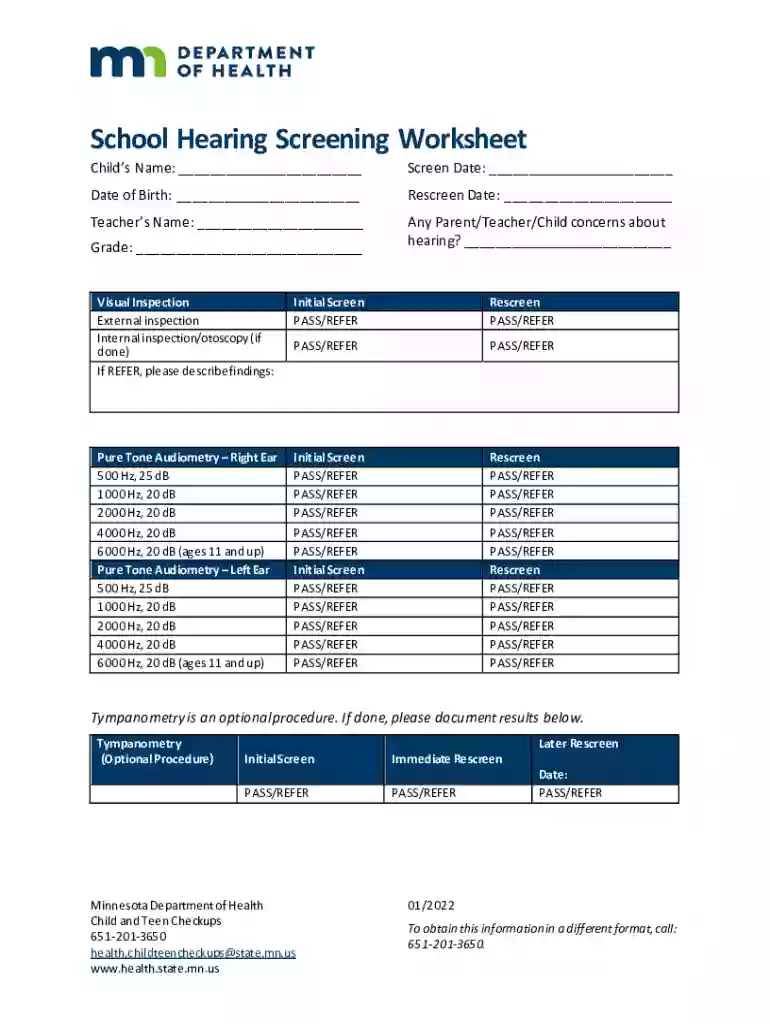
A School Hearing Screening Worksheet is a specialized document used to evaluate and record the hearing capabilities of children in educational settings. This tool is essential for schools to identify students with potential hearing issues that might affect their learning and communication skills. The worksheet includes fields for personal information, hearing test results, and possible follow-up actions, making it a comprehensive tool for ensuring that students' auditory health needs are adequately addressed.
The worksheet is designed for straightforward use by educators and healthcare professionals involved in student health assessments. Here’s a step-by-step process to effectively utilize the worksheet:
Personal Information Collection: Begin by entering the child's personal details, such as name, age, and grade level, which ensure accurate and organized records.
Conducting Hearing Tests: Use the worksheet's sections for recording results from initial pure tone audiometry screenings and rescreens if needed. This helps in monitoring any changes or abnormalities in a child’s hearing over time.
Visual Inspections and Tympanometry: Fill in the optional sections for external ear inspections and tympanometry if these tests are conducted. This additional information can assist in diagnosing more complex hearing issues.
Recording Follow-Up Actions: Mark any recommended follow-up actions or referrals that are necessary based on the screening results. This ensures that children with identified issues receive further evaluation and intervention promptly.
The worksheet is a crucial part of a larger hearing health management strategy within schools, streamlining the monitoring and follow-up of students' auditory health.
Accessing the worksheet is typically straightforward, provided by various educational and healthcare sources:
School Districts: Many local school districts supply these worksheets as part of their standard health screening materials.
State Health Departments: Some states offer downloadable versions of the worksheet via their official health department websites, ensuring standardization and consistency in screening processes.
Educational and Health Organizations: Non-profit and educational organizations focused on child health also distribute these worksheets, often with supplemental resources and guidelines for effective use.
Having these worksheets readily available ensures that professionals can perform screenings efficiently, without delay or the need for unnecessary paperwork generation.
When completing the worksheet, accuracy and attention to detail are paramount:
Acquiring Accurate Equipment: Ensure all audiometric equipment is calibrated and functioning correctly before commencing the screening.
Quiet Environment: Perform screenings in a quiet room, free from auditory distractions, to ensure reliable results.
Detailed Record Keeping: Meticulously fill in each section of the worksheet, paying particular attention to threshold levels recorded during audiometry.
Parent/Guardian Communication: After completing the worksheet, share results with parents or guardians, including recommendations for any necessary follow-up actions.
By systematically following these steps, professionals can maximize the effectiveness of the screenings, ensuring precise documentation and valuable insights into each student's auditory health.
Several crucial elements must be included for the worksheet to be effective:
Personal Information Section: Captures the student’s identifying details, critical for follow-up and record-keeping.
Audiometry Results: This section is dedicated to recording the outcomes of initial and, if required, follow-up screenings, tracking pure tone responses for both ears.
Additional Tests: Space for optional test results, such as visual ear inspections and tympanometry, allows for a comprehensive hearing assessment.
Action Plan: Details any necessary follow-up interventions or specialist referrals based on screening results to address potential hearing issues proactively.
Incorporating these elements ensures that the worksheet serves as a thorough record and action guide throughout the hearing screening process.
This worksheet is an invaluable tool for several professional groups:
School Nurses: Primarily responsible for administering the screenings and documenting results.
Hearing Specialists and Audiologists: Use the completed worksheets to analyze results and determine further examination needs.
Educators and School Administrators: Although they do not conduct screenings, they use the information for planning educational support and accommodations for students with hearing difficulties.
This range of users ensures a holistic approach to hearing care within the educational system, promoting the well-being and success of students.


Each state may have specific guidelines and legal requirements regarding hearing screenings in schools:
Mandatory Screening Ages: Some states mandate screenings at certain ages or grade levels to ensure early detection of hearing issues.
Data Reporting: Regulations may require schools to report aggregated screening data to state health departments, assisting in public health monitoring and resource allocation.
Understanding these state-specific nuances ensures compliance and enhances the quality of hearing health services provided to students.
Consider these real-world scenarios where the worksheet is instrumental:
Early Detection: During a routine screening, a student shows signs of hearing loss in one ear, prompting further audiological evaluation that leads to early intervention and improved communication skills.
Tracking Improvements: Over successive screenings, a student initially diagnosed with mild hearing loss demonstrates improvement following medical treatment, effectively documented using the worksheet.
These examples highlight the worksheet’s role in facilitating effective hearing healthcare within schools, leading to better educational outcomes and quality of life for students.
We've got more versions of the School Hearing Screening Worksheet form. Select the right School Hearing Screening Worksheet version from the list and start editing it straight away!
At DocHub, your data security is our priority. We follow HIPAA, SOC2, GDPR, and other standards, so you can work on your documents with confidence.
downloadable curriculum guides and activity worksheets. creating, testing, evaluating, and revising lesson plans and educational materials.
The requirements for hearing screening [PDF 584KB] apply each year for children enrolled in any licensed child care center, licensed child care home, or schoolRead more


