



01. Edit your 2118ea online
Type text, add images, blackout confidential details, add comments, highlights and more.

Type text, add images, blackout confidential details, add comments, highlights and more.

Draw your signature, type it, upload its image, or use your mobile device as a signature pad.

Send 2118 ea via email, link, or fax. You can also download it, export it or print it out.
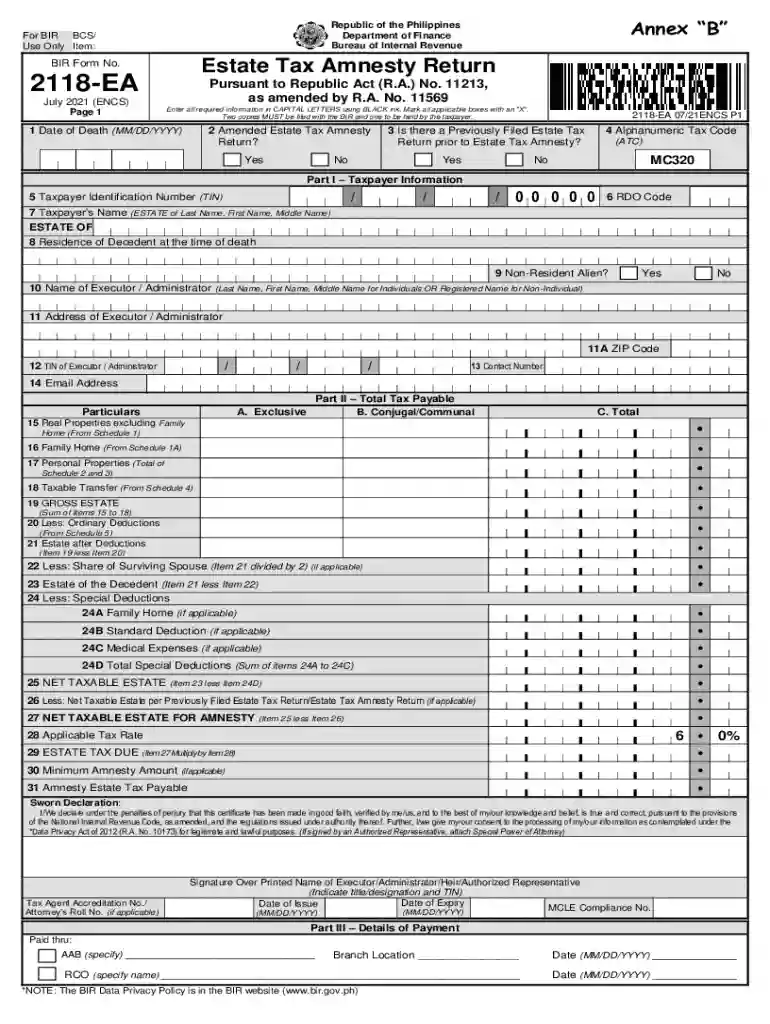
The "assets kpmgcontentdamRepublic of the Philippines For BIR BCS Use Only Estate Tax" refers to a specific form utilized by individuals or entities in the Philippines to report and settle estate taxes. This process is part of the compliance requirements set by the Bureau of Internal Revenue (BIR) under Republic Act No. 11213, which has been amended by Republic Act No. 11569. The form facilitates the declaration and computation of the estate tax due to the Philippine government following the transfer of assets from a deceased individual to their heirs or beneficiaries.
Collect Necessary Information: Gather all relevant documents, including the decedent’s death certificate, testamentary documents, and a comprehensive list of assets.
Identify Taxable Assets: Determine all assets that are subject to estate tax, including real estate, cash, stocks, and any business interests.
Calculate the Gross Estate: Sum the value of all taxable assets to arrive at the gross estate.
Assess Applicable Deductions: Deduct authorized deductions such as funeral expenses, debts, and medical expenses from the gross estate.
Compute the Net Estate: Subtract the total deductions from the gross estate to determine the net estate value.
Determine the Estate Tax Due: Apply the appropriate estate tax rate to the net estate to calculate the tax due.
Complete the Form: Fill in the details on the form, including the computed estate tax, and ensure all sections are accurately completed.
Submission: Submit the completed form to the BIR with any required attachments and payment of the calculated tax.
Filing the estate tax form requires the following documentation:
The estate tax form must be filed within six months from the decedent’s date of death. Extensions may be requested, but they are subject to the approval of the BIR and could incur additional interest.
This form is legally required for the payment and settlement of estate taxes in the Philippines. It ensures the lawful transfer of estate assets and prevents legal issues from arising in the future. Failure to properly file and settle these taxes can result in penalties, interest, and potential legal action.
Non-compliance with filing requirements can result in significant penalties:
Each section of the form requires careful attention to ensure accurate reporting and compliance with Philippine tax laws.
We've got more versions of the 2118ea form. Select the right 2118ea version from the list and start editing it straight away!
At DocHub, your data security is our priority. We follow HIPAA, SOC2, GDPR, and other standards, so you can work on your documents with confidence.


