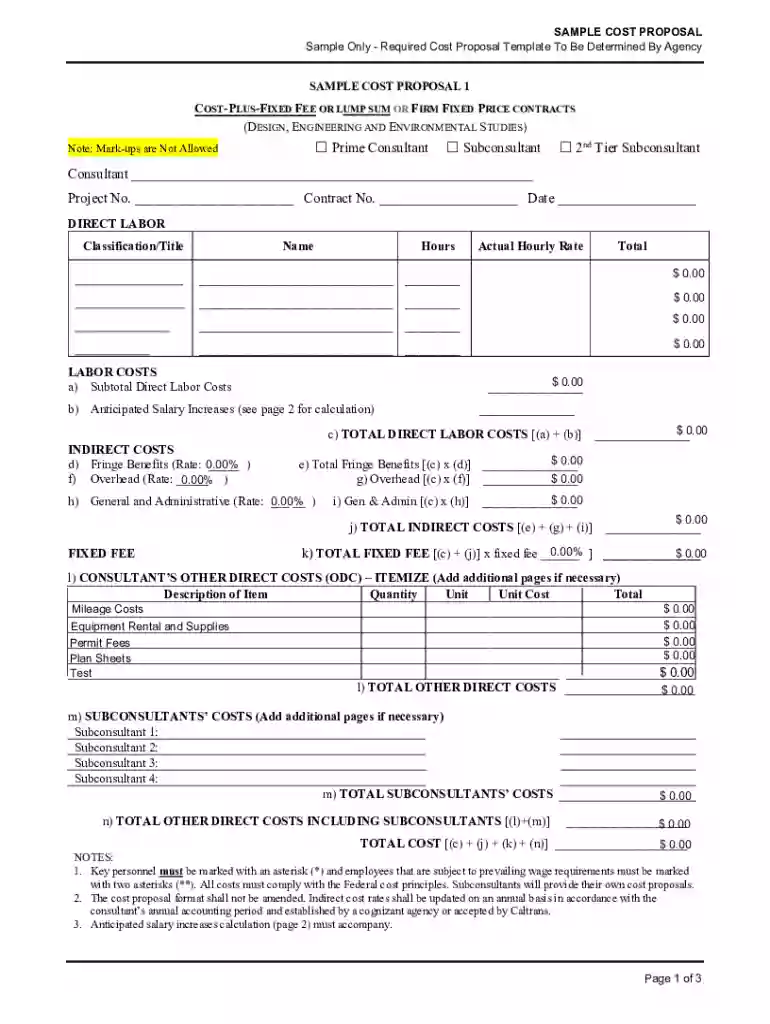
LAPM Chapter 10 Exhibit 10 H1-H3 Cost Proposal 2026

Get Form
cost proposal sample Preview on Page 1

Here's how it works

01. Edit your cost proposal sample online
Type text, add images, blackout confidential details, add comments, highlights and more.

02. Sign it in a few clicks
Draw your signature, type it, upload its image, or use your mobile device as a signature pad.

03. Share your form with others
Send cost proposal via email, link, or fax. You can also download it, export it or print it out.

Definition & Meaning of LAPM Chapter 10 Exhibit 10 H1-H3 Cost Proposal

The "LAPM Chapter 10 Exhibit 10 H1-H3 Cost Proposal" is a structured document used primarily in the fields of design, engineering, and environmental studies. It provides a template for preparing a cost proposal under various contract types, such as cost-plus-fixed fee, lump sum, or firm fixed price contracts. This proposal outlines how to calculate direct labor costs, indirect costs, fixed fees, and other direct costs like subconsultants. Compliance with federal cost principles is a critical aspect, requiring certification of direct costs by an authorized personnel. The form also includes calculations for anticipated salary increases over the contract duration.

Key Elements of the LAPM Chapter 10 Exhibit 10 H1-H3 Cost Proposal

Direct and Indirect Costs

The form is detailed in specifying how to calculate and document both direct and indirect costs. Direct costs might include salaries of employees working on the project and materials directly used in the project, while indirect costs could cover overhead expenses necessary to support the operations.

  • Direct Labor Costs: Involves the basic pay and benefits payable to employees working directly on the project.
  • Indirect Costs: Typically calculated using an indirect cost rate that includes general and administrative expenses.

Fixed Fees and Other Direct Costs

  • Fixed Fees: These are predetermined fees based on the contract type, often negotiated as a percentage of either the estimated costs or the total contract value.
  • Other Direct Costs: These might include costs related to travel, materials, or specific technical services needed to complete the project.

Steps to Complete the LAPM Chapter 10 Exhibit 10 H1-H3 Cost Proposal

  1. Gather Required Information: Collect all relevant financial data, including labor rates, anticipated material costs, and indirect cost rates.
  2. Calculate Direct Labor Costs: Use the provided structure to estimate the direct labor costs based on the project scope.
  3. Estimate Indirect Costs: Apply the correct indirect cost rate to calculate the overhead applicable to the project.
  4. Determine Fixed Fees: Based on contractual agreements, compute the fixed fee component of the proposal.
  5. Document Other Direct Costs: Include detailed descriptions and calculations for any other anticipated expenses.
  6. Compile and Review: Ensure all sections are completed accurately and review for compliance with federal cost principles.
  7. Certification: Have an authorized person certify the accuracy and completion of the proposal.

Important Terms Related to LAPM Chapter 10 Exhibit 10 H1-H3 Cost Proposal

  • Cost-Plus-Fixed Fee Contract: A type of contract where the contractor is reimbursed for all project costs plus a fixed fee.
  • Lump Sum Contract: A contract with a single fixed price for all work.
  • Firm Fixed Price: A contract that sets a fixed total price for all activities regardless of costs incurred.
  • Subconsultants: Third-party consultants hired to furnish specific services or expertise.

Legal Use of the LAPM Chapter 10 Exhibit 10 H1-H3 Cost Proposal

In the United States, adherence to the guidelines laid out in the LAPM Chapter 10 Exhibit 10 H1-H3 Cost Proposal is necessary to ensure compliance with federal cost principals, especially for federally funded projects. It serves as a legal document to authenticate the proposed costs for government grants and contracts, aiding in the transparent and ethical allocation of funds.

Example Scenarios of Using the LAPM Chapter 10 Exhibit 10 H1-H3 Cost Proposal

Scenario 1: Infrastructure Development Project

An engineering firm bidding for a highway expansion project would use this proposal form to itemize expected labor efforts, material costs, and any subconsultant fees. The proposal helps prevent project delays by clearly defining anticipated costs.

Scenario 2: Environmental Study Grant Application

A non-profit organization applying for a federal grant to conduct an environmental study can use this template to project costs accurately, ensuring the proposal meets strict federal standards for fund allocation.


Who Typically Uses the LAPM Chapter 10 Exhibit 10 H1-H3 Cost Proposal?

decoration image ratings of Dochub

Engineering and Design Firms

Organizations involved in designing infrastructure or similar projects heavily rely on this form to structure their financial proposals to potential clients or government bodies.

Non-Profit Organizations

Those applying for federal grants, particularly involving environmental or social impact studies, utilize this proposal template to ensure funding transparency and compliance.

Software Compatibility for the LAPM Chapter 10 Exhibit 10 H1-H3 Cost Proposal

While creating or filling out this proposal, using compatible software like DocHub can streamline the process of inputting data, electronic signing, and converting or uploading completed documents onto cloud services. Applications with robust editing capabilities such as DocHub can assist in making seamless modifications and maintaining compliance-ready documents efficiently.

See more LAPM Chapter 10 Exhibit 10 H1-H3 Cost Proposal versions

We've got more versions of the LAPM Chapter 10 Exhibit 10 H1-H3 Cost Proposal form. Select the right LAPM Chapter 10 Exhibit 10 H1-H3 Cost Proposal version from the list and start editing it straight away!
Versions Form popularity Fillable & printable
2019 4.2 Satisfied (27 Votes)
2015 4.6 Satisfied (51 Votes)
be ready to get more

Complete this form in 5 minutes or less

Get form

Got questions?

We have answers to the most popular questions from our customers. If you can't find an answer to your question, please contact us.
Contact us
A fee proposal is a proposal prepared by a consultant for a prospective client describing the services that the consultant proposes to undertake and the fee that will be charged. This may be in the form of a letter, or may be a more detailed document accompanied by a cover letter.
Proposal costs are defined as the costs of preparing bids, proposals, or applications for potential Awards, including the development of data necessary to support the UWs bids or proposals.
The purpose of a pricing proposal is to help potential clients understand how much a project may cost (and what are all the items included in that price). A contractor may create this document with a certain pricing methodology in mind, such as daily or hourly rate, monthly, cost-based, time and materials-based, etc.
How to write a price proposal? Research the potential client. Read about the organization online, speak with or interview the decision-maker of the company and review the details of the proposal carefully. Follow examples. Set a budget. Build client confidence. Set a completion date. Provide billing options.
The Cost Proposal, also referred to as the budget, describes in detail the estimated cost of implementing the project. It is critical that your organization base the budget on what has been written in the technical proposal.

Security and compliance

At DocHub, your data security is our priority. We follow HIPAA, SOC2, GDPR, and other standards, so you can work on your documents with confidence.

Learn more
ccpa2
pci-dss
gdpr-compliance
hipaa
soc-compliance