Guarantors Indemnity to the 2026

Get Form
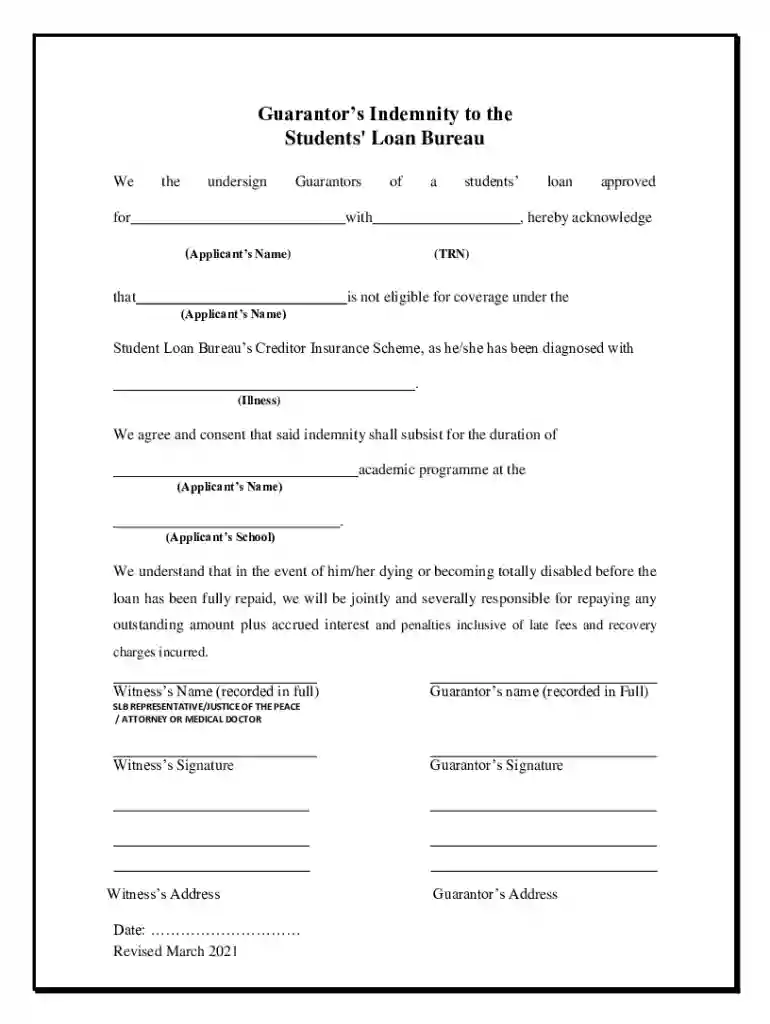
Guarantors Indemnity to the Preview on Page 1

Here's how it works

01. Edit your form online
Type text, add images, blackout confidential details, add comments, highlights and more.

02. Sign it in a few clicks
Draw your signature, type it, upload its image, or use your mobile device as a signature pad.

03. Share your form with others
Send it via email, link, or fax. You can also download it, export it or print it out.

Definition & Overview of Guarantor's Indemnity Agreements

A Guarantor's Indemnity Agreement is a legal contract where an individual or entity, known as the guarantor, agrees to pay off the debt if the primary borrower defaults. This agreement becomes especially important for student loans, wherein the student, due to ineligibility for coverage under a Creditor Insurance Scheme, requires an additional assurance to secure the loan. The indemnity extends beyond just the principal amount, including interest and any associated fees, ensuring the lender is fully compensated in adverse situations like the borrower's death or total disability.

Key Elements of the Guarantor's Indemnity

  • Guarantor's Responsibility: The guarantor agrees to cover outstanding debts if the borrower fails to fulfill payment obligations.
  • Scope of Indemnity: Covers loan principal, interest, and fees.
  • Conditions Triggering Payment: Payment obligations are triggered by scenarios such as the borrower’s death or disability.
  • Legal Obligation: The agreement is legally binding, demanding an informed and willing consent from the guarantor.

How to Use the Guarantor's Indemnity Agreement

Understanding how to effectively utilize a Guarantor's Indemnity Agreement is pivotal to ensuring compliance and safeguarding financial interests.

Steps to Use

  1. Identify the Need: Determine the need for a guarantor when a primary borrower is unable to secure a loan independently.
  2. Contact a Legal Advisor: Before signing, both the borrower and the guarantor should consult legal professionals to comprehend obligations.
  3. Review Terms and Conditions: Carefully examine all clauses related to responsibilities and conditions under which indemnity is called upon.
  4. Sign the Agreement: Upon agreement of terms, the guarantor signs the document, formalizing their commitment.

Guide to Obtaining the Guarantor's Indemnity Agreement

To procure a Guarantor's Indemnity Agreement, certain procedural steps are necessary to ensure legality and enforceability.

Process Overview

  1. Initial Consultation: Begin with discussions with loan officers or legal advisors to go over requirements.
  2. Gather Necessary Documents: Compile financial and identification documents for both the borrower and the guarantor.
  3. Draft the Agreement: Often facilitated by legal professionals who tailor it to specific financial circumstances and legal requirements.
  4. Finalize Details: All involved parties, including the lending institution, validate and accept terms.

Steps to Complete the Guarantor's Indemnity Agreement

The completion of this document involves multiple stakeholders and precise adherence to regulatory requirements.

  1. Understanding Parties Involved: Clarification of each party's roles and responsibilities within the agreement.
  2. Accurate Information Input: Ensure all personal and financial information is correct to avoid future disputes or invalidation.
  3. Signing Process: Witnesses or notaries may be required depending on jurisdictional law, adding an official layer of validity.

Importance of the Guarantor's Indemnity Agreement

This agreement serves as a crucial safety net for lenders and offers specific financial protections while enabling borrowers to acquire loans they might otherwise be ineligible for.

  • Enhanced Loan Security: Provides lenders with confidence, resulting in potentially favorable loan terms or rates for borrowers.
  • Risk Mitigation: Shields borrowers from personal liabilities if unforeseeable financial hardships arise.

Legal Use and Compliance Considerations

A Guarantor's Indemnity Agreement must be crafted and utilized in strict accordance with legal guidelines.

Key Compliance Points

  • Adherence to State Laws: Each U.S. state may have varying requirements influencing the components or enforceability of indemnity agreements.
  • Document Integrity: Must be meticulously maintained with copies kept by all parties for future reference and potential legal scrutiny.

Examples of Guarantor's Indemnity in Action

Practical application scenarios illuminate the significance of these agreements in real-world contexts.

  • Student Loan Case: A student unable to qualify for a loan due to medical histories might secure funding with family as guarantors.
  • Business Financing Scenario: Businesses might use indemnity to attract investors by reducing perceived risk.

Important Terms Related to Guarantor's Indemnity

Success with these agreements heavily depends on understanding the key terms and their implications.

  • Guarantor: The individual or entity assuming responsibility for fulfilling the borrower's obligations in default situations.
  • Borrower: The primary party seeking the loan, subject to various contingencies under the agreement.

By leveraging a deep understanding of these elements, parties involved in a Guarantor's Indemnity Agreement can navigate their legal and financial landscapes with greater assurance.

See more Guarantors Indemnity to the versions

We've got more versions of the Guarantors Indemnity to the form. Select the right Guarantors Indemnity to the version from the list and start editing it straight away!
Versions Form popularity Fillable & printable
2021 4.9 Satisfied (28 Votes)
2018 4.7 Satisfied (21 Votes)
be ready to get more

Complete this form in 5 minutes or less

Get form

Got questions?

We have answers to the most popular questions from our customers. If you can't find an answer to your question, please contact us.
Contact us
Differences between guarantees and indemnities a guarantors liability is limited by the extent of the debtors liability. In contrast, an indemnifiers liability is determined by the terms of the indemnity.
A deed of guarantee and indemnity is a type of binding legal contract, which in simple terms, means that a third party promises that the duties of another party will be fulfilled.
An indemnity obligation is a primary payment obligation, not secondary. A true guarantee contract means the guarantor promises to be responsible if the principal debtor fails to perform their obligations. In a guarantee contract, the guarantors liability is secondary to the principal debtors liability.
A guarantee and indemnity makes you legally responsible for repaying a loan if the borrower cannot. This can include not just the loan amount but also interest, fees, and other costs. Being a guarantor can impact your credit and financial future.

Security and compliance

At DocHub, your data security is our priority. We follow HIPAA, SOC2, GDPR, and other standards, so you can work on your documents with confidence.

Learn more
ccpa2
pci-dss
gdpr-compliance
hipaa
soc-compliance
be ready to get more

Complete this form in 5 minutes or less

Get form