Type text, add images, blackout confidential details, add comments, highlights and more.
02. Sign it in a few clicks
Draw your signature, type it, upload its image, or use your mobile device as a signature pad.
03. Share your form with others
Send it via email, link, or fax. You can also download it, export it or print it out.
How to use or fill out General Form of Employment Agreement with our platform
Ease of Setup
DocHub User Ratings on G2
Ease of Use
DocHub User Ratings on G2
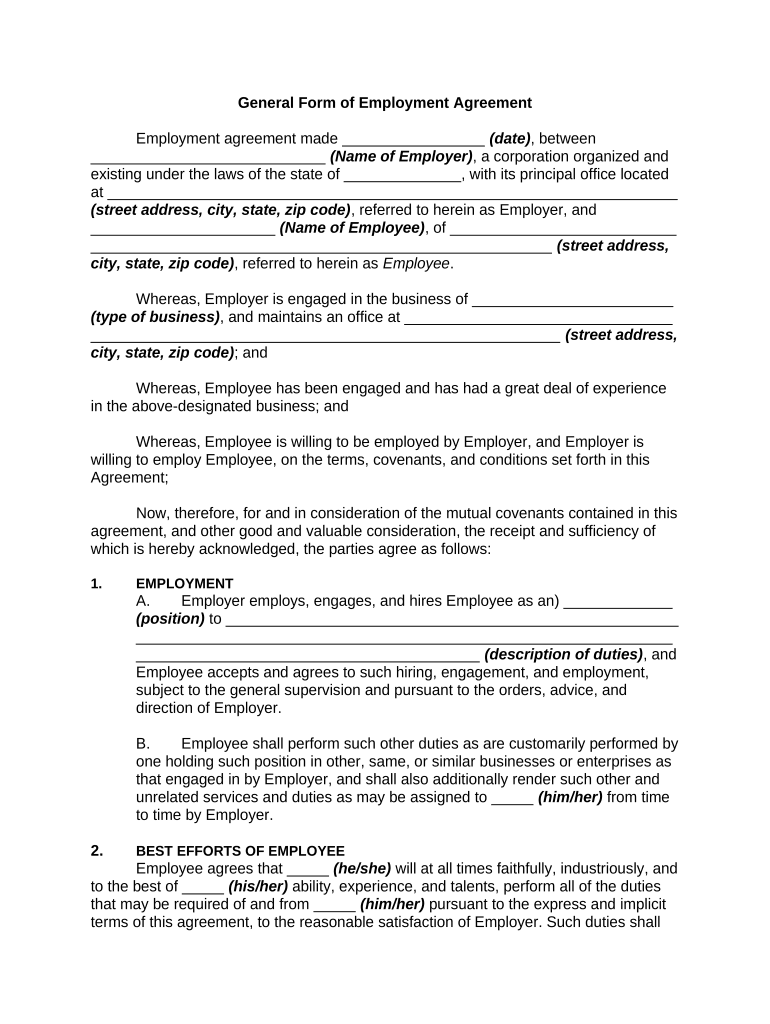
Click ‘Get Form’ to open the General Form of Employment Agreement in the editor.
Begin by entering the date at the top of the form, followed by the name and address of the Employer. Ensure all details are accurate for legal purposes.
Next, fill in the Employee's name and address. This section is crucial as it identifies both parties involved in the agreement.
In Section 1, specify the position being offered to the Employee along with a detailed description of their duties. This clarity helps set expectations.
Proceed to Section 4 to outline compensation details, including salary and payment frequency. Make sure these figures are correct to avoid future disputes.
Review Sections 10 through 22 carefully, ensuring all terms regarding vacation, termination, and compliance with laws are filled out accurately.
Finally, have both parties sign and date the document electronically within our platform for a seamless completion process.
Start using our platform today for free to streamline your employment agreements!
Fill out General Form of Employment Agreement online It's free
General form of employment agreement templateGeneral form of employment agreement template wordGeneral form of employment agreement sampleGeneral form of employment agreement pdfGeneral form of employment agreement exampleGeneral form of employment agreement template freeGeneral form of employment agreement sample pdfEmployee Agreement format in Word
Security and compliance
At DocHub, your data security is our priority. We follow HIPAA, SOC2, GDPR, and other standards, so you can work on your documents with confidence.
Sep 8, 2025 Description of the employers business, the employees professional skill level or position, and the employees desire to enter into employmentRead more
May 12, 2012 COFESA, Contractors, and contracts of employment. Determining the existence of a contract of employment has always been difficult.Read more
Cookie consent notice
This site uses cookies to enhance site navigation and personalize your experience.
By using this site you agree to our use of cookies as described in our Privacy Notice.
You can modify your selections by visiting our Cookie and Advertising Notice.