




01. Edit your history and physical template pdf online
Type text, add images, blackout confidential details, add comments, highlights and more.

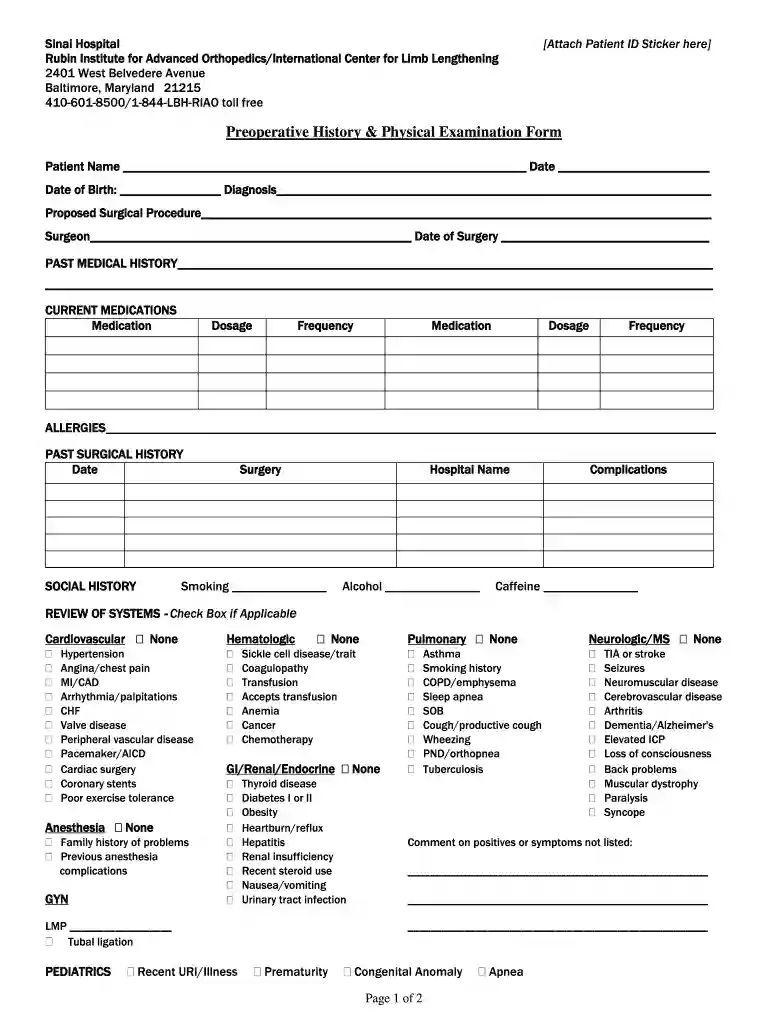
Type text, add images, blackout confidential details, add comments, highlights and more.

Draw your signature, type it, upload its image, or use your mobile device as a signature pad.

Send pre op physical exam template via email, link, or fax. You can also download it, export it or print it out.
The Preoperative History Physical Examination Form is a crucial document utilized in healthcare settings, specifically in surgical contexts. It is designed to gather comprehensive patient information prior to surgical procedures. This form captures essential details such as the patient’s medical history, current medications, allergies, and previous surgical history. By compiling this information, healthcare providers can perform thorough risk assessments and ensure that all necessary precautions are taken during surgery.
This form typically includes sections for demographic data, medical and surgical histories, and observations from the physical examination. The goal is to collect enough relevant information to inform the surgical team about any potential complications that may arise during or after the procedure. By facilitating careful preoperative evaluation, the form plays an integral role in promoting patient safety and optimizing surgical outcomes.
Completing the Preoperative History Physical Examination Form involves several critical steps to ensure accuracy and comprehensiveness. Each section of the form must be filled out meticulously to provide a full picture of the patient's health status.
Personal Information:
Medical History:
Medications:
Allergies:
Physical Examination Data:
Review:
The Preoperative History Physical Examination Form serves several significant purposes in the healthcare process, primarily facilitating effective communication between patients and medical teams. It provides a framework for the surgical team to gather essential information that impacts surgical planning and patient care.
Patient Safety: The primary use of the form is to collect vital medical information that can identify potential risks associated with anesthesia or the surgical procedure itself. This helps in devising strategies to mitigate these risks.
Surgical Decision-Making: The data collected aids the surgical team in determining the appropriateness of the proposed procedure based on the patient's overall health status.
Patient Engagement: Completing the form encourages patient involvement in their healthcare. It allows patients to reflect on their health history and understand the significance of such information in the surgical context.
Understanding specific terminology associated with the Preoperative History Physical Examination Form can enhance clarity and communication between patients and healthcare providers. Here are some common terms related to the form:
The Preoperative History Physical Examination Form encompasses several key elements that ensure its effectiveness and utility in the surgical backdrop.
By carefully considering the information captured in the Preoperative History Physical Examination Form, healthcare professionals can enhance preoperative preparations and ensure a safer surgical experience for patients.
We've got more versions of the history and physical template pdf form. Select the right history and physical template pdf version from the list and start editing it straight away!
| Versions | Form popularity | Fillable & printable |
|---|---|---|
| 2015 | 4 Satisfied (56 Votes) |
Of course, electronically drawing your signature is acceptable, but only if you utilize a tool that complies with industry regulations and policies. Consider DocHub, which ensures eSignature validity under ESIGN and UETA requirements. All you need to eSign your free printable history and physical template pdf is an account with DocHub and an internet connection. After you open your document in our editor, click Sign and select the Draw tool.
As a comprehensive document modifying platform, DocHub is available on mobile devices. Open DocHub in your choice of mobile browser and employ our intelligent mobile-friendly toolset to fill out your history and physical examination form.
At DocHub, your data security is our priority. We follow HIPAA, SOC2, GDPR, and other standards, so you can work on your documents with confidence.
Dr. Hendrix is responsible for the overall coordination, management and leadership of PA education at UMB.Read more
Aug 30, 2019 Medical history and physical, and consults based on patients needs. 1 3. Voluntary or involuntary forms must be signed by a physicians) andRead more


