




01. Edit your form online
Type text, add images, blackout confidential details, add comments, highlights and more.

Type text, add images, blackout confidential details, add comments, highlights and more.

Draw your signature, type it, upload its image, or use your mobile device as a signature pad.

Send it via email, link, or fax. You can also download it, export it or print it out.
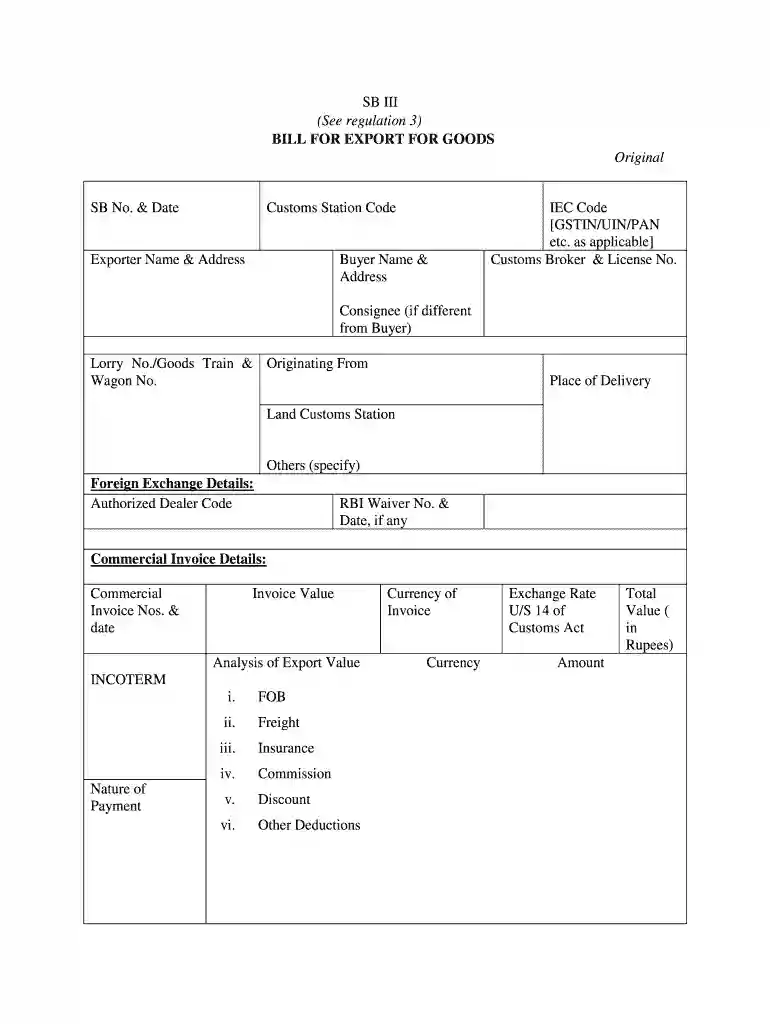
The SB III (See regulation 3) BILL FOR EXPORT FOR GOODS is a formal document used in the export process, detailing crucial information needed to facilitate the exportation of goods. This form is essential in ensuring that all relevant data, such as exporter and buyer details, customs information, and specifics about the cargo, are clearly communicated. Serving as a declaration by the exporter, it affirms the accuracy of the provided information and is pivotal for compliance with customs regulations.
The SB III form encompasses several key components that ensure effective processing. These include:
Understanding specific terms related to the SB III form, such as IGST (Integrated Goods and Services Tax) and export duty, is crucial for accurate completion. Each term plays a significant role in the financial and regulatory aspects of international trade, impacting overall compliance and costs.
Completing the SB III form requires careful attention to detail and understanding of the export process. Here's a step-by-step guide:
Errors in these steps, such as incorrect tagging of HS codes or misreported values, can lead to delays or non-compliance issues. Ensuring accuracy and thoroughness in every section minimizes the risk of complications.
The SB III form serves as a legally binding document within the export transaction framework. It provides an official record of the goods being exported, the particulars of the transaction, and attests to the legal compliance with customs requirements.
Primarily utilized by:


Understanding who uses the form aids in recognizing its pivotal role in international trade logistics and compliance, with a focus on maintaining the integrity and efficiency of the shipping process.
To complete the SB III successfully, the following documents are generally required:
Careful assembly and verification of these documents are crucial for a smooth export process, as they ensure all legal and regulatory requirements are met.
The SB III form can be submitted via several methods, allowing flexibility according to the exporter's needs and preferences.
With the advent of technology, digital submission of the SB III form is increasingly favored for its convenience and efficiency.
Advantages of Digital Submission:
Considerations for Paper Submission:
We've got more versions of the SB III (See regulation 3) BILL FOR EXPORT FOR GOODS form. Select the right SB III (See regulation 3) BILL FOR EXPORT FOR GOODS version from the list and start editing it straight away!
| Versions | Form popularity | Fillable & printable |
|---|---|---|
| 2025 | 4.6 Satisfied (36 Votes) | |
| 2024 | 4.8 Satisfied (57 Votes) | |
| 2024 | 4.5 Satisfied (54 Votes) | |
| 2024 | 4.6 Satisfied (24 Votes) | |
| 2024 | 4.2 Satisfied (22 Votes) | |
| 2023 | 4.6 Satisfied (29 Votes) | |
| 2023 | 4.2 Satisfied (33 Votes) | |
| 2023 | 4.8 Satisfied (51 Votes) | |
| 2023 | 4.3 Satisfied (30 Votes) | |
| 2023 | 4.4 Satisfied (43 Votes) | |
| 2023 | 4.1 Satisfied (50 Votes) | |
| 2023 | 4.8 Satisfied (43 Votes) | |
| 2023 | 4.3 Satisfied (48 Votes) | |
| 2022 | 4.8 Satisfied (52 Votes) | |
| 2022 | 4.1 Satisfied (32 Votes) |
At DocHub, your data security is our priority. We follow HIPAA, SOC2, GDPR, and other standards, so you can work on your documents with confidence.
This bill is a two-year bill pending in the SB 700 (Ayala). Existing law The California Regulatory Law Reporter Vol. 9, No. 3 (Summer 1989)
SB Using the Export Nation methodology, total California exports for goods Chart 3 shows the U.S. progress toward meeting the national export goal.


