




01. Edit your app 150 info online
Type text, add images, blackout confidential details, add comments, highlights and more.

Type text, add images, blackout confidential details, add comments, highlights and more.

Draw your signature, type it, upload its image, or use your mobile device as a signature pad.

Send it via email, link, or fax. You can also download it, export it or print it out.
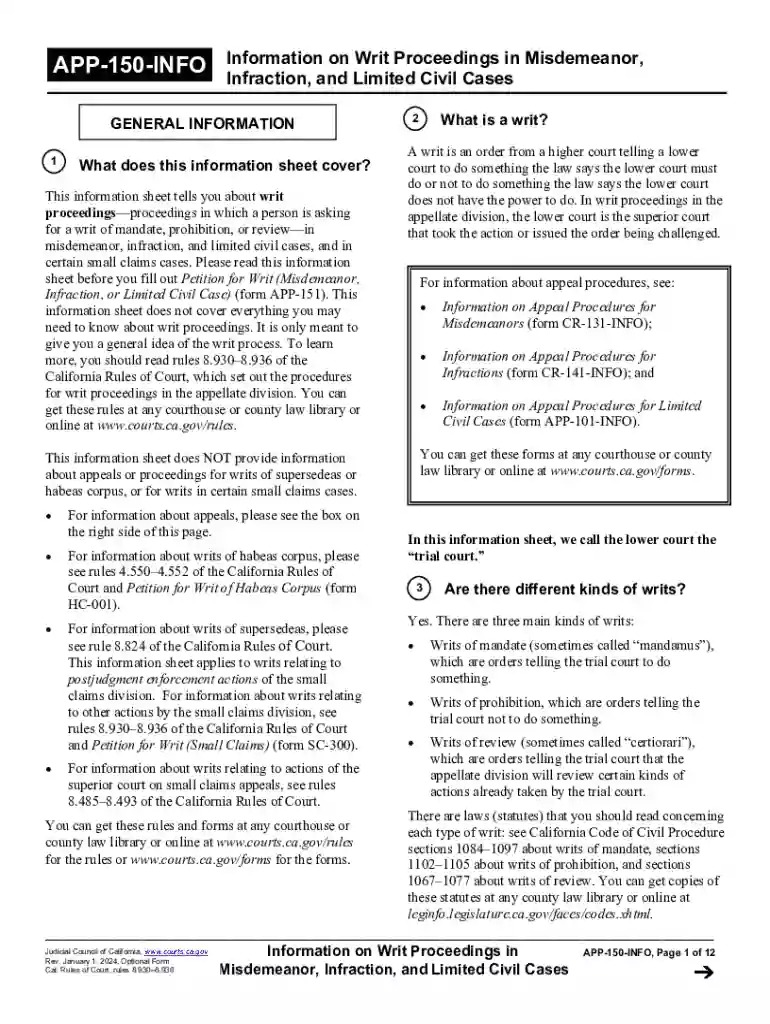
The term "42 Writs in California State Courts" refers to a collection of legal documents and proceedings available within the state of California. These writs are utilized to address specific legal errors that cannot be corrected through traditional appeal processes. Writs of this nature cover various judicial actions, including writs of mandate, prohibition, and review among others. They offer a means for individuals and entities to seek judicial review in situations where no direct appeal is available, aiming to ensure justice and lawful procedure.
These writs are fundamental tools within the California legal system and serve distinct purposes. A writ of mandate directs a court or government official to perform a specific act required by law. A writ of prohibition is intended to stop a lower court or tribunal from exceeding its jurisdiction, while a writ of review allows an appellate court to examine the decisions of a lower court.
To utilize any of the 42 writs, understanding their specific application and procedural requirements is crucial. Each writ must be used in accordance with predefined legal standards and for designated purposes such as seeking redress where a direct appeal is not an option. The process typically involves filing a petition with the appropriate court while clearly articulating the legal error and providing pertinent evidence or documentation to support the claim.
The effectiveness of a writ relies on understanding its specific limitations and intended application. For instance, the misuse of a writ of mandate to rush a legal proceeding is inappropriate; it must be employed when an official or court has failed to fulfill a statutory duty. Legal counsel is often advised to ensure the writ is properly applied and to maximize the likelihood of a favorable judicial review.
To obtain a writ, one must follow a rigorous legal process beginning with the preparation of a petition that outlines the specifics of the case and the relief sought. It is essential to gather all relevant documentation, such as court transcripts and evidence of legal errors, which substantiate the need for a writ. Subsequent to preparing a petition, it must be filed with the appropriate court jurisdiction.
Once the petition is filed, the court may require additional documentation or responses from the involved parties. It is essential to adhere to the court’s deadlines and procedural rules to ensure the petition is processed. Guidance from legal professionals can aid in navigating this intricate process and in drafting a compelling petition.
Identify the Appropriate Writ: Determine which type of writ aligns with the particular legal error or situation encountered.
Prepare the Petition: Draft a comprehensive petition that details the legal error and desired relief. Include all necessary factual and legal foundations to justify the use of the writ.
Gather Supporting Documentation: Assemble vital documents such as transcripts, affidavits, or other evidence significant to the claim.
Submit the Petition: File the petition in the relevant California court, ensuring compliance with all rules, regulations, and deadlines.
Serve Notice: Provide notice to all interested parties about the petition, ensuring they are informed of the legal proceedings.
Attend Court Hearings: Be prepared to attend and participate in any hearings scheduled by the court to present your case.
Follow Up: Adhere to any instructions from the court following the submission, including additional document requests or further clarifications.
Understanding the terminology is crucial when dealing with writs. Some essential terms include:
These terms and their applications are key to effectively navigating writ procedures within California.
Legally, writs must be employed strategically and judiciously, ideally with guidance from an attorney. Misuse or inappropriate use can lead to dismissal or sanctions. Understanding when a writ is necessary—as opposed to an appeal—is important for ensuring that legal actions are appropriate and justified by the circumstances.
Proper application and procedure are vital for the court to consider issuing a writ. This includes ensuring the necessary legal standards are not only met but are evident within the written petition. Legal counsel is beneficial to ascertain these criteria are adequately fulfilled and argued.
California maintains specific rules governing writ procedures, which differ from those in other jurisdictions. These include unique filing requirements, procedural steps, and deadlines that are essential to comply with when seeking a writ within the state’s courts.
Understanding these state-specific rules is vital as non-compliance can invalidate the petition. Given the complexity of these regulations, it is often beneficial to consult California-based legal professionals who specialize in appellate and writ proceedings.
Several cases illustrate the successful use of writs in California:
These examples provide a reference of how writs have been used to ensure just processes within the judiciary.
Filing for a writ necessitates a comprehensive compilation of documents including:
These documents must be methodically organized and presented according to court-specific guidelines to ensure acceptance and processing.
We've got more versions of the app 150 info form. Select the right app 150 info version from the list and start editing it straight away!
At DocHub, your data security is our priority. We follow HIPAA, SOC2, GDPR, and other standards, so you can work on your documents with confidence.


