App 150 info form 2026

Get Form
app 150 info form Preview on Page 1

Here's how it works

01. Edit your form online
Type text, add images, blackout confidential details, add comments, highlights and more.

02. Sign it in a few clicks
Draw your signature, type it, upload its image, or use your mobile device as a signature pad.

03. Share your form with others
Send it via email, link, or fax. You can also download it, export it or print it out.

How to use or fill out app 150 info form with DocHub

Form edit decoration
9.5
Ease of Setup
DocHub User Ratings on G2
9.0
Ease of Use
DocHub User Ratings on G2
  1. Click ‘Get Form’ to open the app 150 info form in our editor.
  2. Begin by reviewing the general information section, which outlines the purpose of the writ proceedings. Familiarize yourself with terms like 'writ of mandate' and 'writ of prohibition' as they are crucial for understanding the form.
  3. Fill in your personal details in the designated fields, ensuring accuracy. This includes your name, contact information, and any relevant case numbers.
  4. In the section regarding your interest in the trial court’s ruling, clearly describe your beneficial interest. This is essential for establishing your right to request a writ.
  5. Detail the legal error you believe occurred in the trial court. Use specific language from applicable statutes to support your claims.
  6. Conclude by stating why you need this writ and what order you are requesting from the appellate division. Be concise yet thorough.

Start using our platform today to streamline your document editing and form completion process for free!

See more app 150 info form versions

We've got more versions of the app 150 info form form. Select the right app 150 info form version from the list and start editing it straight away!
Versions Form popularity Fillable & printable
2024 4.4 Satisfied (45 Votes)
2021 4.9 Satisfied (43 Votes)
2017 4.3 Satisfied (90 Votes)
2016 4.4 Satisfied (57 Votes)
be ready to get more

Complete this form in 5 minutes or less

Get form

Got questions?

We have answers to the most popular questions from our customers. If you can't find an answer to your question, please contact us.
Contact us
After filing a notice of appeal, the appellant usually designates the record. In this step, the appellant looks through the trial court record of what happened in the case. The appellant chooses parts of the trial court record like documents and transcripts of what was said to send the Court of Appeal.
In cases where there is no statutory deadline, the petition should be filed within 30 days when challenging an action in a misdemeanor case, or within 60 days in a felony case. (American Property Management Corp. v. Superior Court (2012) 206 Cal.
Information on Appeal Procedures for Limited Civil Cases (APP-101-INFO) Explains the steps to begin and complete a request that a higher court review (appeal) a final decision of a trial court in a limited civil case (generally a case for $35,000 or less).
The time limit for filing a common law writ petition is controlled by the doctrine of laches, usually interpreted as 60 days from the date of the ruling. (Peterson v. Superior Court (1982) 31 Cal.
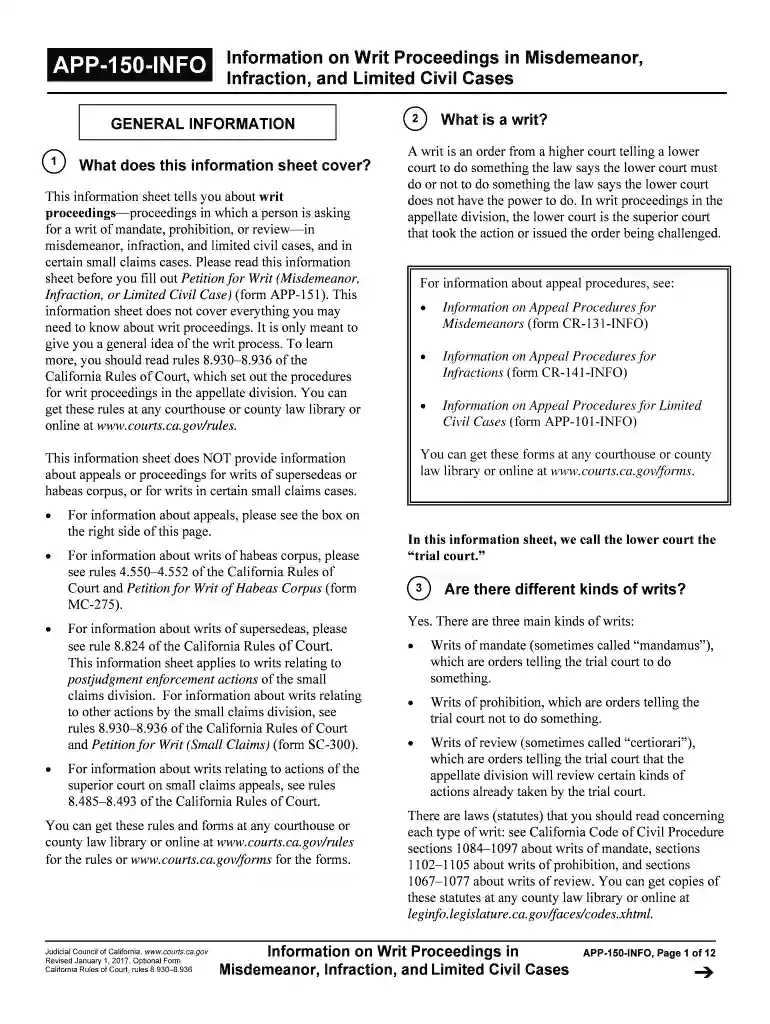
APP-150-INFO This information sheet tells you about writ proceedingsproceedings in which a person is asking for a writ of mandate, prohibition, or reviewin misdemeanor, infraction, and limited civil cases, and in certain small claims cases.

Security and compliance

At DocHub, your data security is our priority. We follow HIPAA, SOC2, GDPR, and other standards, so you can work on your documents with confidence.

Learn more
ccpa2
pci-dss
gdpr-compliance
hipaa
soc-compliance

People also ask

A prevailing party who claims costs must serve and file a memorandum of costs within 15 days after the date of service of the notice of entry of judgment or dismissal by the clerk under Code of Civil Procedure section 664.5 or the date of service of written notice of entry of judgment or dismissal, or within 180 days
As such, the only way for most interlocutory decisions to be reviewed before trial is through ordinary mandate. Most such writ petitions are common-law writ petitions, which are not specifically set out by statute, and do not have a specific statute of limitation.

Related links