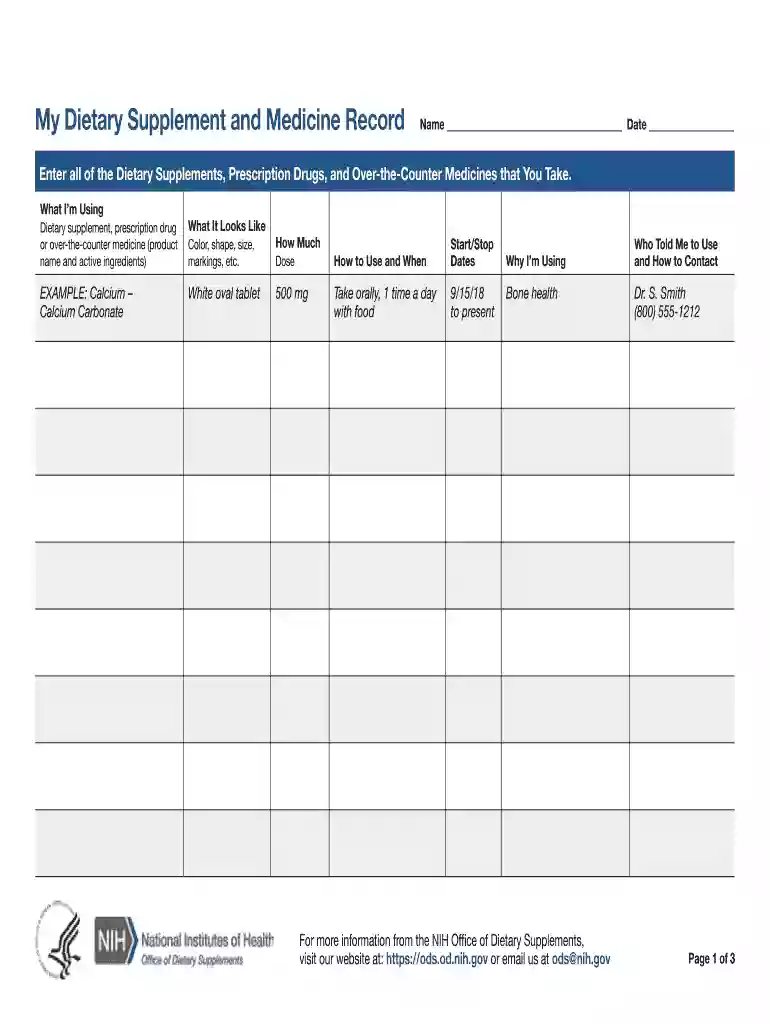
My dietary supplement and medicine record 2026

Get Form
my dietary supplement and medicine record Preview on Page 1

Here's how it works

01. Edit your my dietary supplement and medicine record online
Type text, add images, blackout confidential details, add comments, highlights and more.

02. Sign it in a few clicks
Draw your signature, type it, upload its image, or use your mobile device as a signature pad.

03. Share your form with others
Send dietary supplements drugs via email, link, or fax. You can also download it, export it or print it out.

How to use or fill out my dietary supplement and medicine record

Form edit decoration
9.5
Ease of Setup
DocHub User Ratings on G2
9.0
Ease of Use
DocHub User Ratings on G2
  1. Click ‘Get Form’ to open it in the editor.
  2. Begin by entering your name and the date at the top of the form. This personalizes your record.
  3. In the 'What I’m Using' section, list all dietary supplements, prescription drugs, and over-the-counter medicines you take. Include product names and active ingredients for clarity.
  4. Describe each item in 'What It Looks Like' by noting its color, shape, size, and any markings. This helps identify products easily.
  5. Fill in the 'How Much' section with the dosage of each item you take.
  6. Specify 'How to Use and When' for each product, detailing instructions such as frequency and whether to take it with food.
  7. Record 'Start/Stop Dates' to track when you began or ceased taking each supplement or medication.
  8. In 'Why I’m Using', note the purpose of each item for reference during medical consultations.
  9. Complete any additional sections regarding allergic reactions or questions you may have about your supplements or medications.

Start using our platform today to effortlessly manage your dietary supplement and medicine record online for free!

See more my dietary supplement and medicine record versions

We've got more versions of the my dietary supplement and medicine record form. Select the right my dietary supplement and medicine record version from the list and start editing it straight away!
Versions Form popularity Fillable & printable
2019 4.9 Satisfied (40 Votes)
be ready to get more

Complete this form in 5 minutes or less

Get form

Got questions?

We have answers to the most popular questions from our customers. If you can't find an answer to your question, please contact us.
Contact us
Which two vitamins pose the greatest risk of toxicity? Vitamin A - taken in excessive doses may cause liver damage, weaker bones and cause birth defects. Vitamin D - excessively high doses can cause cognitive issues, heart problems, kidney failure and, in severe cases, possibly death.
Vitamin D: Too Much Can Harm Your Kidneys. St. Johns Wort: Avoid Drug Interactions. Calcium: The Excess May Settle in Your Arteries. Multivitamins and Multiminerals: No Substitute for a Healthy Diet. Fish Oil Supplements: Choose Fish or Flaxseed Instead. Kava: Overuse Can Harm Your Liver. Soy Isolate: Careful With Estrogen?
Yes, consuming excessive amounts of vitamins through supplements can lead to adverse health effects over time. Some vitamins can be harmful in high doses, causing toxicity symptoms and potentially impacting organ function.
The Dietary Supplement Label Products sold as dietary supplements come with a Supplement Facts label that lists the active ingredients, the amount per serving (dose), and other ingredients, such as fillers, binders, and flavorings.
Supplements: What You Really Need 1/15. Vitamin D. It helps keep your bones strong. 2/15. Probiotics. Also called good bacteria, probiotics are found in fermented foods like yogurt, kombucha, miso, and sauerkraut. 3/15. Multivitamins. 4/15. Folic Acid. 5/15. Fiber Supplements. 6/15. Fish Oil. 7/15. Calcium. 8/15. Joint Supplements.

Security and compliance

At DocHub, your data security is our priority. We follow HIPAA, SOC2, GDPR, and other standards, so you can work on your documents with confidence.

Learn more
ccpa2
pci-dss
gdpr-compliance
hipaa
soc-compliance

People also ask

ConsumerLab.com is my go-to place to evaluate dietary supplements. Its an independent organization staffed by good people providing good advice for anyone taking supplements.
Dietary supplements are intended to add to or supplement the diet and are different from conventional food. Generally, to the extent a product is intended to treat, diagnose, cure, or prevent diseases, it is a drug, even if it is labeled as a dietary supplement.

dietary drugs