




01. Edit your race score online
Type text, add images, blackout confidential details, add comments, highlights and more.

Type text, add images, blackout confidential details, add comments, highlights and more.

Draw your signature, type it, upload its image, or use your mobile device as a signature pad.

Send race stroke scale via email, link, or fax. You can also download it, export it or print it out.
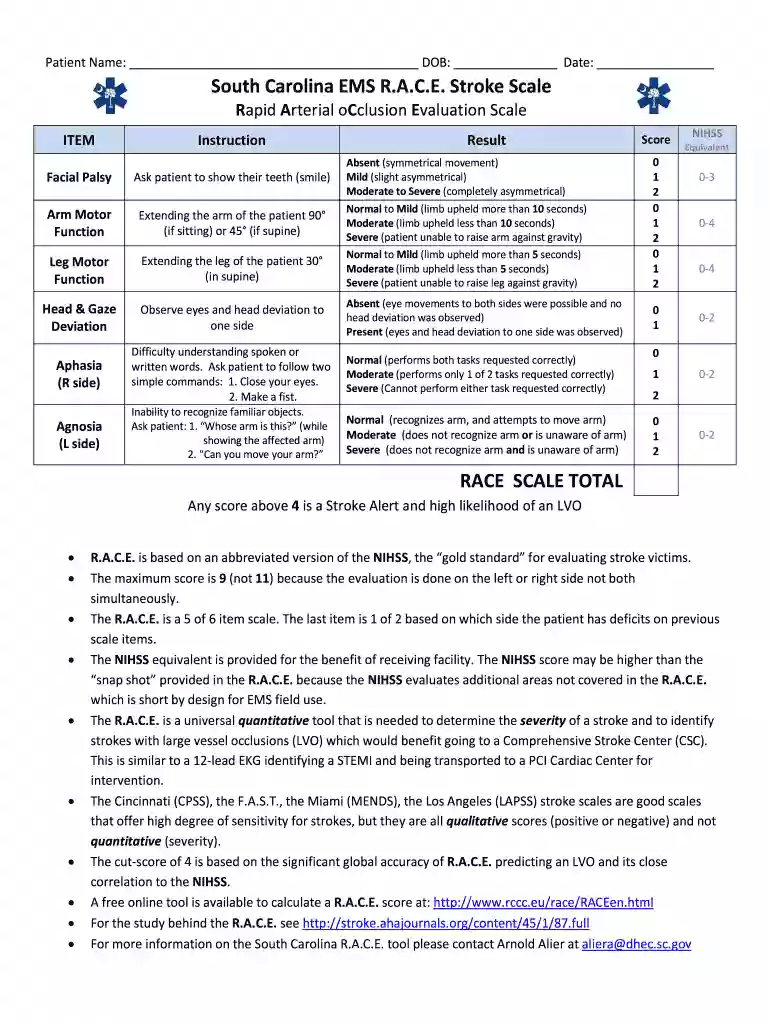
The Race Stroke Scale is a specialized tool used in emergency medical settings to quickly evaluate stroke severity and identify potential large vessel occlusions (LVO). This scale is vital for determining a patient's status and informing treatment decisions upon arrival at healthcare facilities.
The Race Stroke Scale is composed of five fundamental components, each designed to assess specific neurological functions. Medical professionals utilize these assessments during triage to prioritize care.
Each component of the Race Stroke Scale is scored based on specific observations. Scoring is predominantly categorical, with predefined points allocated per item assessed.
Scores aggregate across all components; a total score above four triggers an alert to transport the patient to a Comprehensive Stroke Center for advanced evaluation and potential intervention.
Effective implementation of the Race Stroke Scale requires training and familiarity among emergency medical services (EMS) personnel. The process includes:
By adhering to these steps, EMS can effectively streamline decision-making processes and deliver timely care.
Timeliness in stroke recognition and intervention significantly impacts patient outcomes. The Race Stroke Scale serves as a critical framework for:
Training programs on using the Race Stroke Scale should focus on both theoretical knowledge and practical application:
Continual education and training ensure that EMS can confidently utilize the Race Stroke Scale for optimal patient outcomes in stroke care.
In practice, practitioners may encounter variations in the interpretation and scoring of the Race Stroke Scale. Adaptations can occur based on:
It is essential for EMS teams to stay updated on best practices and modifications to ensure consistent application of the Race Stroke Scale.
With a comprehensive approach to using the Race Stroke Scale, EMS teams can enhance their stroke response capabilities, ultimately improving patient outcomes in emergency care settings. Familiarity with the scale and its practical application is essential for all healthcare providers involved in stroke care management.
At DocHub, your data security is our priority. We follow HIPAA, SOC2, GDPR, and other standards, so you can work on your documents with confidence.
*The RACE Scale is one of many scales EMS can use to identify patients with a potential Large Vessel Occlusion (LVO). No single scale has been proven mostRead more
Total RACE Stroke Score. If 5 or greater, transport patient to nearest comprehensive stroke center. SCORE. OR. If a left-side deficit is found, check for.Read more
Below are stroke tips picked up from fellow paddlers, blogs, videos, etc. This is an attempt at detailing the ideal stroke.Read more


