Type text, add images, blackout confidential details, add comments, highlights and more.

02. Sign it in a few clicks
Draw your signature, type it, upload its image, or use your mobile device as a signature pad.

03. Share your form with others
Send it via email, link, or fax. You can also download it, export it or print it out.

How to use or fill out horse identification chart with our platform
Ease of Setup
DocHub User Ratings on G2
Ease of Use
DocHub User Ratings on G2
Click ‘Get Form’ to open the horse identification chart in the editor.
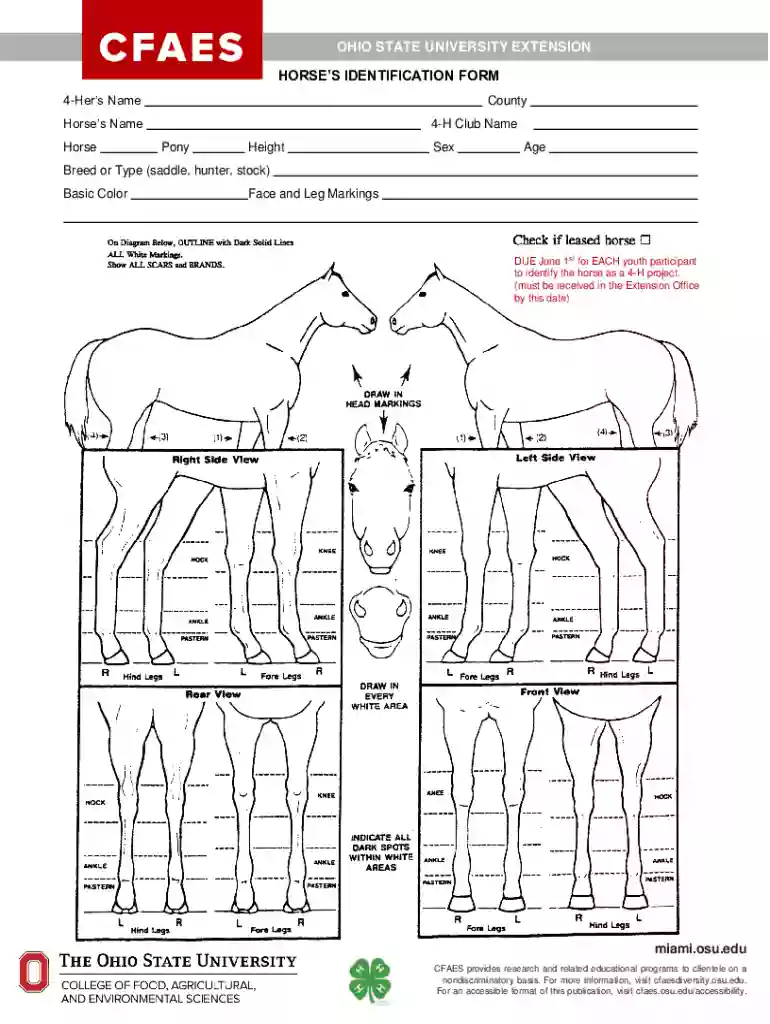
Begin by entering the 4-Her’s Name and County in the designated fields. This information is crucial for identifying the participant.
Next, fill in the Horse’s Name and specify whether it is a Horse or Pony. This helps categorize your entry accurately.
Indicate the Height, Sex, Age, and Breed or Type of your horse. These details are essential for proper identification and classification.
Provide information on Basic Color and any Face and Leg Markings. This visual description aids in recognizing your horse.
Ensure all fields are completed before submitting. Remember, this form must be received by June 1st at the Extension Office for each youth participant.
Start filling out your horse identification chart today for free using our platform!
Fill out horse identification chart online It's free
We've got more versions of the horse identification chart form. Select the right horse identification chart version from the list and start editing it straight away!
As horse owners, riders and keepers, it is our duty to provide the horses in our care with a species-appropriate life centred around their three essential needs: friends, forage, and freedom.
How can I tell what kind of horse I have?
Today, many methods are used to identify a horse, including markings, cowlicks, chestnuts, tattooing, freeze branding, blood typing, DNA typing, and microchip identification.
How do you identify a horse?
Tattoos, brands, freeze marks, scars, and pin-firing marks are the most common examples. The location and shape of these marks are sometimes also described as markings. On plain-colored horses without natural white markings, these features can be very useful, along with hair whorls to identify a horse.
How to identify horse markings?
Horse Markings: A Guide to Equine Identification and Beauty Star: White mark between or above eyes. Snip: White mark on muzzle between nostrils. Blaze: Wide white stripe down the face. Bald Face: Very wide blaze, extending past eyes.
How to read a horse pedigree chart?
For example, the far left would be the horse the pedigree is for. Immediately to the right would be that horses parents, with the sire listed on the top and the dam on the bottom. The pedigree branches out from there, typically going back several generations.
Related Searches
Horse identification chart with picturesHorse identification chart pdfHorse leg markingsHorse identification methodsHorse leg markings ChartHorse markings ChartHorse identification tagsHorse face markings
Security and compliance
At DocHub, your data security is our priority. We follow HIPAA, SOC2, GDPR, and other standards, so you can work on your documents with confidence.
Cookie consent notice
This site uses cookies to enhance site navigation and personalize your experience.
By using this site you agree to our use of cookies as described in our Privacy Notice.
You can modify your selections by visiting our Cookie and Advertising Notice.