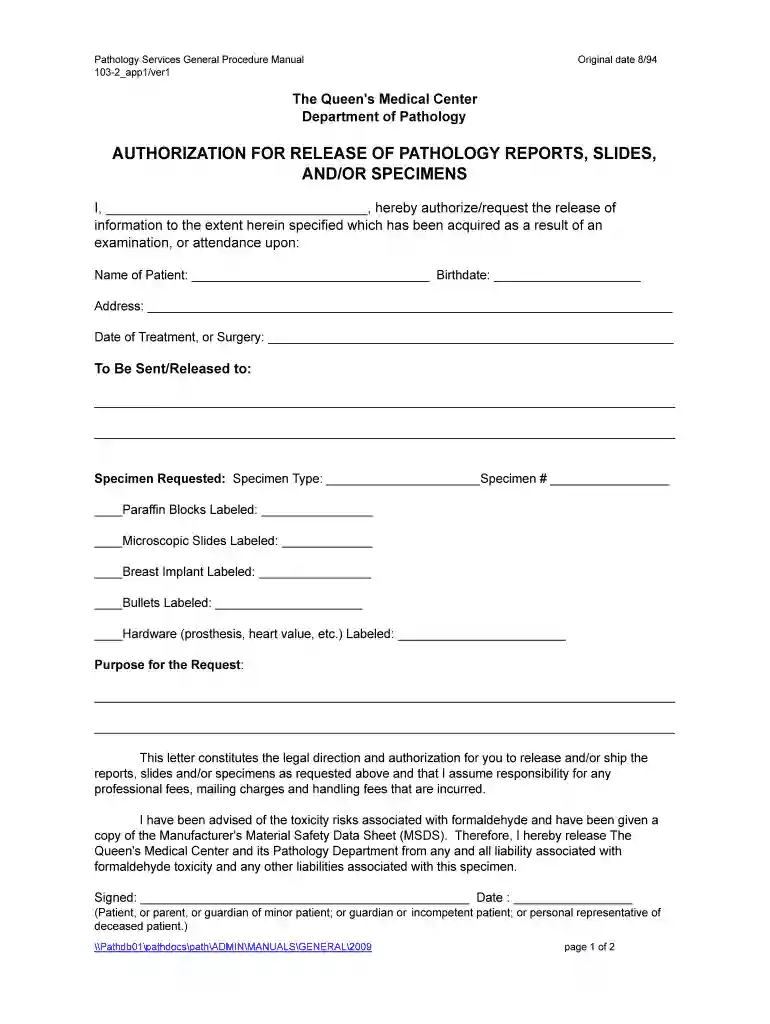
Authorization slides 2026

Get Form
authorization slides Preview on Page 1

Here's how it works

01. Edit your form online
Type text, add images, blackout confidential details, add comments, highlights and more.

02. Sign it in a few clicks
Draw your signature, type it, upload its image, or use your mobile device as a signature pad.

03. Share your form with others
Send it via email, link, or fax. You can also download it, export it or print it out.

How to use or fill out authorization slides with our platform

Form edit decoration
9.5
Ease of Setup
DocHub User Ratings on G2
9.0
Ease of Use
DocHub User Ratings on G2
  1. Click ‘Get Form’ to open the authorization slides in the editor.
  2. Begin by entering the patient's name in the designated field. Ensure accuracy for proper identification.
  3. Fill in the birthdate of the patient. This is crucial for verifying identity and ensuring compliance.
  4. Provide the patient's address in the specified section. This information is necessary for any correspondence related to the release.
  5. Indicate the date of treatment or surgery, which helps contextualize the request for pathology reports and specimens.
  6. In the 'To Be Sent/Released to' section, enter the recipient's details accurately to ensure proper delivery.
  7. Select and label the specimen type you are requesting, such as paraffin blocks or microscopic slides, by checking the appropriate boxes.
  8. Clearly state the purpose for your request in the provided space, as this may be required for processing.
  9. Finally, sign and date at the bottom of the form to authorize release. If applicable, include your relationship to the patient.

Start using our platform today to streamline your document editing and signing process for free!

See more authorization slides versions

We've got more versions of the authorization slides form. Select the right authorization slides version from the list and start editing it straight away!
Versions Form popularity Fillable & printable
1994 4.8 Satisfied (120 Votes)
be ready to get more

Complete this form in 5 minutes or less

Get form

Got questions?

We have answers to the most popular questions from our customers. If you can't find an answer to your question, please contact us.
Contact us

Electronic signatures are a great alternative to traditional signing, as they save time, effort, and costs people spend on printing, scanning, and paper delivery. You can electronically sign your authorization slides utilizing a trustworthy and powerful online document management services like DocHub. It complies with major eSignature policies (ESIGN and UETA), so all documents approved there are legally binding and have the same validity as physically signed ones.

In case your go-to email service is Gmail, you can easily integrate your DocHub editor into your work. Modify your authorization slides with DocHub instruments and connect it to your drafts in Gmail. See how straightforward it can be to exchange documents and collaborate with a swift PDF editing solution at hand.

Authorization involves the following phases: defining a security policy (set of rules), selecting an access control model to encapsulate the defined policy, implementing the model and enforcing the access rules. Each phase requires specific tools to be deployed.
Authentication verifies a users identity by validating credentials like a username and password. Authorization then determines what access and permissions an authenticated user has.
I authorized him to use my name. She was authorized [=empowered] to act for her husband.

Security and compliance

At DocHub, your data security is our priority. We follow HIPAA, SOC2, GDPR, and other standards, so you can work on your documents with confidence.

Learn more
ccpa2
pci-dss
gdpr-compliance
hipaa
soc-compliance

People also ask

In the upper right corner, select the Share icon and then select Invite People. If the file is on your device, youll be asked to upload the file to the cloud first. Invite users by adding their email addresses to the invite field.
A user might be authorized to access a word processor, an email client, a CRM and more. With basic authorization, users would have a distinct user ID and password for each system. For example, your employees might need one log in for the CRM, another for their email, another to access a server, and so on.
A good example is house ownership. The owner has full access rights to the property (the resource) but can grant other people the right to access it. You say that the owner authorizes people to access it. This simple example allows us to introduce a few concepts in the authorization context.

Related links