Audit of the Departmental Information System and - Canada 2026

Get Form
Audit of the Departmental Information System and - Canada Preview on Page 1

Here's how it works

01. Edit your form online
Type text, add images, blackout confidential details, add comments, highlights and more.

02. Sign it in a few clicks
Draw your signature, type it, upload its image, or use your mobile device as a signature pad.

03. Share your form with others
Send it via email, link, or fax. You can also download it, export it or print it out.

How to use or fill out Audit of the Departmental Information System and - Canada with our platform

Form edit decoration
9.5
Ease of Setup
DocHub User Ratings on G2
9.0
Ease of Use
DocHub User Ratings on G2
  1. Click ‘Get Form’ to open it in the editor.
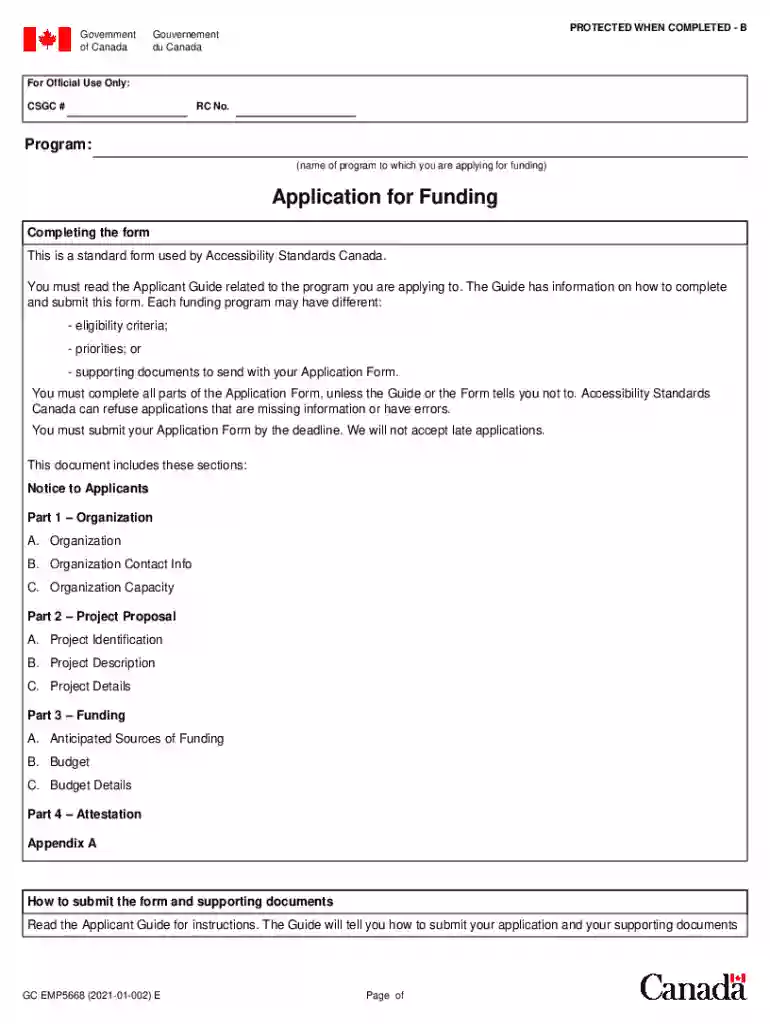
  2. Begin with Part 1 – Organization. Fill in your organization’s legal name, operating name, and registration number. Ensure all mandatory fields are completed accurately.
  3. Proceed to Part 2 – Project Proposal. Clearly define your project title, start and end dates, objectives, and activities. Make sure these align with the program's goals.
  4. In Part 3 – Funding, outline anticipated sources of funding and provide a detailed budget breakdown. Confirm any in-kind contributions as necessary.
  5. Finally, complete Part 4 – Attestation by checking the required boxes and providing your name, title, and date. No signature is needed.

Start using our platform today for free to streamline your document editing and submission process!

See more Audit of the Departmental Information System and - Canada versions

We've got more versions of the Audit of the Departmental Information System and - Canada form. Select the right Audit of the Departmental Information System and - Canada version from the list and start editing it straight away!
Versions Form popularity Fillable & printable
2021 4.8 Satisfied (152 Votes)
be ready to get more

Complete this form in 5 minutes or less

Get form

Got questions?

We have answers to the most popular questions from our customers. If you can't find an answer to your question, please contact us.
Contact us
Weve always believed that boards should ensure that their organizations maximize the full potential of internal audit. This issue of Board Perspectives discusses the four Cs directors should consider when evaluating the sufficiency of any risk-based audit plan: culture, competitiveness, compliance and cybersecurity.
Information system audit is the process of collecting and evaluating evidence to determine whether the information system safeguards assets, maintains data integrity, achieves organisational goals effectively and efficiently keeping in view of the IT Policy of the Bank.
Information Systems Auditing (IS Auditing) is a critical process that evaluates the management controls within information systems to ensure their security, integrity, and effective use.
Lets take a look at four common types of audits in their applications: financial audits, operational audits, compliance audits, and internal audits. Understanding the different types of audits, their purposes, and their benefits, can help organizations effectively manage risk and improve their operations.
A typical audit is comprised of four stages: planning, fieldwork, reporting, and follow-up. Planning. During the planning phase, we notify you of the audit through an announcement letter. Fieldwork. Reporting. Audit Follow-Up.

Security and compliance

At DocHub, your data security is our priority. We follow HIPAA, SOC2, GDPR, and other standards, so you can work on your documents with confidence.

Learn more
ccpa2
pci-dss
gdpr-compliance
hipaa
soc-compliance
be ready to get more

Complete this form in 5 minutes or less

Get form

People also ask

10 Best Practices of a Smarter IT Audit Develop an audit plan and set clear goals aligned with your organizations risk profile. Focus on high-risk systems first (risk-based auditing). Choose independent, objective auditors. Follow frameworks like COBIT or NIST. Document everything from controls to test results.
There are four types of audit opinions: unqualified, qualified, adverse, and disclaimer of opinion. Each type reflects a different level of assurance and has distinct implications for the audited entity.

Related links