Changes to the Alternative Minimum Tax as Proposed in 2026

Get Form
Changes to the Alternative Minimum Tax as Proposed in Preview on Page 1

Here's how it works

01. Edit your form online
Type text, add images, blackout confidential details, add comments, highlights and more.

02. Sign it in a few clicks
Draw your signature, type it, upload its image, or use your mobile device as a signature pad.

03. Share your form with others
Send it via email, link, or fax. You can also download it, export it or print it out.

How to use or fill out Changes to the Alternative Minimum Tax as Proposed in

Form edit decoration
9.5
Ease of Setup
DocHub User Ratings on G2
9.0
Ease of Use
DocHub User Ratings on G2
  1. Click ‘Get Form’ to open it in the editor.
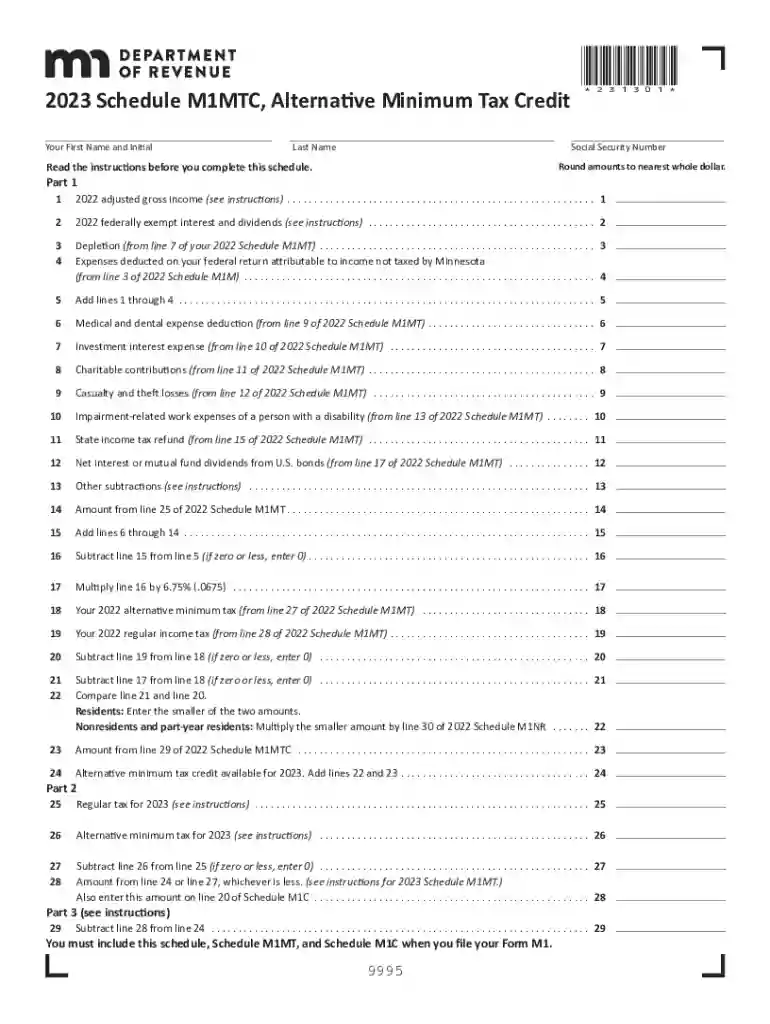
  2. Begin with Part 1. Enter your adjusted gross income from your previous year's tax return on line 1. Ensure you have the correct figure as this is crucial for calculating your minimum tax credit.
  3. Proceed to line 2 and input any federally exempt interest and dividends. Refer to the instructions if you're unsure about what qualifies.
  4. Continue filling out lines 3 through 15, entering relevant deductions such as medical expenses, charitable contributions, and any other applicable subtractions from your income.
  5. Once you've completed Part 1, move on to Part 2. Here, calculate how much of your minimum tax credit can be utilized for the current year based on your tax liability.
  6. Finally, review all entries for accuracy before saving or exporting your completed form. Utilize our platform's features to ensure everything is correctly filled out.

Start using our platform today for free and streamline your document editing process!

See more Changes to the Alternative Minimum Tax as Proposed in versions

We've got more versions of the Changes to the Alternative Minimum Tax as Proposed in form. Select the right Changes to the Alternative Minimum Tax as Proposed in version from the list and start editing it straight away!
Versions Form popularity Fillable & printable
2023 4.1 Satisfied (43 Votes)
2022 4.8 Satisfied (31 Votes)
2021 4.3 Satisfied (42 Votes)
2019 4.4 Satisfied (137 Votes)
be ready to get more

Complete this form in 5 minutes or less

Get form

Got questions?

We have answers to the most popular questions from our customers. If you can't find an answer to your question, please contact us.
Contact us
The AMT was originally designed to ensure that higher-income taxpayers pay at least a minimum amount of taxes. Depending on your AMT taxable income, the AMT rate is 26% or 28%. For 2025, the higher rate kicks in when the taxable income exceeds $239,100 ($119,550 for married individuals filing separately).
The AMT rate Before 2024, AMT rules applied a flat 15% tax rate on adjusted taxable income. Starting in 2024, the government increased the AMT rate to 20.5%, which equals the rate for the second federal income tax bracket.
The AMT provisions, along with almost all other individual income tax measures in the TCJA, are set to expire at the end of 2025. Thus, barring legislation from Congress, the AMT will return in force in 2026, affecting 7.6 million taxpayers.
The One Big Beautiful Bill Act (OBBBA) lowers AMT exemption thresholds starting in 2026, leaving more high-income taxpayers at risk of the tax. Heres what you need to know. The Tax Cuts and Jobs Act of 2017 (TCJA) made some favorable changes to the alternative minimum tax (AMT) for individual taxpayers.
Summary of key provisions Raises SALT cap to $40,000 if you earn up to $500,000. Qualified tip income deduction. Qualified overtime pay deduction for certain workers. Deduction for auto loan interest for certain vehicles. Child Tax Credit expansion. Enhanced deduction for seniors.

Security and compliance

At DocHub, your data security is our priority. We follow HIPAA, SOC2, GDPR, and other standards, so you can work on your documents with confidence.

Learn more
ccpa2
pci-dss
gdpr-compliance
hipaa
soc-compliance

People also ask

The exemption phaseout thresholds will drop to $500,000 for single filers and $1 million for joint filers in 2026. (In 2025, those amounts are $626,350 and $1,252,700, respectively.)
Changes to the AMT calculation have been introduced for 2024 and later tax years. These changes include an increase to the minimum tax rate and the basic exemption threshold, as well as changes to the calculation of adjusted taxable income for AMT purposes, the special foreign tax credit, and the minimum tax carryover.
More bad news: Starting in 2026, the OBBBA increases the exemption phase-out percentage from 25% to 50%. Bottom line: For 2026 and beyond, AMT exemptions for higher-income taxpayers can be phased out faster. That means more taxpayers may owe the AMT for 2026 and beyond.

Related links