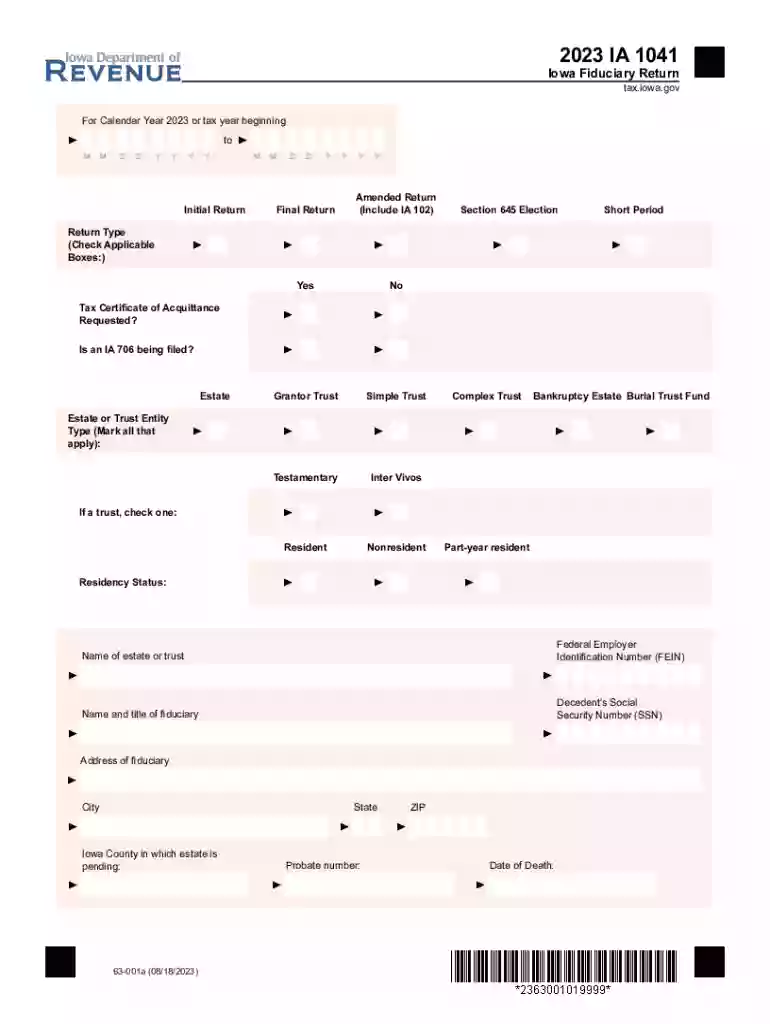
For Calendar Year 2023 or tax year beginning-2026

Get Form
For Calendar Year 2023 or tax year beginning Preview on Page 1

Here's how it works

01. Edit your form online
Type text, add images, blackout confidential details, add comments, highlights and more.

02. Sign it in a few clicks
Draw your signature, type it, upload its image, or use your mobile device as a signature pad.

03. Share your form with others
Send it via email, link, or fax. You can also download it, export it or print it out.

How to use or fill out For Calendar Year 2023 or tax year beginning

Form edit decoration
9.5
Ease of Setup
DocHub User Ratings on G2
9.0
Ease of Use
DocHub User Ratings on G2
  1. Click ‘Get Form’ to open it in the editor.
  2. Begin by entering the tax year at the top of the form. Ensure you select 'For Calendar Year 2023' or indicate the tax year beginning date.
  3. Check the applicable boxes for return type: Initial, Amended, or Final Return. If filing an amended return, include IA 102.
  4. Fill in the entity type by marking all that apply: Grantor Trust, Simple Trust, Complex Trust, etc. This helps categorize your estate or trust correctly.
  5. Provide the Federal Employer Identification Number (FEIN) and details of the fiduciary including name, title, and address.
  6. Complete income sections by entering amounts for interest income, dividends, business income/losses, and other relevant fields as specified.
  7. Review deductions carefully; enter any applicable deductions such as fiduciary fees and charitable contributions.
  8. Finally, ensure all signatures are completed before submitting your form electronically or via mail.

Start using our platform today to simplify your document editing and form completion process for free!

See more For Calendar Year 2023 or tax year beginning versions

We've got more versions of the For Calendar Year 2023 or tax year beginning form. Select the right For Calendar Year 2023 or tax year beginning version from the list and start editing it straight away!
Versions Form popularity Fillable & printable
2023 4.4 Satisfied (41 Votes)
2023 4.4 Satisfied (36 Votes)
2023 4.1 Satisfied (51 Votes)
2023 4.7 Satisfied (28 Votes)
2022 4.9 Satisfied (20 Votes)
2022 4.6 Satisfied (54 Votes)
2022 4.4 Satisfied (37 Votes)
2021 4.8 Satisfied (208 Votes)
2021 4.9 Satisfied (58 Votes)
2021 4.8 Satisfied (77 Votes)
2021 4.8 Satisfied (71 Votes)
2021 4.8 Satisfied (193 Votes)
2020 4.1 Satisfied (38 Votes)
2020 4.3 Satisfied (114 Votes)
2020 4.2 Satisfied (83 Votes)
be ready to get more

Complete this form in 5 minutes or less

Get form

Got questions?

We have answers to the most popular questions from our customers. If you can't find an answer to your question, please contact us.
Contact us
Why does the tax year start on 6 April? Video Player is loading. This is a modal window.
Tax season is the period of time, generally between Jan. 1 and about April 15 of each year, when taxpayers prepare to report their taxable income to the federal government and, in most cases, to the government of the state where they live. Tax day in the U.S. is usually April 15.
Calendar Tax Year: This is a period of 12 consecutive months beginning January 1 and ending December 31; or. Fiscal Tax Year: This is a period of 12 consecutive months ending on the last day of any month except December.
April 18 tax filing deadline in 2023 The filing deadline to submit 2022 tax returns or an extension to file and pay tax owed is Tuesday, April 18, 2023, for most taxpayers.
A tax year is an annual accounting period for keeping records and reporting income and expenses. An annual accounting period does not include a short tax year. The tax years you can use are: Calendar year 12 consecutive months beginning January 1 and ending December 31.

Security and compliance

At DocHub, your data security is our priority. We follow HIPAA, SOC2, GDPR, and other standards, so you can work on your documents with confidence.

Learn more
ccpa2
pci-dss
gdpr-compliance
hipaa
soc-compliance
be ready to get more

Complete this form in 5 minutes or less

Get form

People also ask

Income Tax year (tax year) A tax year is a period starting on 6 April in one year and ending on 5 April in the following year. For example, the 2023 to 2024 tax year starts on 6 April 2023 and ends on 5 April 2024.
Calendar year 12 consecutive months beginning January 1 and ending December 31. Fiscal year 12 consecutive months ending on the last day of any month except December. A 52-53-week tax year is a fiscal tax year that varies from 52 to 53 weeks but does not have to end on the last day of a month.

Related links