App 006 2010 form-2026

Get Form
dochub app Preview on Page 1

Here's how it works

01. Edit your dochub app online
Type text, add images, blackout confidential details, add comments, highlights and more.

02. Sign it in a few clicks
Draw your signature, type it, upload its image, or use your mobile device as a signature pad.

03. Share your form with others
Send key2prepaid app via email, link, or fax. You can also download it, export it or print it out.

How to use or fill out app 006 2010 form with our platform

Form edit decoration
9.5
Ease of Setup
DocHub User Ratings on G2
9.0
Ease of Use
DocHub User Ratings on G2
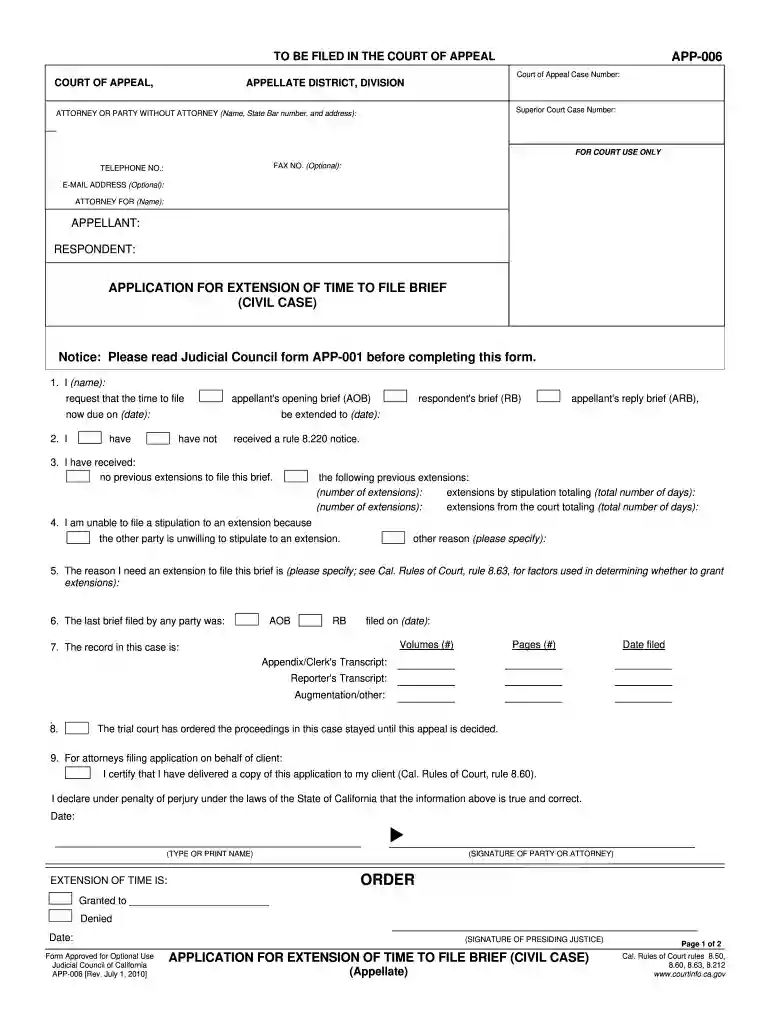
  1. Click ‘Get Form’ to open the app 006 2010 form in the editor.
  2. Begin by entering your Court of Appeal Case Number and Superior Court Case Number at the top of the form.
  3. Fill in your name, State Bar number, and address in the Attorney or Party Without Attorney section. Include optional contact details like fax number and email address.
  4. In Section 1, specify your name and request an extension for filing the appellant's opening brief, indicating the due date.
  5. Complete Section 2 by checking whether you have received a rule 8.220 notice and provide dates for any previous extensions in Section 3.
  6. In Section 4, explain why you cannot file a stipulation for an extension. Use Section 5 to detail your reasons for needing more time.
  7. Fill out Sections 6 through 9 with relevant information about previous briefs filed, case records, and certification if you're an attorney representing a client.
  8. Finally, sign and date the form before submitting it as instructed in the Proof of Service section.

Start using our platform today to easily fill out your app 006 2010 form online for free!

See more app 006 2010 form versions

We've got more versions of the app 006 2010 form form. Select the right app 006 2010 form version from the list and start editing it straight away!
Versions Form popularity Fillable & printable
2024 4.4 Satisfied (46 Votes)
2017 4.8 Satisfied (165 Votes)
2015 4.4 Satisfied (276 Votes)
2010 4.3 Satisfied (49 Votes)
2007 4 Satisfied (46 Votes)
be ready to get more

Complete this form in 5 minutes or less

Get form

Got questions?

We have answers to the most popular questions from our customers. If you can't find an answer to your question, please contact us.
Contact us
After a Decision is Issued Step 1: File the Notice of Appeal. Step 2: Pay the filing fee. Step 3: Determine if/when additional information must be provided to the appeals court as part of opening your case. Step 4: Order the trial transcripts. Step 5: Confirm that the record has been transferred to the appellate court.
Medicares 5-Level Appeal Process Level 1: Reconsideration from your plan. Level 2: Review by an Independent Review Entity (IRE) Level 3: Decision by the Office of Medicare Hearings and Appeals (OMHA) Level 4: Review by the Medicare Appeals Council (Appeals Council) Level 5: Judicial review by a federal district court.
Having strong arguments is the best way to win. So how do you make sure your appeal is as strong as it can get? Well, the data shows you should call in an appellate attorney. Most litigators understand that a trial is predominantly about facts, whereas an appeal is predominantly about law.
The best approach is to write a chronological description of the underlying facts of the case. Include the circumstances of the crime, the charges against the defendant, and then the trial. Create a narrative; do not recite all the facts of the entire crime or the trial. Use only what is necessary for your argument.
EXTENSION OF TIME FOR FILING APPEAL BRIEF In the event that the patent owner finds themself unable to file a brief within the time allowed by the rules, they may file a request with the appropriate extension of time fee, to the Central Reexamination Unit (CRU) or Technology Center (TC), requesting additional time.
be ready to get more

Complete this form in 5 minutes or less

Get form

People also ask

An appeal is the legal process where you are asking a higher court to review a decision made in the lower court. Either the plaintiff or the defendant can file an appeal. Sometimes both can file an appeal. The person filing the appeal is the Appellant (sometimes called Petitioner).
Understanding the 5-Step Appeal Simple Appeal: Listen Actively. The first step in the 5-Step Appeal is the Simple Appeal. Reasoned Appeal: Acknowledge Emotions. Personal Appeal: Explore Options. Final Appeal: Agree on a Solution. Action: Follow up.

Related links